
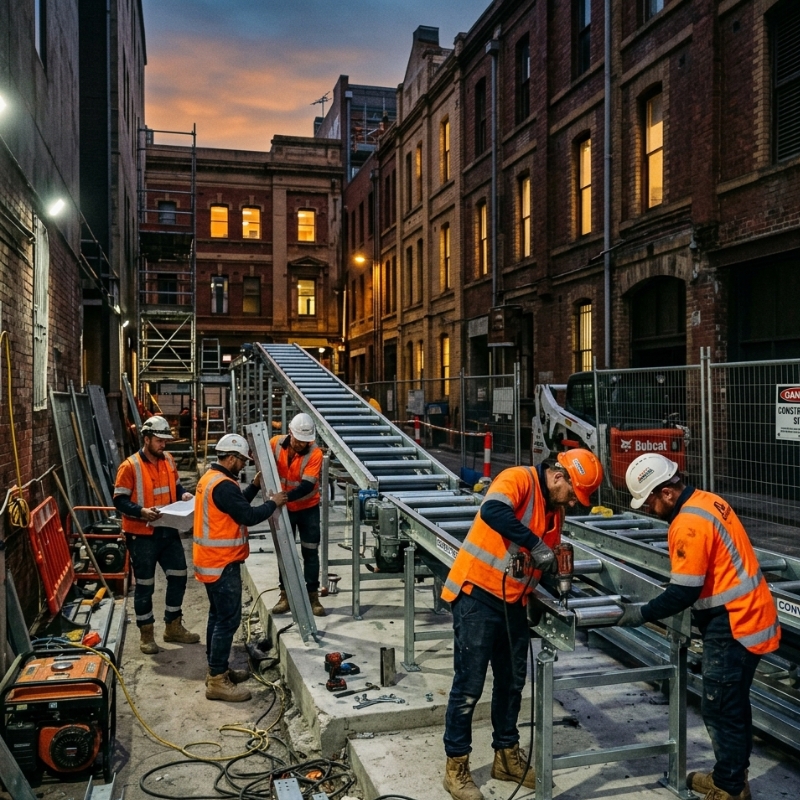
Tight-access projects—from CBD refurbishments to suburban backyard extensions—leave very little room for bulky equipment, yet materials still need to move quickly and safely. Choosing the wrong conveyor design can add days of non-productive labour, drive up crane costs and even breach local council noise curfews. In more cases than you might think, a modular conveyor system offers a faster, leaner answer than a traditional long-belt set-up. In this guide, we’ll break down what “modular” really means, where it pulls ahead, where it still falls short, and how to decide which option will keep your crew productive. If you find you need flexible lengths, quick deployment or specialist attachments, explore the conveyor hire range for sizes and configurations that can be on site fast.
Why Tight-Access Sites Need a Different Conveyor Mindset
Traditional belt conveyors were born for quarries, mines and large industrial sheds—environments where you can roll in a long frame, bolt on some legs and run. Australian renovation and infill construction, however, is increasingly squeezed by:
- Zero-lot-line boundaries and shared driveways
- Heritage façades that must remain intact
- Overhead services criss-crossing laneways
- Council limits on road closures and footpath occupation
- Steep, narrow or multi-level backyard sites
In these spaces, you rarely have the luxury of a straight, uninterrupted 10–15 m run. Curves, changes in elevation and space to store long frames become real headaches. Every extra scaffold bay or crane lift eats into already slim margins. That’s why contractors across Sydney, Melbourne and Brisbane are re-thinking their material-flow strategy and turning to modular belts that slot together like adult-size building blocks.
What Makes a Conveyor “Modular” – and Why It Matters
A modular conveyor system is built from lightweight, interlocking sections (often 2–3 m each) that can be carried by two people, linked in minutes and powered by a single or daisy-chained motor set. Key design features include:
Compact Sections
Even on a congested site, you can usually find a spot to store a 2 m frame until it’s needed, unlike a fixed 12 m chassis that needs a crane, street closure or both.
Quick-Connect Couplings
Pins or clamps make alignment fast and accurate, so your belt runs true without hour-long shimming sessions.
Plug-and-Play Drives
Each section shares drive power via quick-fit couplings, or only the head section is powered, reducing electrical complexity.
Adjustable Stands and Hoppers
Trestle legs and swivelling hoppers let the belt snake around corners or over formwork.
The upshot? You can thread a belt through an L-shaped corridor, feed rubble straight into a skip or keep cutting trenches while masonry waste evacuates in the opposite direction—all without shutting down the footpath.
Practical Scenarios Where Modular Belts Save the Day
Inner-City Renovations
Heritage terraces in Paddington or Fitzroy rarely have rear lane access. A modular belt fed through a bathroom window can carry demolition rubble to a street-side skip without risky manual haul-outs. For hands-on planning tips, see our guide to planning a conveyor setup for tight access.
Basement Dig-Outs
Under-house excavations often involve narrow steps and a single driveway shared with neighbours. Modular sections let you start short (say 4 m), then add links as the dig lengthens, maintaining clearance for foot traffic.
Multi-Level Extensions
During second-storey additions in Brisbane or Perth suburbs, a modular conveyor paired with a small hoist can move bricks and sand up, while carrying waste timber down the same chute line—avoiding double-handling.
Remote Solar Farms
Site hours from the nearest hire depot appreciate spare 2 m sections that can be swapped without specialist tools, keeping conveyors running when freight delays bite.
When a Traditional Conveyor Still Makes Sense
- Long, Straight Runs
Feeding crushed rock 60 m from the quarry face to the stockpile is still cheaper with a single fixed unit.
- High-Volume, High-Speed Tasks
Asphalt plants or recycling yards shifting > 300 t/h may require the beefier frames and motors of conventional belts.
- Minimal Re-Route Risk
On greenfield sites where the conveyor path stays open and unchanged for months, the savings from one-off cranage can outweigh modular hire rates.
- Existing Plant Integration
If an established crusher or screener already mates with a traditional conveyor, bolt-up compatibility can beat modular flexibility.
If your site fits any of the above, don’t force a modular system—match the tool to the task.
Key Mistakes to Avoid When Choosing for Tight Access
- Underestimating Start-Up Time – Even modular belts need clear travel paths; mark these before frames arrive.
- Ignoring Power Availability – A single 15 A outlet may not handle multiple drives—verify site circuits.
- Skipping Guard Adjustments – Removable guards speed cleaning, but must be latched before restart to comply with AS 1755.
- Overloading the Belt – Modular sections have lighter frames; keep to the rated kg/metre to avoid sag.
- Forgetting Spill Containment – In laneway sites, dropped spoil can become a traffic hazard or incur council fines.
Avoiding these traps ensures the flexibility you paid for isn’t lost to downtime.
Quick Site Checklist: Are You a Good Candidate for Modular?
Tick any that apply:
- Access routes narrower than 1.5 m.
- Need for at least one 90-degree turn.
- Project duration under six weeks.
- Council or strata noise limits under 85 dB after 7 pm.
- No feasible crane location for full-length frames.
- Expectation that the conveyor path may change mid-project.
Three or more ticks strongly suggest modular is the lower-risk choice.
Compliance and Safety Considerations
Whether you opt for modular or traditional, Australian regulations require guarding of nip points, emergency stop lanyards and safe access for cleaning. Tight sites add slip, trip and public-interaction risks. The broad principles laid out in the Safe Work Australia guidance on plant and manual handling remain the baseline. In practice:
- Keep return idlers at least 2.5 m above ground or guarded.
- Provide secondary guarding where the belt passes close to walkways.
- Ensure quick-release pins are securely latched before start-up—loose pins are a common source of belt misalignment.
- Document daily visual inspections; small tears escalate faster on shorter, tighter belts because pulleys rotate more often per linear metre.
A simple smartphone checklist shared with the crew can prevent most shutdowns.
FAQs
1. Do modular conveyors handle the same load as traditional belts?
They’re rated for lighter tonnes per hour—typically up to 100 t/h—because of their slimmer frames. For demolition rubble and soil on renovation sites, that’s usually plenty. If you’re moving mine ore or quarry rock, a heavy-duty fixed belt is safer.
2. Can I mix modular and traditional sections?
Generally, no—connection geometry differs. You can, however, feed a modular belt into an existing fixed conveyor if you allow for height transfer and guard the transition zone.
3. How long does it take to train workers to assemble modular systems?
Most crews adapt within an hour’s hands-on practice. Suppliers often include a toolbox talk or QR-code video so new hires can review the process on day two.
4. Are modular conveyors more expensive to hire?
Daily rates are slightly higher, but savings from fewer crane lifts, faster pack-up and reduced idle labour usually level the ledger within the first week on tight sites.
5. What maintenance do modular belts need?
Daily: visual check for belt tracking and debris build-up. Weekly: tension check and lubrication of quick-connect pins. Monthly: full section inspection, especially if the route twists tighten around formwork.
Final Thoughts
Australia’s construction landscape is shifting toward infill, renovation and space-restricted builds. In that environment, time spent craning in long conveyor frames or hand-balling rubble downstairs is money lost. Modular conveyor systems won’t replace traditional belts on every job, but when your footprint is cramped, your schedule tight and your route anything but straight, they’re often the smarter hire. Keep the checklist above handy, weigh up the real on-site costs, and choose the conveyor style that moves more materials and fewer headaches. If signs point to modular, having a flexible hire partner ready can make the swap seamless.