
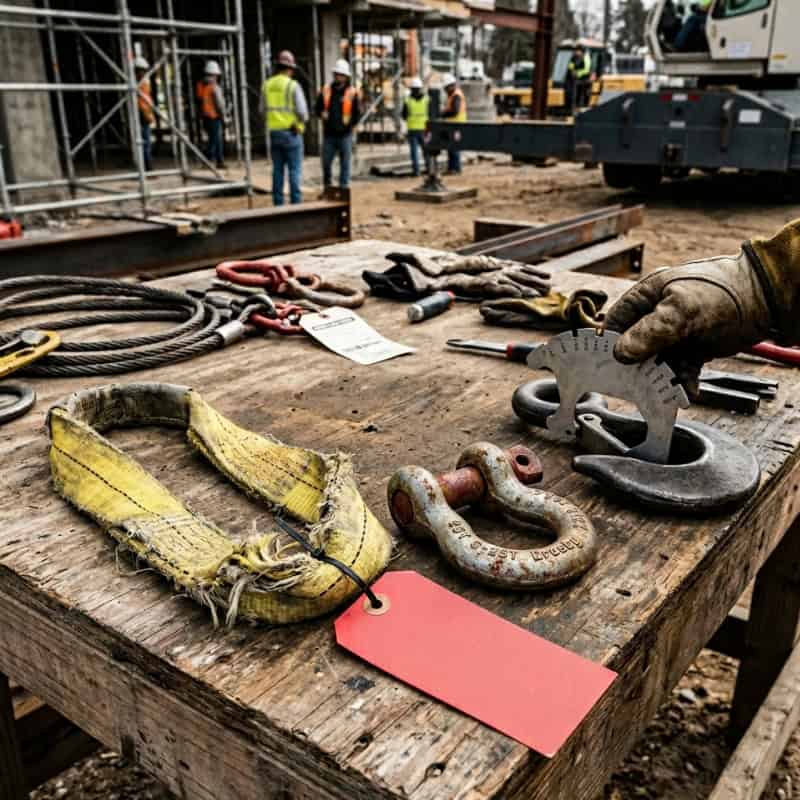
Lifting equipment doesn’t usually fail “out of nowhere”. Most of the time, it gives warnings first: a tag that’s gone missing, a sling that’s been cut, a hook that’s opened up slightly, a shackle pin that no longer seats smoothly, or corrosion that’s started to pit the surface.
The hard part on site isn’t spotting any wear — it’s deciding what wear is acceptable and what means the item must be removed from service immediately. Because when you’re working around cranes, forklifts, gantries, chain blocks, and spreader beams, “maybe it’s fine” is not an acceptable risk setting.
This guide is designed to help you make safer calls quickly and consistently. It’s written for real-world Sydney conditions too: coastal air, wet weather, concrete dust, UV exposure, and gear that gets moved between sites and storage.
What “retire” means (and what it doesn’t)
Retiring lifting equipment means the item is taken out of lifting service because it can no longer be relied upon to perform safely at its rated capacity.
Retire can mean:
• Permanently discarded (cut up / rendered unusable where appropriate)
• Quarantined and assessed by a competent person
• Returned to the manufacturer or an approved repairer (only if the item type and damage are repairable and the repair pathway is allowed)
Retirement does not mean:
• “We’ll just use it for a lighter lift”
• “We’ll keep it for non-critical lifts”
• “We’ll use it one more time and replace it later”
If there’s doubt, the safest default is: stop, isolate, and escalate.
Q&A: Can we keep using gear if we derate it?
Sometimes people try to “derate” damaged gear informally (“we’ll only use it for half the weight”). In practice, this is a high-risk habit because:
• Damage often changes failure mode, not just capacity
• You can’t reliably calculate the new safe limit without an engineered assessment
• It normalises using compromised equipment
If you believe derating is an option, it should only happen through a documented, competent-person process — and for many common defects, it won’t be permitted at all.
The fastest decision framework on site
When you’re under time pressure, use this three-question filter:
- Is identification and traceability intact?
If you can’t confirm what it is, who made it, and what it’s rated for, it’s not a lifting item anymore. - Is there any sign of strength loss, deformation, or heat/chemical damage?
If yes, retire or quarantine immediately. - Could the defect worsen suddenly during a lift (shock load, side load, abrasion, twisting)?
If yes, retire or quarantine immediately.
If you want a consistent process to share with the crew, link your internal procedures to a simple “remove from service” flow and keep it where pre-start checks happen. Many teams also build this into their inspection registers and pre-use routines. For busy sites, it’s worth aligning your inspection notes with the exact lifting and rigging accessories you keep in circulation.
Damage signs that are almost always “remove from service now”
These are the defects that should trigger immediate action on most worksites, across most gear types.
1) Missing, illegible, or incorrect tags and markings
If the gear’s ID tag, label, stamping, or serial number is missing or unreadable, you can’t verify:
• Working Load Limit (WLL)
• Sling material and configuration
• Manufacturer/standard
• Traceability and inspection history
That’s not paperwork fussiness — it’s a safety control. Without ID, the item can be easily misused (wrong angle factor, wrong hitch type, wrong environment).
Practical site rule:
• If you can’t confirm WLL and identity, quarantine it.
Q&A: Is a missing tag an automatic fail?
In many workplaces, yes — especially for synthetic web slings and round slings where the tag carries crucial information. Even if the sling “looks fine”, the tag is how you confirm rating, length, and compliance.
2) Deformation: bending, spreading, twisting, or “opening up”
Any change in shape is a big warning sign because it suggests overloading, side loading, shock loading, or misuse.
Look for:
• Hooks that appear more “open” than normal
• Shackles that are no longer symmetrical
• Links in chain slings that look elongated
• Lifting points that look bent, pulled, or distorted
• Eyebolts or swivel hoist rings that don’t sit correctly anymore
If metal has permanently deformed, it has moved beyond its intended elastic behaviour. That can mean the structure has been compromised and may fail unpredictably.
3) Cracks, fractures, and sharp gouges
Cracks are an immediate stop sign. So are sharp gouges, deep nicks, and impact damage that create stress risers.
Pay extra attention to:
• Hook throats and load-bearing corners
• Shackle crowns
• Threads on pins and eyebolts
• Welded areas on lifting lugs
• Any location where the item has been side-loaded
If a defect can concentrate stress, it can trigger brittle failure.
4) Heat damage and “blueing”
Heat can change the properties of lifting-grade alloys and synthetic materials. If you see:
• Blue, purple, or straw-coloured heat tinting
• Evidence of welding spatter on the lifting gear
• Melted fibres, glazing, hard shiny patches on slings
• Burn marks, charring, or brittle sections
Treat it as a serious defect. Heat exposure is one of the easiest ways to unknowingly weaken gear.
Q&A: What if the gear still looks strong after heat exposure?
Looks can be misleading. Heat can alter the temper and microstructure in metal, and can degrade synthetic fibres internally. When there’s evidence of heat exposure, the safest approach is quarantine and competent assessment — and for many sling types, retirement is the likely outcome.
5) Severe corrosion, pitting, and “crusty” rust
Surface rust isn’t automatically a retire trigger, but pitting and section loss can be. Sydney’s coastal air and humid storage conditions can accelerate corrosion, especially if gear is stored damp or contaminated with concrete dust and salts.
Red flags include:
• Pitted corrosion that you can feel with a fingernail
• Flaking, scaling, or deep rust pockets
• Seized pins, stiff movement, or rough bearing surfaces
• Corrosion near load-bearing threads
If corrosion has reduced the cross-section or interferes with correct function, treat it as a remove-from-service.
Gear-by-gear retirement signs (what to check, where to check)
Different equipment fails differently. A quick “general” inspection helps, but gear-specific checks are where you prevent the nastiest surprises.
Synthetic web slings and round slings
Synthetic slings are vulnerable to:
• Cuts and tears (especially at edges)
• Abrasion and fibre wear
• UV degradation (fading, stiffness, powdery fibres)
• Chemical damage (bleaching, swelling, brittle fibres)
• Heat damage (glazing, melted fibres)
• Stitching failure and cover damage (for rounds)
What to check:
• Full length, both sides, including eyes and wear pads
• Stitching lines for broken threads
• Any lumpiness, thinning, or unevenness
• Tag presence and legibility
Remove from service if:
• Cuts, tears, or holes expose load-bearing fibres
• Stitching is damaged in a way that affects strength
• Heat, chemical, or UV damage is evident
• The tag is missing or unreadable (site policy often treats this as immediate quarantine)
For a practical reference on sling inspection principles and what defects matter most, the NSW Government dogging and rigging guidance is a useful baseline: how to inspect synthetic slings.
Q&A: Can web slings be repaired?
Some synthetic sling damage is not repairable in a way that restores certified capacity. Even when repairs exist, they must follow manufacturer or approved repairer guidance and return to service controls. If you’re unsure, quarantine and escalate rather than guessing.
Chain slings and components
Chain slings often show failure risk through:
• Elongation of links (stretching)
• Cracks in links
• Severe corrosion/pitting
• Mechanical damage from dragging or shock loading
• Damaged coupling links, connectors, or shortening clutches
What to check:
• Each link for deformation and wear
• High-wear points (where it wraps loads)
• Connectors and master links
• Function of shortening devices (smooth movement, no jamming)
Remove from service if:
• Any link is cracked, stretched, or deformed
• Wear is beyond acceptable limits (site procedure/manufacturer)
• Heat damage suspected
• Corrosion has pitted or reduced the section
Wire rope slings
Wire rope can “look okay” from a distance while hiding serious defects.
What to check:
• Broken wires (especially clustered)
• Kinks, birdcaging, crushing, or flat spots
• Corrosion between strands
• Damaged thimbles, ferrules, or terminations
• Uneven diameter or necking
Remove from service if:
• There are significant broken wires
• The rope has kinks or birdcaging
• Terminations are compromised
• Corrosion is advanced or internal strand damage suspected
Shackles
Shackles are robust, but common retire triggers include:
• Distortion of the bow
• Damaged threads on the pin or body
• Pin that doesn’t seat fully or binds
• Side-loading evidence (wear patterns)
• Corrosion that affects fit and function
• Markings missing or unreadable
Remove from service if:
• Threads are damaged or cross-threaded
• The pin cannot be fully engaged
• The bow is distorted
• There is cracking, deep gouging, or serious pitting
• Identification markings are illegible
Hooks (including swivel hooks)
Hooks deserve special attention because they can slowly open over time.
What to check:
• Throat opening (compare to a known-good hook or manufacturer reference)
• Twisting, bending, or tip damage
• Latch function (if fitted)
• Wear in bearing surfaces on swivels
• Cracks at high-stress points
Remove from service if:
• The hook is opened, twisted, or bent
• Is there any sign of cracking
• The latch doesn’t operate as intended (where a latch is required for the lift plan)
• The swivel binds, grinds, or has abnormal play
Lifting points, eyebolts, and swivel hoist rings
These are often misused through side loading, incorrect seating, or thread engagement issues.
What to check:
• Threads (clean, undamaged, correct engagement)
• Seating surfaces (flush, no gaps, no debris)
• Signs of bending or pulling
• Markings and WLL
Remove from service if:
• Threads are damaged
• The point is distorted or shows side-load damage
• Markings are illegible
• It doesn’t seat correctly or moves unexpectedly under light tension
If you’re building a consistent approach to high-frequency items like shackles, hooks, and lifting points, align your crew language and inspection notes to your existing equipment categories. Many sites simplify this by grouping common items under a shared reference, like lifting slings and rigging gear, so pre-start conversations and registers match what’s physically in the kit.
What to do immediately when you find damage
A good retirement decision is only as safe as what happens next. Here’s a practical on-site flow that avoids confusion:
1) Stop the task safely
• Lower and secure the load if safe to do so
• Don’t “just finish this lift” with questionable gear
2) Isolate the item
• Remove it from the lifting area
• Prevent it from being picked up by someone else
3) Mark it clearly
• Tag it “Out of Service” / “Do Not Use”
• If you use colour tags or a quarantine bin, use them consistently
4) Record what you found
• What item is it (ID/serial if available)
• What defect did you observe
• Where and when it was found
• Who isolated it
5) Escalate to the right person
Depending on your site, that might be a supervisor, a leading hand, a safety officer, or a nominated “competent person” for lifting gear. The key is: don’t leave it as “someone will deal with it”.
Q&A: What if the crew disagrees about whether it’s safe?
If there’s disagreement, default to caution:
• Quarantine the item
• Use a known-good replacement
• Get a competent assessment
This keeps production moving without gambling on a disputed call.
“Borderline” wear vs retirement: how to handle grey areas
Not every scuff is a failure. But the mistake many teams make is treating grey areas casually instead of handling them systematically.
A practical approach:
• If wear is minor and identification is intact, keep using — but record it and recheck frequently
• If wear is progressing, quarantine and assess before it becomes urgent
• If the defect affects load-bearing fibres, geometry, function, or traceability, retire/quarantine immediately
This is where your restraint and load control practices matter too. Poor load control can turn minor wear into major damage fast (shock loads, snatch lifts, uncontrolled rotation). Building discipline around lift planning, smooth take-up, and correct restraint reduces the number of borderline decisions you face. If your crew wants a shared reference point for that side of the job, align the language and kit checks with your load control and restraint standards so “how we lift” and “what we lift with” stay consistent.
Sydney-specific realities that accelerate gear retirement
Sydney and NSW worksites often face conditions that shorten gear life:
• Salt air and coastal storage: accelerates corrosion and pitting, especially if gear is stored damp
• Concrete dust and grit: increases abrasion on slings and can contaminate moving parts
• Wet weather: increases corrosion risk and can hide defects under grime
• UV exposure: degrades synthetic slings left in the sun
• Mixed-site logistics: gear moved between jobs can lose tags, records, and inspection continuity
Practical tips:
• Keep gear dry and ventilated in storage
• Avoid leaving synthetic slings exposed to the sun for long periods
• Clean gear before storage (dust + moisture is a corrosion recipe)
• Use dedicated bins for quarantined items so they don’t “wander back” into service
Final FAQ
How often should lifting equipment be inspected?
Most sites use layers:
• Pre-use checks by the user, every time
• Regular documented inspections (frequency depends on environment and usage)
• Additional inspections after overload, shock load, incident, or unusual event
Your local procedures and manufacturer guidance should set the schedule.
Who decides a piece of lifting gear must be removed from service?
Anyone should be empowered to stop and quarantine gear if they see a concerning defect. Returning an item to service should be controlled through your documented process and, where required, a competent person assessment.
Is “cosmetic damage” ever okay?
Sometimes. Light surface marks that do not affect function, geometry, fibres, or traceability may be acceptable. The moment the defect affects strength, movement, seating, or identification, treat it as a remove-from-service issue.
What’s the most commonly missed retirement sign?
Missing or unreadable identification is a big one, especially on synthetic slings. Another is subtle deformation (hooks opening slightly, shackles bowing), because it creeps in over time.
Should we keep “retired” gear for non-lifting tasks?
Be careful. Retired lifting gear can accidentally return to service, especially if it still “looks fine”. If your site allows repurposing, it should be clearly modified or destroyed so it cannot be mistaken for certified lifting equipment.
What should we do if we suspect the gear was overloaded?
Quarantine immediately. Overload can cause damage that isn’t always obvious. Document the event and have the item assessed before any consideration of reuse.