
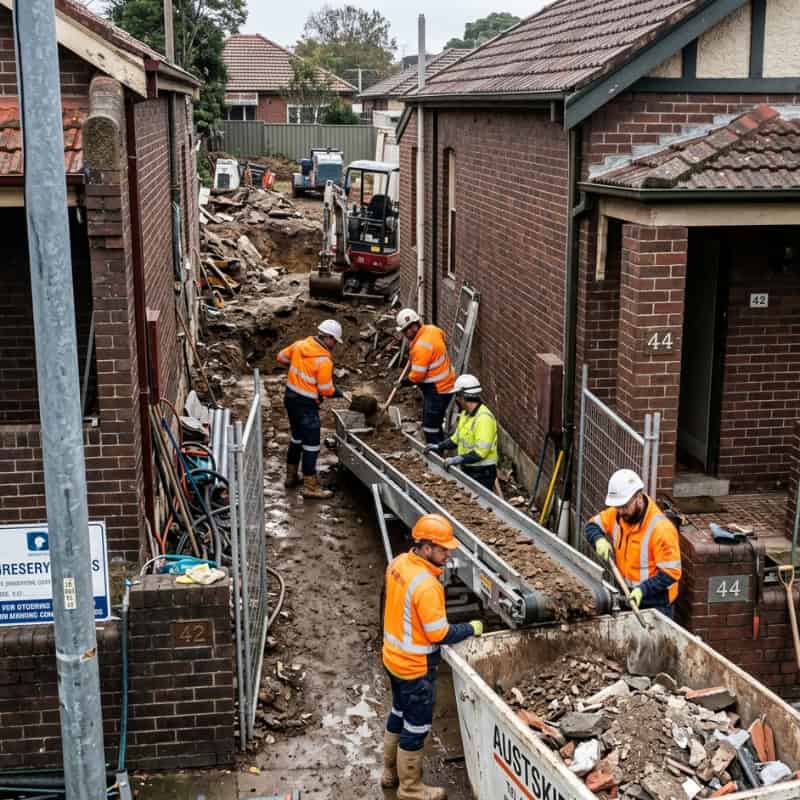
Tight-access Sydney jobsites are where good planning—and the right conveyor hire solution—pays for itself. Think terrace-house side alleys in the Inner West, steep blocks in the Northern Beaches, split levels in the Hills, or renovation work where you’re sharing a driveway, protecting finishes, and keeping neighbours onside.
When access is restricted, the “moving material” part of the job can quietly become the whole job: spoil out, aggregates in, rubble to the skip, soil away from the trench, all while keeping walkways clear and people safe.
This guide is about planning a conveyor setup that fits tight access conditions without turning into a service checklist. You’ll get the measurements that matter, layout rules that prevent double-handling, and the practical risk controls crews actually use on compact sites.
What “tight access” really means on Sydney sites
Tight access isn’t just “the gate is narrow”. In Sydney, it’s usually a combination of constraints:
• Narrow side passages with bends (often 800–1,000 mm wide, sometimes less)
• Level changes: stairs, retaining walls, split slabs, steep fall to the backyard
• Shared access: common driveways, strata walkways, rear laneways
• Sensitive neighbours: noise, dust, early starts, footpath and parking pressure
• Limited laydown area: nowhere to stockpile, nowhere to turn plant, nowhere to stage bags
• Pedestrian interface: deliveries crossing footpaths, residents coming and going
The best outcomes come from planning the material flow first, then choosing the method that fits the flow.
Start with flow, not gear: the “one-touch” rule
On tight sites, double-handling kills productivity and increases risk. A simple planning target helps:
Aim for one-touch handling
Try to touch the material once:
• Load at the dig/strip-out point
• Move it along a defined route
• Discharge where it’s meant to end up (skip, stockpile, truck, bin)
If the plan forces you to shovel, wheelbarrow, re-stockpile, then reload, you’ll burn time and fatigue people fast. Tight access magnifies every extra step.
Q&A: What’s the fastest way to move spoil off a tight site?
It’s the method that lets you keep a continuous flow from the workface to the disposal point with minimal re-handling. On many compact Sydney jobs, that means planning a straight(ish) run, stable base, and a discharge point that doesn’t require rework—rather than relying on short, repeated barrow trips that clog the accessway.
The five measurements to take before you plan anything
Before anyone talks about lengths, angles, or “what’ll fit”, measure these five things. They’re the difference between a smooth run and a day of “nearly”.
1) Clear access width (at the tightest point)
Measure the narrowest section, including:
• gate openings
• corridor pinch points
• turns around air con units, hot water systems, downpipes
• protruding brickwork or garden edging
Also note what must remain passable for people (egress matters).
2) Total run length (workface to discharge)
Map where the material starts and where it must end. Don’t guess—walk it and measure. Include bends and detours around stairs, garden beds, or scaff.
3) Vertical change (rise/fall)
Record height differences:
• trench depth to ground level
• steps, retaining walls, split slabs
• driveway fall or backyard slope
This informs how you manage incline, stability, and discharge height.
4) Turning points and radii
Tight sites rarely allow perfect straight lines. Mark:
• where the run must turn
• how tight each turn is
• whether a turn narrows the available width further
5) Discharge zone constraints
The discharge end is where tight sites often fail. Check:
• how close you can get to the skip/bins/stockpile
• overhead clearance (eaves, trees, powerlines—treat these as serious hazards)
• what you must protect (pavers, driveways, landscaping, finished flooring)
• whether the discharge will spill into walkways or neighbour boundaries
If you do nothing else, do this measurement set. It prevents most “we thought it would fit” blow-ups.
Map your site like a mini logistics plan
You don’t need CAD. A rough plan with key constraints is enough.
Draw the run and mark “no-go” zones
On a simple sketch, mark:
• the workface (dig, strip-out room, demolition zone)
• the discharge point (skip, bin, stockpile, truck)
• fixed hazards (stairs, drops, retaining walls, glass, finished surfaces)
• pedestrian routes (where people must still walk)
• emergency access (don’t block exits and egress routes)
Think in “zones”
On tight sites, zone planning stops chaos:
• Loading zone: clear footing, stable, protected from foot traffic
• Travel zone: defined route, controlled access, minimal crossings
• Discharge zone: protected from people, controlled spillage, stable base
If zones overlap, you’ll spend your day stopping and starting.
Q&A: What’s the most common tight-site planning mistake?
Putting all the thinking into “getting the conveyor in” and not enough into “where the material ends up”. If the discharge zone is awkward—too high, too far, too exposed—you’ll create double-handling, spillage, and stoppages.
Material behaviour: soil isn’t rubble, and rubble isn’t soil
On compact sites, material type changes the whole plan.
Wet clay and sticky spoil
• Clings and builds up → higher jam risk
• Heavier loads → stability matters more
• Spillage becomes slip risk fast
Practical planning response:
• keep the run as straight as possible
• manage incline conservatively
• keep the loading consistent (avoid big slugs of wet spoil)
• plan clean-out points before it becomes a shutdown
Mixed demolition debris
• Sharp edges, irregular shapes, snag points
• Timber offcuts can bridge and wedge
• Nails and fragments increase handling hazards
Practical planning response:
• pre-sort oversized items before loading
• keep loading consistent and controlled
• keep the travel zone separated from people
Sand and aggregates
• Flows easily but can spill everywhere
• Dust becomes the issue, especially on windy days or dry demolition
Practical planning response:
• minimise drop heights
• protect sensitive areas
• plan dust suppression and tidy-up cadence
Tight access layout rules that keep sites moving
Keep the run stable first, efficient second
A slightly longer stable run beats a short run on a dodgy base. Compact sites amplify instability: one wobble becomes a constant stop-start.
Avoid “pinch point crossings”
If people must cross the travel zone, build the plan around controlled crossings:
• designate a crossing point
• keep it visible
• supervise during high-flow periods
• avoid crossing near loading/discharge where attention is already split
Don’t block your only way out
Sydney’s tight access often means one path in, one path out. Keep egress clear. If the run blocks exits, you’re creating a serious risk.
For general construction plant safety expectations and controls (guarding, exclusion zones, safe operation), align your approach with recognised guidance like SafeWork NSW’s machinery and equipment hazard information (embedded link below). It keeps the plan grounded in practical risk management rather than guesswork. SafeWork NSW machinery and equipment guidance
A practical pre-start checklist for tight access runs
Use this as a “before you start moving material all day” check.
Site fit and stability
• Has the narrowest width been confirmed (not assumed)?
• Are all turns marked and achievable without forcing the run?
• Is the base stable and level where needed (no rocking, no sinking)?
• Are level changes managed without creating unstable transitions?
• Is the discharge zone protected and stable?
Safety controls people actually notice
• Can the operator access emergency stops quickly?
• Are pinch points and moving parts guarded as expected?
• Is the travel zone separated from foot traffic (barriers, cones, signage, spotter where needed)?
• Is there a clear rule for who can approach the equipment—and when?
• Is housekeeping planned (spillage clean-up cadence)?
Neighbour and public interface
• Dust controls planned (especially for dry rubble/sand)?
• Noise-aware work sequencing (avoid peak nuisance where possible)?
• Footpath/driveway crossings controlled and left clean?
When a conveyor plan makes sense on tight access
This is where conveyors often shine on compact Sydney work—when the flow is continuous and the path is predictable.
Common good-fit scenarios:
• Spoil from a backyard excavation to a front skip with narrow side access
• Rubble from internal strip-out to a controlled disposal point
• Moving aggregates into a backyard where barrows would choke the accessway
• Repeated movement over days, where manual handling fatigue becomes the hidden cost
If you’re exploring options specifically for restricted-access sites, a useful next step is understanding what configurations are commonly used and what site info is typically needed—without turning your plan into guesswork. Here’s a relevant internal reference: conveyor hire for tight access sites
When a conveyor is not the right answer
Tight access sometimes pushes people toward a conveyor when the real issue is the flow plan. Watch for these red flags:
• Too many level changes (constant transitions create instability and stoppages)
• Extremely tight turns that force awkward placement
• The discharge point can’t be controlled (spillage into walkways or onto finished surfaces)
• The base is unreliable (soft ground, unstable fill, waterlogged areas)
• Pedestrian interface can’t be separated (shared access with residents/public)
• The waste stream is contaminated/unsafe (needs specialised handling)
Q&A: When should you stop and reassess mid-job?
If you’re seeing repeated jams, spillage creating slip risks, unstable movement, or people routinely stepping into the travel zone, stop and reset. Tight access jobs don’t “sort themselves out” over time—they usually deteriorate as fatigue and clutter build.
Common tight-site mistakes (and how to avoid them)
Mistake 1: Planning only for “fit”, not for “flow”
Fix:
• define start and end points first
• eliminate double-handling
• keep zones separate
Mistake 2: Underestimating discharge mess
Fix:
• minimise drop heights
• protect surfaces
• stage bins/skips to reduce secondary handling
Mistake 3: Ignoring clean-out and housekeeping
Fix:
• set a clean-up cadence (every X barrows worth of output, or every break)
• keep walkways dry and clear
• treat spillage as a safety control issue, not a cosmetic issue
Mistake 4: Letting people “just step past it”
Fix:
• set an exclusion zone that matches the reality of the site
• Nominate a spotter during busy movement periods
• make the crossing points obvious and controlled
How a well-planned conveyor run reduces manual handling risk
On tight sites, manual handling is where injuries quietly stack up: twisting with loads, rushing barrows through narrow gaps, stepping over hoses, carrying down stairs.
A well-planned conveyor run can help by:
• reducing repeated lifting and pushing
• keeping movement predictable
• limiting awkward turns with loads
• decreasing congestion in the accessway
If you’re building a safety-and-productivity case for your method, this internal explainer angle can help you frame it clearly for the crew and supervisors: how conveyor hire improves safety and efficiency on construction sites
Sydney-specific realities to factor in (so the plan survives contact with the day)
Narrow streets and parking pressure
Where the discharge point depends on a skip or truck position, think about:
• where it can legally and safely sit
• how you’ll keep pedestrian access reasonable
• how you’ll keep the street frontage tidy and safe
Neighbours, strata, and shared access
If you’re working alongside residents or in shared access areas:
• avoid blocking paths for long periods
• control dust proactively
• keep noise predictable and communicate work windows
Weather: rain turns tight access into a slip-and-slide
Sydney rain plus clay plus narrow access equals:
• higher slip risk
• heavier, stickier loads
• more spillage and cleanup
Plan for:
• extra housekeeping
• anti-slip thinking in walk zones
• slowing the flow rather than forcing it
FAQ: Tight access material movement in Sydney
What measurements should I take before planning a tight access run?
Take the narrowest width, total run length, vertical changes, turning points, and discharge zone constraints. Those five stop most fit-and-flow problems before they start.
How do I reduce jams when moving wet clay or sticky spoil?
Keep the run as straight as possible, avoid steep transitions, load consistently (no big slugs), and plan clean-out points before build-up becomes a shutdown.
How do I keep people safe around moving equipment in tight spaces?
Separate the travel zone from foot traffic, keep emergency stop access clear, manage pinch points with guarding, control crossings, and maintain housekeeping so spillage doesn’t become a slip hazard.
What’s the best way to avoid double-handling on a small site?
Plan the discharge point so material ends up where it’s meant to go—skip, bin, stockpile—without needing to re-shovel or move it again. “One-touch” handling is the target.
When should I choose another method instead?
If the site has too many level changes, unstable base conditions, uncontrolled discharge areas, or pedestrian access you can’t separate, reassess. Sometimes a different flow plan or combination of methods is safer and faster.