
Anyone operating a builder’s barrow hoist on a NSW site needs a Class HM high risk work licence (materials hoist). If the hoist will ever carry people, the operator needs a Class HP licence instead. The licence belongs to the operator, not the hoist or the business. The site’s person conducting a business or undertaking (PCBU) must check it before anyone runs the hoist.
This guide answers the questions site managers and builders ask us most often when they hire a materials hoist in Sydney. It covers what the HM class allows, which hoists it applies to, how to get licensed, what it costs, and what else has to be in place on site.
Key takeaways
- SafeWork NSW’s HM class covers hoists that lift goods or materials only. Its holder “cannot hoist personnel” (SafeWork NSW).
- The pathway is training and assessment in unit CPCCLHS3002 through a registered training organisation, then an application to SafeWork NSW within 60 days of your assessment.
- A new HM licence costs $95 per class in 2026–27 and lasts five years. Renewal is $88.
- Materials hoists commissioned on a new NSW site after 1 May 2014 must have interlocking landing gates.
- The site’s PCBU must see written evidence of the operator’s licence before letting them run the hoist. The maximum penalty for a company is 217 penalty units (section 85).
- For ladder hoists, inclined track hoists and swivel-arm hoists, check with SafeWork NSW rather than assuming either way.
What the HM licence covers
What is an HM licence?
An HM licence is the high risk work licence class for operating a materials hoist (Schedule 3, item 19 of the Work Health and Safety Regulation 2025 (NSW)). The Regulation defines a materials hoist as a hoist that “consists of a car, bucket or platform cantilevered from, and travelling up and down outside, a face of the support of a structure” and “is used for hoisting things and substances but not persons”. SafeWork NSW’s hoist licence guidance puts it plainly: with an HM licence “you cannot hoist personnel”. In site language, that’s the mast-mounted barrow hoist on the side of the scaffold. SafeWork NSW’s own guidance calls them “builder’s or barrow hoists” (SafeWork NSW, Interlocking gates for material hoists).
High risk work licences in NSW now sit under the Work Health and Safety Regulation 2025, which was published on 22 August 2025 and replaced the 2017 Regulation (Clayton Utz). Older guides that quote clause numbers from the 2017 Regulation are out of date.
What’s the difference between HM and HP?
The difference is whether people ride the hoist. HM is goods and materials only. HP is for a hoist “in which personnel, goods and/or materials may be hoisted” (SafeWork NSW).
| Class HM (materials hoist) | Class HP (personnel and materials hoist) | |
|---|---|---|
| What can be lifted | Goods and materials only | People, goods and materials |
| Hoist configuration | Platform cantilevered off the mast, travelling outside it | Cantilever, tower or multiple-winch hoists |
| Typical site use | Bricks, blocks, tiles, plasterboard, mortar barrows | Workers and materials on mid-rise and high-rise builds |
| Training unit | CPCCLHS3002 Licence to operate a materials hoist | CPCCLHS3001 Licence to operate a personnel and materials hoist |
An HP licence covers “use of a personnel and materials hoist” and “use of a materials hoist” (Schedule 3, item 20), so an HP holder can run a barrow hoist. An HM holder cannot operate a hoist that carries people.
Which hoists need an HM operator?
Barrow-style materials hoists do. Three hoists in our material hoist hire fleet are mast-mounted barrow hoists that match SafeWork NSW’s HM description:
- the GEDA 300 kg single barrow hoist
- the GEDA 500 kg double barrow hoist
- the Maber 800 kg double barrow hoist
Plan for an HM-licensed operator (or an HP holder) on each.
Other lifting gear is less clear-cut, because the definition turns on a platform “cantilevered from, and travelling up and down outside” a structure. The GEDA 200 kg Combi Lift runs on a track that can be set anywhere from horizontal to vertical. Set up as a vertical mast hoist, treat it like the barrow hoists above. A ladder hoist runs a carriage up an inclined ladder rather than a platform cantilevered off a mast. A swivel-arm star hoist lifts on a rope from a pivoting arm. SafeWork NSW’s published licence guidance doesn’t address inclined or swivel-arm configurations directly. If your site plan relies on one of them without a licensed operator, confirm the position with SafeWork NSW on 13 10 50 first. Our team can also tell you what other builders are doing on similar jobs.
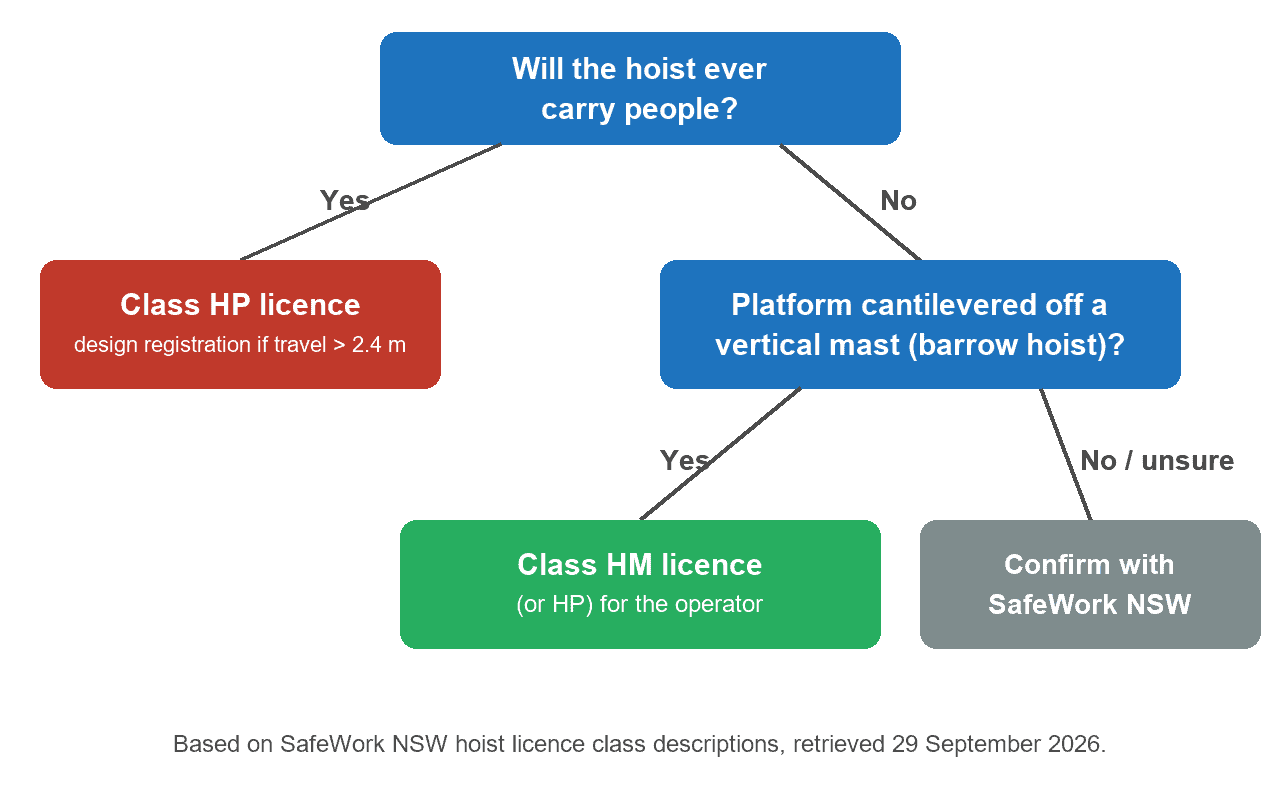
Which licence the hoist operator needs. Source: SafeWork NSW, Hoist licences (retrieved 29 September 2026).
Getting licensed
How do I get an HM licence?
There are three steps, and the order matters:
- Train and get assessed. Enrol with a registered training organisation for unit CPCCLHS3002 Licence to operate a materials hoist. A SafeWork NSW accredited assessor runs the assessment. If you pass, you receive a Notice of Satisfactory Assessment (NSA).
- Apply within 60 days. Service NSW states: “You must apply for your licence within 60 days of the date your NSA was issued” (Service NSW). Miss that window and you may need to be reassessed. Section 82(1A) of the Regulation lets you do the work for 60 days after your certification is issued. If you apply within that time, you can keep working until the licence is granted, or until 28 days after you’re notified of a refusal. The PCBU must sight your certification, and your application if you’re past the 60 days (section 85(2A)).
- Meet the basic criteria. You must be aged 18 or over (Service NSW). Only people holding the Schedule 4 qualification can apply (section 86).
What does it cost, and how long does it last?
SafeWork NSW’s 2026–27 fee schedule lists a new high risk work licence at $95 per class for a five-year term. Renewal is $88 for another five years (SafeWork NSW, Licensing fees). Fees are indexed each year, so check the current schedule before you budget. Training and assessment fees are separate and set by each RTO.
Can a trainee run the hoist under supervision?
Yes, but only as part of training. Section 82(1) says a person doesn’t need the licence if the work is done “in the course of training towards a certification” and “under the supervision of a person who is licensed”. Section 84 puts a duty on the PCBU to ensure that supervision is direct: the licence holder is “directing, demonstrating, monitoring and checking” the trainee’s work and can respond in an emergency. Someone licensed elsewhere on site doesn’t count. The only exception is where direct supervision is impracticable or unnecessary and the reduced supervision won’t put anyone at risk (section 84(2)). The PCBU must also see written evidence that the trainee is enrolled in the course (section 85(2)).
Is an interstate licence valid in NSW?
Yes. Section 83 recognises an equivalent licence granted under another state’s or territory’s WHS law. It has to be current and used within its conditions, and a suspended, cancelled or expired licence doesn’t count.
On site: who’s responsible
Who has to check the operator is licensed?
The PCBU. On a construction site that usually means the builder or principal contractor. Section 85(1) of the Regulation says a PCBU “must not direct or allow a worker to carry out high risk work” that needs a licence “unless the person sees written evidence” that the worker holds it. The maximum penalty is 43 penalty units for an individual and 217 penalty units for a body corporate. SafeWork NSW’s high risk work licence guidance covers the licensing side. Before the first lift:
- Sight the operator’s licence card and check the class shows HM or HP.
- Check the expiry date. Licences run for five years.
- Keep a record of that evidence for at least one year after the work is done (section 85(4)). Your site induction or plant register is the natural place.
- Make sure every operator on the roster is covered, not just the first-day crew.
A hire company can deliver and install the hoist. Running it day to day is the site’s responsibility.
Does the hoist itself need to be registered?
Materials-only hoists don’t appear on SafeWork NSW’s plant registration lists. Schedule 5 of the Regulation requires design registration for “hoists with a platform movement exceeding 2.4 metres, designed to lift people”. A hoist that only lifts materials falls outside that entry (SafeWork NSW, Plant design registration). Hoists also don’t appear on the plant item registration list (SafeWork NSW, Plant item registration).
“Not registered” doesn’t mean “not regulated.” Builders’ hoists are designed to AS 1418.7:2024 (Cranes, hoists and winches – Builders’ hoists and associated equipment). Safe use falls under AS 2550.7:2024 (Cranes – Safe use – Builders’ hoists and associated equipment). Standards Australia published both editions in December 2024, replacing earlier editions. Ask your hire supplier which standard the hoist and its installation are certified to.
What about interlocking gates?
They’re mandatory. SafeWork NSW states that “all material hoists (new or used) commissioned at a new site after 1 May 2014 must have interlocking gates, regardless the number of floors” (SafeWork NSW). An interlock stops the hoist moving unless every landing gate is closed. It protects workers at each level from falling into the hoist way or being struck by the platform. A licensed operator should never bypass one to speed up a run of loads.
Does the operator’s licence cover putting the hoist up?
No. Under section 82(4), a person who is only setting up or dismantling a hoist doesn’t need the operator licence if they hold a rigging licence that qualifies them for the work. The basic rigging class covers rigging work involving “hoists” (Schedule 3, item 5).
Where the hoist is part of the scaffold, the scaffolding classes also apply. Basic scaffolding covers “cantilevered materials hoists with a maximum working load of 500kg” (item 1). Heavier cantilevered hoists, such as an 800 kg double barrow hoist, fall under advanced scaffolding (item 3). Our team can install and certify each hoist on request. That keeps the operator’s job to the lifting.
What does this look like on a real job?
Take a three-storey brick walk-up in the inner west with a GEDA 500 kg double barrow hoist on the scaffold. The bricklaying subcontractor’s labourer runs it, so they need an HM licence, sighted and recorded by the builder at induction. The hoist is materials-only, so its design doesn’t need registering. It does need interlocked gates at ground, level 1 and level 2, because it was commissioned after 1 May 2014. If a second labourer covers Fridays, their card is checked too. If the site later wants to ride the hoist to the roof, the answer is no: that needs a different hoist and an HP operator.
Hiring a materials hoist in Sydney
Before a hoist arrives on site, confirm three things:
- You have an HM or HP-licensed operator rostered for every shift.
- Your landing gates are planned for every level the hoist will serve.
- The hoist’s capacity matches your heaviest load, with a margin.
Our guide to choosing the right material hoist size covers the capacity side. Who is responsible for lifting gear inspections covers the inspection duties that run alongside licensing.
Conveying & Hoisting Solutions hires GEDA and Maber materials hoists from 200 kg to 800 kg across Sydney and NSW. We also offer a zero-obligation site inspection to match the hoist to your site. See the full range on our construction hoist rental Sydney page, or call (02) 9707 2797 to check availability.
This guide summarises the Work Health and Safety Regulation 2025 (NSW) and SafeWork NSW and Service NSW published guidance as at 29 September 2026. It is general information, not legal advice. For site-specific questions, contact SafeWork NSW on 13 10 50.