
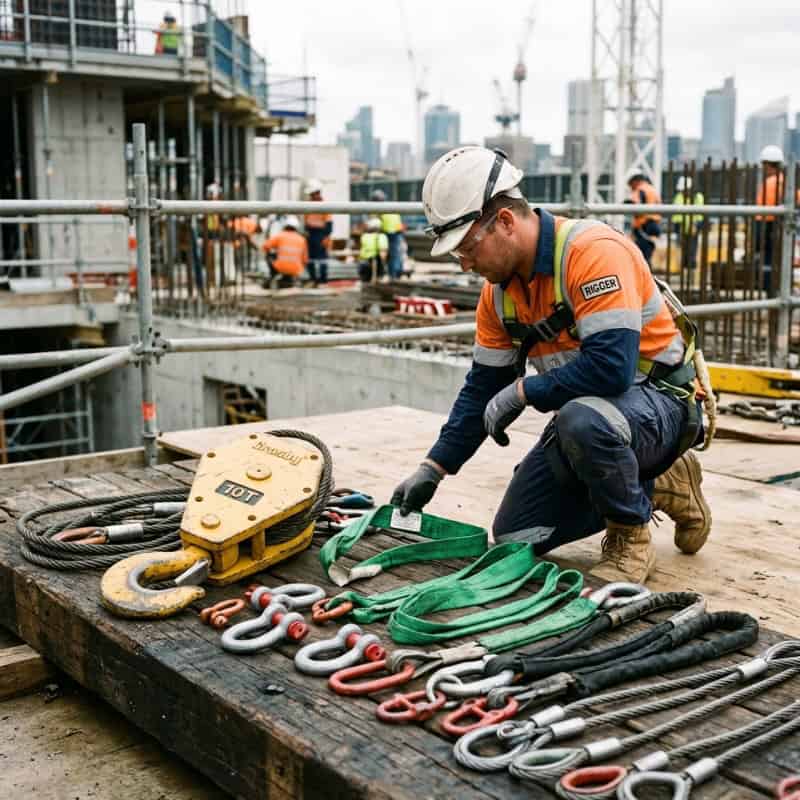
If you’ve ever heard “It was tagged, so it’s fine” right before a lift, you already know the problem: lifting gear safety isn’t one person’s job.
On Australian worksites (including across Sydney and NSW), responsibility is shared. Different people are responsible for different parts of the inspection and maintenance chain — and the chain only works if everyone understands what they own.
This guide breaks it down in plain language:
• who is responsible (and when)
• what “competent person” really means on site
• how pre-use checks and periodic inspections fit together
• what to document so your process is defensible when something goes wrong
Throughout, you’ll see practical scenarios you can relate to: shared gear between crews, hire gear arriving late, and the “we’re behind schedule” moments when shortcuts are most tempting.
Start here: responsibility depends on the type of inspection
Most confusion comes from mixing up three different activities:
• Pre-use checks (every time the gear is used)
• Routine / scheduled inspections (set intervals based on risk, environment and use)
• Maintenance/testing (when required by manufacturer guidance, a risk assessment, or after repair/damage)
On-site, these usually map to different roles.
Pre-use check: responsibility sits with the person using the gear
If you’re the one about to lift the load, you’re responsible for checking the gear in your hands before it goes into the lift. That’s true whether you’re a rigger, dogger, tradesperson, forklift operator using a lifting attachment, or a supervisor stepping in.
A pre-use check is not a paperwork exercise. It’s a quick, practical scan for obvious issues like:
• cuts, tears or abrasions on slings
• heat damage, chemical damage, stiffness, glazing or melted fibres
• kinks, birdcaging or broken wires on wire rope
• chain stretch, gouging, corrosion, cracks
• bent pins, deformed bow shackles, damaged threads
• illegible or missing identification tags
• anything that just “doesn’t look right” compared to the last safe lift
If there’s a doubt, the safe call is simple: stop, quarantine the gear, and escalate.
Scheduled inspections and maintenance: responsibility sits with the duty holder who controls the system
On an Australian worksite, the duty holder is typically the PCBU (the business running the work), or the person with management or control of the plant/gear.
In practice, this means the PCBU is responsible for ensuring there is:
• a system that defines inspection intervals
• a process for removing damaged gear from service
• a way to ensure inspections are done by competent people where required
• records that prove it happened
That system can be delegated (for example, to a supervisor, leading hand, HSE adviser, plant manager, or a contractor), but the duty to ensure the system exists and works can’t be shrugged off.
“Competent person” inspections: responsibility sits with whoever is actually competent for that gear and task
Some inspections are beyond a quick pre-use check. Examples include:
• periodic inspections of critical lifting components
• inspections after shock loading, suspected overload, or a dropped load incident
• inspections after repair, modification, or replacement of key parts
• situations where a risk assessment determines that more formal checks are required
A “competent person” is not simply someone who has been around for a while. Competency is about having the knowledge, training and experience to identify faults, judge whether the gear is compliant and safe, and decide the correct action.
In many workplaces, that competent person may be an internally trained inspector, a plant/maintenance specialist, or an external inspection provider — depending on the complexity and risk level of the gear.
Who is responsible, role by role (without the legal jargon)
Let’s translate “shared responsibility” into real worksite roles you see in Sydney every day.
The PCBU is responsible for the inspection system
The PCBU’s responsibility is to make sure lifting operations are supported by a working system, not wishful thinking.
That includes:
• selecting fit-for-purpose lifting gear for the environment (salt air, heat, abrasive dust, chemical exposure)
• setting inspection frequencies based on manufacturer guidance and risk
• making sure competent inspections happen when required
• providing training/instructions for pre-use checks
• maintaining records and traceability (so gear isn’t a mystery item in a ute)
• ensuring damaged gear is quarantined and cannot “wander back” into use
A practical test: if the key supervisor leaves site tomorrow, does the inspection process keep functioning? If not, the system is too reliant on a person rather than being built into the way work is done.
Site supervisors and leading hands: responsible for day-to-day control
Supervisors are usually responsible for making the PCBU’s system real at ground level:
• ensuring pre-start/toolbox talks include lifting gear checks when lifting is planned
• checking that the right gear is used (correct WLL, configuration, sling angles, edge protection)
• verifying inspection status and records are current
• stopping unsafe lifting before it begins
• enforcing quarantine rules and making sure “Do Not Use” actually means do not use
Supervisors don’t need to be the competent person for every piece of gear — but they must be able to recognise when a lift is trending unsafe and trigger escalation.
Workers (including riggers/doggers/operators): responsible for pre-use checks and reporting
Workers have responsibilities that are often underestimated:
• do the pre-use check properly (not just a glance)
• use the gear as intended (no improvised connectors, no shock loading, no “it’ll be right”)
• follow site procedures and SWMS
• report defects, near misses and unsafe conditions immediately
• refuse to use gear that is damaged, unidentified or questionable
If your culture says “workers are responsible” but doesn’t give them time, training, or an easy way to quarantine gear, that’s a system failure — not a worker failure.
Contractors and subcontractors: responsible for their gear, and also the site rules
Here’s where things get messy on multi-contractor Sydney sites.
If a subcontractor brings their own lifting gear, they’re responsible for ensuring it is fit for purpose and appropriately inspected. But the principal contractor/site PCBU still has to manage the risks on the site overall, which usually includes making sure contractor gear meets site rules.
A common practical approach:
• contractors declare what lifting gear they’re bringing
• site verifies minimum inspection/traceability expectations
• pre-start includes a quick confirmation of gear condition and suitability
• any gear found non-compliant is removed from use immediately
Hire gear and shared gear: responsibility follows “management or control”
If gear is hired or shared between crews, responsibility typically follows the party with management/control at the time of use.
What matters in practice is setting a simple rule:
• No gear is used unless it can be identified and its inspection status is known.
That means your process needs to work even when the gear arrives late, the lift is urgent, or the usual person is off site.
If your site uses a lot of shared gear, having a consistent supply of standard items that are easy to identify can reduce risk. For example, standardising common connectors and consumables can help prevent ad-hoc substitutions. If you’re reviewing your site’s baseline stock, it can help to start with a defined set of lifting gear for worksites so crews aren’t tempted to improvise when the correct item is missing.
Qualifications: what counts (and what doesn’t)
People often ask for a single licence or ticket that “makes you authorised” to inspect lifting gear. Reality is more nuanced.
What “competent person” means on a real worksite
Competency is evidence-based. It’s usually demonstrated through a mix of:
• task-specific training (relevant to the gear type)
• practical experience inspecting and using that gear
• understanding of failure modes and discard criteria
• ability to interpret markings, IDs and manufacturer instructions
• knowing when to escalate to an engineer/manufacturer or remove from service
In other words: being competent to inspect a textile sling doesn’t automatically make someone competent to inspect chain, wire rope, lifting beams, or specialist lifting attachments.
Does a dogger or rigger automatically qualify?
High risk work roles can involve excellent practical knowledge, but that doesn’t automatically equal competency for formal inspection requirements across all gear types and scenarios.
A good rule:
• Pre-use checks can be done by trained workers and supervisors
• Periodic/major inspections should be done by someone demonstrably competent for that gear and inspection scope
If you want to reduce grey areas, document what “competent” means for your site and who meets that standard (and for which gear categories).
Rules and responsibilities in action: three Sydney scenarios
Scenario 1: “It was in the gang box, so it must be fine”
A crew grabs a sling from a shared gang box on a CBD build. The tag is faded and you can’t read the ID.
What happens next should be automatic:
• worker stops and does not use it
• supervisor is notified
• sling is quarantined (physically separated and clearly marked)
• replacement sling is sourced
• the unidentified sling is assessed by a competent person (or disposed of if identification cannot be restored)
This is where having a consistent supply of site lifting accessories helps — not for sales reasons, but because standardised, identifiable gear reduces the “mystery sling” problem.
Scenario 2: Contractor brings their own shackles
A subcontractor shows up in Western Sydney with their own shackles and chains. They look fine, but there’s no clear ID and no record.
A practical site approach:
• confirm the gear is identifiable and suitable for the lift plan
• if the site requires traceable IDs, enforce that requirement
• if it can’t be verified, it doesn’t get used on that site
• offer a compliant alternative pathway (site-supplied gear or verified inspection evidence)
This isn’t about being difficult — it’s about preventing the “unknown history” factor, which is where lifting incidents love to hide.
Scenario 3: Shock load event during a hurried lift
A load snags, the crane operator lifts again, and the sling takes a sharp shock load.
Immediate responsibilities:
• stop work and remove the sling from service
• supervisor ensures the area is safe and the lift plan is reviewed
• the sling is quarantined and inspected by a competent person before any reuse
• incident/near miss is recorded, and the root cause is addressed (rigging method, communication, lift plan, edge protection, snag risk)
This is one of the most important moments to get right. Shock loading can create internal damage that a quick glance won’t catch.
What a strong inspection system looks like (without turning into paperwork theatre)
A good inspection system is simple enough to be followed under pressure.
Here’s a practical structure that works on busy worksites.
1) Define categories of lifting gear you use
List your common gear families, for example:
• synthetic slings, round slings
• chain slings
• wire rope slings
• shackles, hooks, master links, connectors
• below-the-hook lifting devices, lifting beams/spreader bars
• lifting points, eyebolts/eye nuts, swivel hoist rings
• lifting attachments and accessories
Once categories are clear, you can define:
• who can do pre-use checks
• who can do periodic inspections
• what triggers a “major inspection” or escalation
If you’re building a baseline list for frequently replaced items, it can help to group common lifting equipment consumables so teams don’t substitute random hardware when something is missing.
2) Set inspection frequency based on risk and environment
Rather than relying on a single “every X months” rule, base it on:
• manufacturer instructions (where available)
• intensity of use (daily lifts vs occasional)
• environment (coastal corrosion, chemical exposure, abrasive dust)
• criticality (what happens if it fails?)
• history (repeat defects, harsh handling patterns)
If a single lift could cause catastrophic harm, your inspection schedule should reflect that risk.
For NSW-focused guidance on building inspection and maintenance schedules for plant, a useful reference is the SafeWork NSW guide on inspecting and maintaining plant: Guide to inspecting and maintaining plant.
3) Make quarantine non-negotiable (and easy)
Quarantine fails when it’s inconvenient.
Make it easy by having:
• a physical quarantine location
• clear “Do Not Use” tags available where lifts happen
• a simple rule: if you can’t identify it, you can’t use it
• a short escalation path (who to tell, what happens next)
4) Recordkeeping that actually helps
Your records should answer:
• what is the item (unique ID/description)
• where is it normally stored/used
• when was it inspected
• who inspected it (and their competency basis)
• what was found
• what action was taken
• when it is next due
Records aren’t just for compliance. They’re a learning tool:
• which crews are hard on gear
• which gear types fail most often
• which suppliers or models last longer in your environment
Q&A: “If everyone is responsible, does that mean no one is responsible?”
No. Shared responsibility doesn’t mean diluted responsibility.
On site:
• the PCBU is responsible for the system existing and working
• supervisors are responsible for controlling daily implementation
• workers are responsible for doing pre-use checks, following procedures, and reporting hazards
• a competent person is responsible for making inspection decisions that require competency beyond a basic check
Think of it like layers of safety. Each layer catches what the others miss.
Q&A: “What if the gear has a tag — does that mean it’s safe to use?”
A tag can be useful, but it is not a forcefield.
You still need to:
• confirm the gear is the correct type and capacity for the lift
• visually check for damage and deformation
• confirm the ID is legible and traceable (especially for shared gear)
• ensure the gear hasn’t been misused since the last inspection
• stop if anything looks wrong
Tags support a system. They don’t replace judgement.
Q&A: “Who gets blamed if something fails?”
That’s not the right way to think about it — but it’s why your roles and records matter.
When an incident happens, investigators typically look for:
• whether the PCBU had a functioning system
• whether training and instructions existed
• whether inspections were done at appropriate intervals
• whether defects were acted on
• whether the lift was planned and controlled
A strong system reduces both harm and confusion.
FAQ
Who is responsible for lifting gear inspections on site in Australia?
Responsibility is shared. Workers are responsible for pre-use checks before lifting. Supervisors are responsible for ensuring the process is followed day-to-day. The PCBU (or the person with management/control) is responsible for ensuring an inspection and maintenance system exists, including competent inspections and records.
What does “competent person” mean for lifting gear inspection?
A competent person is someone who can demonstrate the training, knowledge and experience to identify defects, assess safety and compliance, and decide what action is required for the specific gear type and inspection scope.
Do pre-use checks replace periodic inspections?
No. Pre-use checks catch obvious damage and changes since the last lift. Periodic inspections are a planned control that looks deeper and is performed at set intervals based on manufacturer guidance and risk.
What should happen when lifting gear is damaged or can’t be identified?
It should be removed from service immediately, quarantined so it can’t be used, and assessed by a competent person (or disposed of if it can’t be verified/identified).
Do contractors have to follow the host site’s inspection rules?
In practice, yes. Contractors remain responsible for their own gear, but the site PCBU must manage overall risk and can require contractor gear to meet site rules for identification, inspection status and suitability.
What records should be kept for lifting gear inspections?
At minimum: item ID/description, inspection dates, inspector name/competency basis, findings, actions taken, and next due date. Records should be easy to access when gear is shared or moved between crews.