
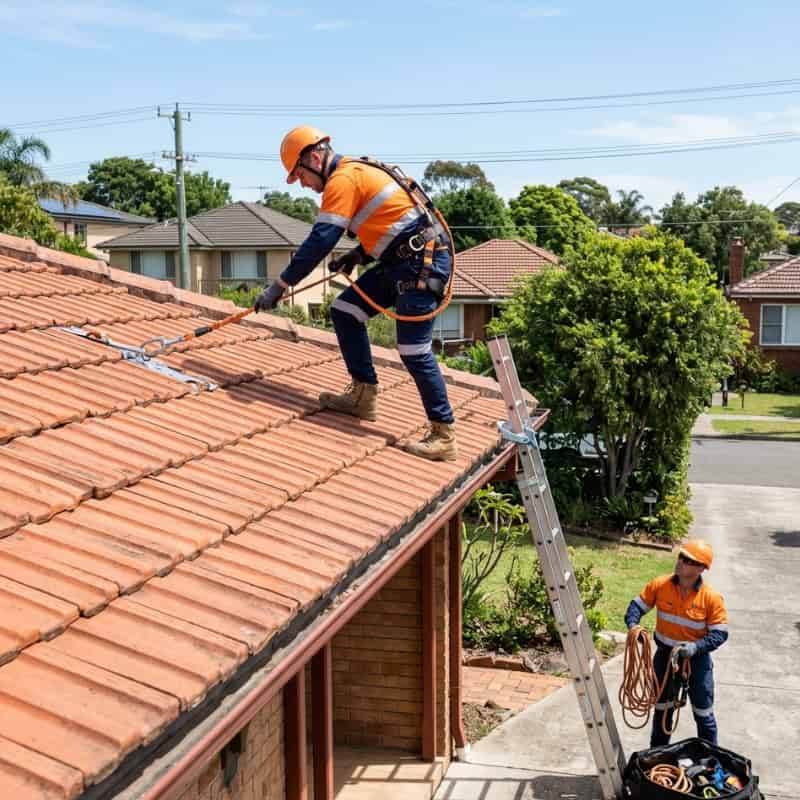
Roof-edge falls aren’t only a “big construction site” problem. In Australia, plenty of serious incidents happen during short, everyday tasks on residential homes—even when a roofing harness kit is available but not used: clearing gutters, checking a leak, swapping a couple of tiles, trimming overhanging branches, or installing a small antenna.
This guide is practical by design. It’s written for Aussie home roofs and the way people actually work: carrying a bundle of tiles, stepping over a valley, moving around skylights, dealing with morning dew, or trying to finish before the next Sydney shower rolls through. You’ll learn how to reduce fall risk near edges using the hierarchy of controls (starting with the most effective), plus a clear pre-start checklist and “stop-work” red flags.
Why roof edges are uniquely risky on Aussie homes
Roof edges create a perfect storm of hazards because they combine:
• A steep consequence (the edge is the drop)
• Reduced traction (tiles, metal, dust, lichen, wet leaves)
• Awkward movement (bending, reaching, stepping sideways)
• Distraction (tools, hoses, power leads, materials)
• False confidence (“I’m only up here for 10 minutes”)
On many suburban roofs, you also get design features that encourage edge drift: hips and ridges that guide your steps outward, valleys that channel water and make surfaces slippery, and eaves that hide the true distance to the ground when you’re looking down.
Quick answer
If you only remember one thing: the safest approach near roof edges is to avoid being near the edge at all, then use physical edge protection where practicable, and treat harness-based systems as a later control that still requires careful planning and competent setup.
Start with the hierarchy of controls (it’s not just paperwork)
When it comes to working near roof edges, the hierarchy of controls is the difference between “hoping nothing goes wrong” and actively designing the risk out of the job.
1) Eliminate the need to be on the roof (best option)
Ask: Can the task be done from the ground or from inside the roof space?
Examples:
• Use a gutter vacuum system or long-reach tools from the ground (where suitable)
• Inspect suspected leaks from inside the manhole/roof space first
• Use drone or pole-mounted camera inspection for a quick look (where legal and practical)
• Shift work to a platform that isn’t the roof (see below)
Even if elimination isn’t possible, this step often reduces time spent on the roof, which cuts exposure.
2) Substitute the roof surface for a safer work position
Can you work from:
• A properly set up scaffold platform
• An elevated work platform (EWP) used correctly
• A temporary work platform that keeps you away from the edge
Working from a stable platform often lets you keep both feet planted and your centre of gravity where it belongs.
3) Use engineering controls: edge protection and barriers
Physical edge protection (like guardrails) is powerful because it prevents a slip from becoming a fall over the edge. If you’re in NSW, SafeWork NSW guidance discusses roof edge protection as a key control when work at height can’t be eliminated. It’s worth reading their roof edge protection fact sheet for the NSW context. SafeWork NSW roof edge protection fact sheet
Where barriers aren’t practicable for the job, consider:
• Temporary guardrails/perimeter protection systems
• Scaffolding edge protection
• Exclusion zones below (to manage falling objects), even when you’re still controlling fall risk above
4) Administrative controls: systems of work (supporting controls)
Administrative controls don’t “stop” a fall by themselves, but they reduce the chance you’ll create the conditions for one.
Examples:
• A pre-start checklist and a clear “no-go” list
• Weather rules (wet roof = stop, high wind = stop)
• Setting a “work line” that keeps people back from the edges
• Tool management: no loose tools, manage cords/leads, keep pathways clear
• Buddy system: someone present to assist/call for help
5) PPE: restraint/fall-arrest systems (important, but not magic)
Harness-based systems can be essential in some scenarios, but they require:
• The right equipment for the roof and task
• Correct anchorage and setup
• Training/competency
• A rescue plan (because a fall arrest can leave someone suspended)
If you’re planning roof work and want to understand how these systems fit into a sensible approach, you can read more about harness systems for roof work.
The roof-edge risk “multiplier”: small jobs and rushed timing
Many roof-edge incidents happen during small, “routine” jobs. The risk isn’t only the height; it’s the mindset.
Common “rushed job” triggers:
• “I’ll just pop up and have a quick look.”
• “I’ve done this a hundred times.”
• “It’s dry enough.” (Then you find dew in the shade.)
• “I’ll be careful.” (Careful isn’t a control.)
The practical fix is to make your setup routine, even for small tasks. That starts with a pre-start checklist.
A practical pre-start checklist before anyone steps onto the roof
Use this as a quick, repeatable routine. If you can’t tick the key safety items, don’t improvise your way into danger.
Access and ground setup
• Stable ladder position and correct angle (no wobbly footing)
• Ladder secured against movement (top and/or bottom as appropriate)
• Clear access path: no hoses, leads, kids’ toys, slippery leaves
• Establish an exclusion zone below (protect people from falling objects)
• Tools/materials managed so you’re not carrying awkward loads while climbing
Roof condition check (from ladder line or a safe vantage point)
• Is the roof wet, dewy, dusty, or covered in leaf litter?
• Is there moss/lichen (especially on shaded sides)?
• Are there loose tiles, cracked ridges, or fragile sections?
• Are there skylights, polycarbonate sheets, or brittle panels?
• Are there power lines or service cables close to access points?
Job planning near edges
• Define where the work happens and how close you’ll be to the edge
• Plan movement paths: avoid stepping backwards near edges
• Decide the highest-level control you can use (platform/edge protection first)
• Confirm who is in charge of the call to stop work
Weather and timing rules (Sydney reality check)
• If the roof is wet or getting wet: stop and reschedule
• If wind gusts make balance uncertain: stop
• If heat is causing fatigue or sweat (reduced grip and judgement): take breaks, hydrate, reassess
• If light is fading: stop (visibility matters more than people admit)
Q&A: “If I’m only going up for five minutes, do I really need a checklist?”
Yes. Five minutes is enough time to slip, lose balance, or step onto a fragile surface. The checklist isn’t about bureaucracy—it’s about catching the two or three conditions that turn a short job into a life-changing fall.
The biggest hazards near roof edges (and what to do about them)
Slips on tiles and metal roofs
Tile roofs can be deceptively slick—especially with dust, lichen, or moisture. Metal roofs can be slippery even when they look dry, and they often get worse with fine dust.
Practical controls:
• Choose footwear with a suitable grip and keep soles clean
• Keep your “working zone” clear of debris (leaf litter is a skating rink)
• Avoid stepping on ridges/hips in a way that forces you toward the edge
• Don’t carry heavy loads across the roof near edges—stage materials safely
Trips and snags: leads, hoses, and loose materials
Trips cause unexpected momentum, and momentum near an edge is unforgiving.
Practical controls:
• Route cords/leads away from walking lines
• Use tool buckets or secure storage, not “leave it there for a sec”
• Keep one clear path to and from your work area
• Don’t throw tools onto the roof surface (they roll, and you chase them)
Fragile surfaces: skylights, polycarbonate, and old sheeting
Skylights and brittle panels are a recurring factor in serious falls. People step where they shouldn’t, or they put a knee down while reaching, and the surface gives way.
Practical controls:
• Treat skylights and translucent sheets as “do not step” zones
• Mark them clearly before work starts
• Use covers/temporary protection where appropriate and competent
• Plan your route so you’re never stepping over or around a fragile panel while carrying tools
Roof pitch and edge geometry
The steeper the pitch, the more your body is fighting gravity. Add an edge, and you’re in a high-consequence environment.
Practical controls:
• Reassess whether a roof is “safe enough” for the task without a platform or edge protection
• Shorten time on the roof; stage work so you’re not wandering
• Use a competent setup for any restraint/fall arrest approach
Q&A: “What’s safer near a roof edge—guardrails or a harness?”
In general, physical edge protection (like guardrails) is safer because it prevents the fall from happening in the first place and doesn’t rely on perfect user behaviour every second. Harness-based systems can be appropriate when designed and set up correctly, but they still require planning, correct anchorage, and consideration of rescue if a fall occurs.
Practical movement rules that prevent edge drift
Many falls happen when someone isn’t “working at the edge” but gradually drifts there while focusing on the task.
Use these movement rules:
• Face your direction of travel; avoid walking backwards near edges
• Keep your centre of gravity over your feet; don’t overreach
• Move in small steps; don’t lunge across a gap or valley
• Keep three points of contact when transitioning from ladder to roof
• Don’t rush transitions—most slips happen during transitions, not during steady work
A simple behaviour tweak that helps: before every reposition, pause and scan your next two steps. It sounds basic, but it interrupts autopilot.
Job scenarios on Aussie homes: what “good” looks like
Scenario 1: Cleaning gutters along the eaves
This job puts people close to the edge by default.
Safer approach:
• Consider doing sections from a platform rather than standing on the roof
• If you must be on the roof, plan a movement path that keeps you away from the edge while still reaching the gutter line safely
• Don’t carry buckets while moving; stage tools and move them in controlled steps
• Keep the ground exclusion zone in place—gutter debris and tools fall
Scenario 2: Replacing a few broken tiles near the perimeter
Tile replacement encourages awkward reaches and sideways steps.
Safer approach:
• Stage tiles/tools so you’re not walking around with armfuls near the edge
• Work from a stable position; avoid “one foot here, one foot there” stances
• Consider edge protection if you’ll be repeatedly working near the perimeter
Scenario 3: Investigating a leak after rain
Post-rain is when roofs are most deceptive: patches look dry, but shaded spots hold moisture.
Safer approach:
• Inspect inside first (roof space) to narrow the problem area
• If the roof is wet or dewy, delay roof access
• If you must attend urgently (e.g., active ingress), prioritise safe access and the highest-level controls available
Q&A: “Is a wet roof always a no-go?”
A wet roof is a major risk multiplier. If you can eliminate or delay the roof work, do it. If you can’t, you need a higher level of control than “being careful”—and for many domestic contexts, postponing until conditions improve is the safest call.
Understanding restraint vs fall arrest in plain English
Harness systems are often discussed as if they’re one thing, but they’re not.
Travel restraint (aim: prevent reaching the edge)
A restraint setup is intended to stop you from getting to a position where you could fall. In theory, this reduces the likelihood of a fall event—because you can’t physically reach the drop.
Key point: restraint only works if the system is configured so you truly can’t reach the edge.
Fall arrest (aim: stop you after you fall)
Fall arrest is designed to catch a fall. That means you can still go over the edge, and the system limits the forces and distance.
Key point: fall arrest requires a rescue plan. Suspension after a fall is dangerous, and “we’ll figure it out” is not a plan.
If you’re weighing up equipment for roof work, it helps to think through real-world setup, anchorage suitability, and what happens if someone slips. If you want a practical starting point, this page on choosing the right roof harness kit can help frame the considerations.
Stop-work red flags (don’t negotiate with these)
If any of these are true, stop and reassess:
• You can’t maintain a stable footing and predictable movement
• The roof is wet, dewy, or contaminated (dust, lichen, leaf litter)
• There are fragile surfaces you can’t protect/avoid confidently
• You don’t have a safe access/egress point you trust
• Wind gusts are affecting balance
• You’re tired, rushed, or working alone without a safety plan
• You don’t have a realistic rescue plan for a fall arrest scenario
These aren’t “nice to have” warnings. They’re the moments where people either reset the plan or roll the dice.
What homeowners and site managers can do (even if you’re not the one on the tools)
If you’re organising roof work (rather than doing it yourself), you can reduce risk by asking better questions and setting safer expectations.
Practical actions:
• Don’t pressure anyone to work in wet or windy conditions
• Ask what controls will be used near edges (platforms/edge protection first)
• Make sure access points are clear, and the work area below can be kept clear
• Identify skylights and fragile panels before anyone steps up
• Ensure there’s daylight to do the job safely (avoid “late afternoon rush”)
Q&A: “What’s one question I should ask before anyone goes on the roof?”
Ask: “How are we preventing someone from falling over the edge?”
If the only answer is “we’ll be careful”, the plan isn’t strong enough.
Final FAQ: Roof edge safety on Australian homes
What’s the most effective way to prevent falls near roof edges?
Eliminating the need to be on the roof is best. If roof work can’t be eliminated, physical edge protection or working from a stable platform is generally more effective than relying only on behaviour or PPE.
Do skylights count as a serious fall hazard?
Yes. Skylights and other fragile roof elements can fail under body weight. Treat them as no-step zones and plan routes and protection accordingly.
Are short “maintenance” jobs actually high risk?
They can be, because people tend to skip setup and accept marginal conditions. Many incidents occur during quick tasks like gutter cleaning, tile replacement, and inspections.
What should be in a simple pre-start roof safety check?
Access/ladder stability, roof condition (wet/contaminated surfaces), fragile surfaces, weather, a planned movement path, and a clear stop-work rule set.
Is it enough to just use a harness?
A harness system can be part of risk control, but it isn’t automatically “safe” without correct selection, anchorage, setup, user competency, and (for fall arrest) a rescue plan. Higher-level controls like platforms and edge protection should be considered first where practicable.
Next step if you’re planning roof work
If your job requires harness-based controls, make sure the setup matches the roof, the task, and the real movement patterns near edges. You can explore options for roofing safety gear hire in Sydney if you’re working through what a sensible equipment approach looks like for roof work conditions.