
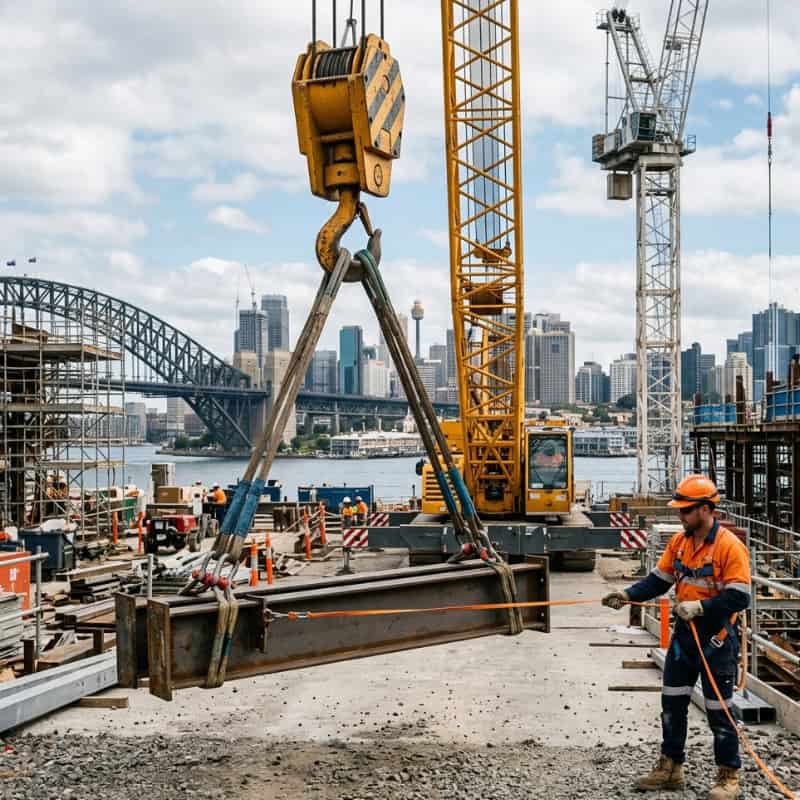
If you’ve ever stood near a load and thought, “The tag says this should be fine… but is it really?”, you’re not alone. On busy Sydney worksites and in warehouses across NSW, lifting happens fast. The risk is that capacity gets treated like a single number, when in reality it’s affected by how you rig the load, the angles you create, the condition of the gear, and whether the load’s centre of gravity is behaving.
This guide breaks SWL down in plain English, then walks you through a practical decision process so you can choose lifting gear that matches the load and the lift conditions, not just the label.
SWL, WLL and breaking strength: what the numbers really mean
The terminology can feel messy because different industries and older paperwork may use different terms. The key is understanding what the number is trying to tell you: the maximum load the equipment is allowed to carry in normal use.
Safe Working Load (SWL)
SWL is commonly used to describe the maximum load that can be safely applied to equipment under specified conditions. You’ll still see SWL on older tags, signage, and site language.
Working Load Limit (WLL)
WLL is the term you’ll often see on modern lifting gear and standards-based labelling. In practical terms on site, people often use SWL and WLL interchangeably, but you should follow what the manufacturer states on the equipment tag and instructions.
Minimum breaking strength (MBS) or breaking load
Breaking strength is not a “usable” number for planning lifts. It’s the approximate load where failure may occur in testing, and it’s not what you should be lifting to. The usable limit is the rated capacity (SWL/WLL) under stated conditions.
Quick sanity check
If someone quotes a breaking strength figure to justify a lift, stop and reset the conversation. Your lift plan should be based on the rated limit and the actual configuration you’re using, not the theoretical point of failure.
The simple rule that prevents most lifting mistakes
Before you think about selecting gear, you need two things:
• The best available estimate of load weight
• A clear plan for how the load will be attached and controlled
If you don’t know the weight, don’t guess. Unknown load weight is one of the quickest ways to exceed capacity without realising it.
Q&A: “What if I don’t know the weight of the load?”
If the weight isn’t marked on the load or paperwork, use one of these approaches:
• Check drawings, job packs, or asset registers (common in plant rooms and construction projects)
• Use known material weights and dimensions (steel sections, concrete panels, machinery components)
• Use a suitable scale/load cell method where appropriate, under a competent plan
• Break the job down into smaller lifts with known components
If none of that is available, treat it as a stop-work trigger until a competent person can verify the weight.
A practical process for choosing the right lifting gear
You can think of lifting gear selection as a sequence of questions. Answer them in order and you’ll avoid most of the classic “tag said it was fine” incidents.
Step 1: Confirm load weight and lifting points
Start with:
• Load weight (best available verified figure)
• Number and location of lifting points
• Whether lifting points are engineered/lift-rated or improvised
• Any constraints: headroom, access, obstacles, nearby services
If the load has certified lifting lugs or points, confirm they’re intended for the direction of pull you’re about to apply. If you’re not sure, don’t assume.
Step 2: Find the centre of gravity (COG)
A load doesn’t just “weigh X”. It also has a balance point. If your rigging doesn’t line up with the COG, the load will tilt, shift, or swing as soon as it takes weight.
For a practical explanation of how COG affects sling selection and stability, NSW Government’s dogging and rigging guidance is a good reference: calculating centre of gravity for lifting.
Q&A: “Why does my load tilt as soon as it leaves the ground?”
Because the COG isn’t directly under the hook (or not evenly shared between legs). Even small offsets can create a surprising tilt once the load is free, especially with long loads, machinery, or anything with an uneven mass distribution.
Step 3: Choose the type of sling or attachment for the load shape
This is where you match the gear to the load’s surfaces, edges, temperature, and handling requirements.
Common options include:
• Chain slings (tough, good for rugged loads, but vulnerable to incorrect configuration/angle loading and must be inspected carefully)
• Webbing slings (good for delicate surfaces, but sharp edges can cut fibres without proper protection)
• Wire rope slings (durable and heat-tolerant in many scenarios, but still need protection from crushing and sharp edges)
• Shackles, hooks, master links, eyebolts and lifting points (must be rated, compatible, and used in the intended orientation)
If you’re updating or restocking site kit, make sure you’re sourcing properly marked, traceable lifting and rigging gear that matches your typical loads and environments.
Step 4: Understand sling configuration and hitch type
Capacity changes depending on how you rig:
• Straight lift (vertical): generally the simplest to interpret
• Basket hitch: can increase capacity for some slings (depending on manufacturer guidance), but introduces stability considerations
• Choke hitch: typically reduces capacity because it concentrates load and introduces tight bends
Never assume a hitch increases capacity. Check manufacturer guidance and the tag information for the sling type you’re using.
Step 5: Account for sling angles (this is where many lifts go wrong)
As sling angles become shallower (legs spread wider), the tension in each leg increases. Even if the load weight doesn’t change, the force in the sling legs does.
A practical way to think about it:
• The wider you spread the legs, the harder each leg has to pull to hold the same load
This is why a lift that “should” be fine at a steeper angle can become unsafe when the legs are pushed out to clear an obstruction or reach awkward lifting points.
A simple example (conceptual, not a substitute for competent calculation)
Imagine a 2-leg bridle lifting a 1-tonne load.
• If the legs are near vertical, each leg shares the load more efficiently
• As the angle gets shallower, each leg can see significantly higher tension than half the load weight
The takeaway: Sling angle is not a minor detail. It’s a capacity changer.
Q&A: “What sling angle is ‘safe’?”
There isn’t one universal “safe angle” because it depends on the sling’s rating, configuration, and the load. What matters is that your calculated/verified leg loads remain under the rated capacity for that exact setup. If you can’t verify it, treat it as a stop-work trigger and get competent help.
Step 6: Consider dynamic loading and shock
Rated capacities assume controlled loading. Real lifts can introduce extra forces through:
• Snatching a load to free it
• Sudden crane/hoist movements
• Load swing due to wind (not uncommon around exposed Sydney sites, rooftops, or coastal areas)
• Load snagging on edges or nearby structures
If there’s a realistic chance of shock loading, your “paper capacity” can be misleading. The safer approach is to remove the cause (free the load, adjust the path, slow down the lift, control swing) rather than hoping the gear will absorb it.
Step 7: Verify compatibility, markings, and condition
Before the lift, confirm:
• The gear is clearly marked with rating/ID
• Components match (pin sizes, hook throat fit, master link compatibility)
• No side loading where it’s not permitted (common with shackles)
• No twists, knots, or cross-loading of hooks
• The gear has passed inspection and is in acceptable condition for use
When you’re checking tags and markings, you’re effectively confirming you’re using rated lifting equipment and not “mystery gear” that’s been floating around the site container for years.
The “before you lift” checklist you can actually use
Use this as a practical pre-lift scan. It’s not a substitute for competent planning where required, but it catches common failure points.
Load and plan
• Weight verified (not guessed)
• Lifting points suitable for the direction of pull
• COG considered and addressed
• Clear lift path and set-down location
• Exclusion zone set (people clear)
Rigging setup
• Sling type suits edges/surfaces/temperature
• Sling angles checked and within the setup rating
• Hitch type appropriate and understood
• Shackles/hooks oriented correctly (no unintended side loading)
• Edge protection applied where needed
Control and environment
• Tag lines or control method planned where appropriate
• Wind and weather considered (especially exposed lifts)
• Communication method agreed (signals/radios)
• No potential for shock loading/snatch
Gear condition
• Tags/markings readable
• No obvious damage: cuts, abrasion, corrosion, deformation, stretched links, broken stitches, crushed wire rope, damaged hooks/latches
• Any doubt = remove from service
If you need to build better control into lifts (preventing swing, protecting edges, stabilising loads), it often comes down to smart accessories and planning around load control and restraint rather than pushing the main sling/chain to its limit.
Common mistakes that turn “rated” into “overloaded”
Mistake 1: Treating SWL/WLL as a single universal number
The rating is tied to conditions. Change the configuration, angle, or hitch and you’ve changed the real capacity.
Mistake 2: Ignoring the centre of gravity
A load that tilts can suddenly shift load share between legs, overload one leg, or cause swing. It can also roll out of a basket hitch if not stabilised.
Mistake 3: Forgetting sharp edges
Webbing slings and even wire rope can be damaged fast by a sharp edge. Edge protection isn’t optional when edges are present.
Mistake 4: Side-loading shackles or hooks
Shackles and hooks are usually designed for loading in a specific direction. Side loading can reduce capacity and increase failure risk.
Mistake 5: Shock loading
Snatching a load is one of the fastest ways to exceed rated capacity. If a load is stuck, fix the cause; don’t force the lift.
When to stop and get a competent person involved
Some lifts are routine. Others are deceptively complex. Use these as practical escalation triggers:
• Load weight is unknown or cannot be verified
• Lifting points are unverified, improvised, or the direction of pull is uncertain
• Multi-leg bridles with shallow angles that you can’t confidently verify
• Complex shapes, high COG, or loads that can shift internally
• Tandem lifts (two cranes/hoists)
• Lifts near live services, over public areas, or with tight clearances
• Any evidence of gear damage, missing tags, or mismatched components
In NSW, different work types and risk profiles may require specific competencies and planning. If you’re unsure, treat that uncertainty as a hazard, not a minor inconvenience.
FAQs
What’s the difference between SWL and WLL in Australia?
You’ll hear both. WLL is commonly used on modern lifting gear labelling, while SWL still appears in site language and older documentation. In all cases, follow the manufacturer’s rated limit for the specific configuration and conditions.
Does the sling angle really make that much difference?
Yes. As sling angles get shallower, the tension in each leg increases. A setup that looks “only a bit wider” can meaningfully increase leg load and overload a sling leg or attachment.
Can I use a shackle sideways?
Shackles are generally designed for loading along a primary axis. Side loading can reduce capacity and increase risk. If a setup requires side loading, it’s a sign the rigging arrangement may need redesign by a competent person.
How do I know if the lifting gear is still safe to use?
If there’s damage, missing/illegible tags, deformation, corrosion, cuts, broken stitching, stretched links, or anything that raises doubt, remove it from service and follow your inspection process. “Looks okay” is not a rating.
Is breaking strength a safe limit for lifting?
No. Breaking strength is not a planning number. Use the rated capacity (SWL/WLL) for the exact setup, including angles and hitch type, and control dynamic loading.
What should I do if the load starts to swing?
Stop and stabilise. Swing increases risk, can introduce dynamic forces, and can lead to impact or snagging. Use appropriate control methods (like tag lines where suitable), slow movements, and plan the lift path to minimise swing.