
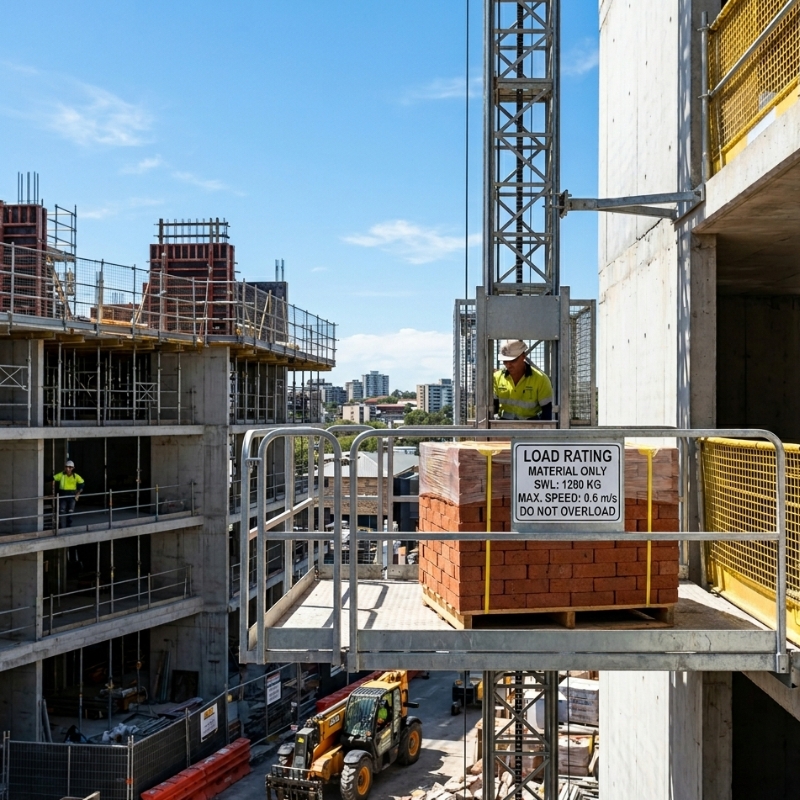
Thinking about renting a material hoist for a project soon? You see load ratings boasting 250 kg, 500 kg, 2 t—what’s that all about? Ask three tradies, and you’ll probably get five different answers. Can a 500 kg hoist manage 525 kg just this once? Does that weight include the bucket? And—what about wind, dust, or last-minute sling changes? How do they factor into the safe working load (SWL)?
Messing up these details isn’t just about filing the right forms. It can mean bending mast sections, snapping slings, delaying schedules, or worse—putting people at risk. Let’s bust the common myths about material hoist capacity, explore how engineers and regulators determine SWL, and check out some practical on-site tips to avoid the dangers of overload.
What Does “Load Capacity” Really Mean?
You’ll encounter three terms frequently on spec sheets:
- Rated Capacity or Working Load Limit (WLL)
- Safe Working Load (SWL)
- Test Load
SWL is the max a hoist can handle under normal circumstances—comes with a built-in safety cushion. In Australia, that cushion’s typically four times the load, so a 250 kg hoist is tested up to around 1,000 kg under specific conditions.
Why the buffer? Real-world variables—like sudden gusts of wind, dynamic movements, or worn gearboxes—can push forces beyond just the static weight. That’s why Safe Work Australia and others insist on it. You want equipment to stay reliable when things get a bit dicey.
Clearing Up Material Hoist Load Limit Misconceptions
Let’s take on some of the most common misunderstandings.
| Myth | Reality | Why It Matters |
| “A 500 kg hoist can handle 500 kg of bricks plus the bucket.” | SWL accounts for everything: bucket, slings, chains, and load. | Overlooking accessory weight can push limits by 5-15%. |
| “If the mast is only five meters, I can add more weight.” | Hoist parts are rated for worst-case loads, not the height options. No extra room with shorter masts. | Overloads still put a strain on drive units and attachments. |
| “Static lifts are safe, so I can increase the weight.” | Dynamic loads (lift stop/start) add 10-25% extra force. Even static lifts have some movement. | Force spikes can trip safety devices or damage equipment. |
| “If the sensor hasn’t gone off, I’m good.” | Sensors are backups, not scales. Poorly set devices might fail. | Depending on them skips essential human checks. |
| “Manufacturer ratings are too conservative.” | Ratings already include safety factors. Overloading chips away at safety buffers. | Getting greedy in the short term can damage gear or void insurance. |
What Sets the Real Safe Working Load
1. Manufacturer Specs and Safety Cushion
Initial calculations—gearbox power, mast strength, brake ability—establish the baseline. You can’t exceed these legally without fresh engineering and certification.
2. Lifting Attachments and Sling Angle
Every piece—shackle, sling, spreader bar—carries a WLL. A 1 t sling in a vertical pull might be down to 700 kg at 60°. Ignoring these adjustments often causes overloads.
3. Load Distribution in the Cage or Bucket
Point loads, such as a pallet of tiles, can overload corners while appearing under SWL. Even weight distribution is crucial for longevity.
4. Environmental Factors
- Wind on sheets acts like sails.
- Dust or mud can sneak in extra weight.
- Steep sites tilt masts, shifting gravity centres.
5. Condition and Maintenance of Equipment
Worn brakes or stretched chains compromise integrity. An old hoist might not handle loads it once could.
6. Regulatory Margins and Site Rules
Some contractors or regulators may add more reductions (like 80%) for high-risk tasks. Check your site-specific plans.
Quick Guide to Verify Load Ratings Onsite
Here’s a five-minute check before that first lift of the day.
| Step | What to Check | Red Flag |
| 1 | SWL plate matches job requirements | Missing, unreadable, or mismatched plate |
| 2 | Visible WLL marks on the gear | Unknown capacity or faded tags |
| 3 | Confirmed load weight | No reliable weight data |
| 4 | Clear lift path, vertical mast | Obstructions or uneven base |
| 5 | Test the emergency stop and sensor | Alarm fails to engage |
Any red flags? Pause and reassess before proceeding.
Watch for Possible Overload Warning Signs
| Early Warning | Likely Cause | Immediate Action |
| Motor struggles or breaker trips | Excess load or drag | Lower load, try smaller batches |
| Cage jerks during ascent | Poor load distribution | Re-stack before retrying |
| Mast makes creaking sounds | Excessive lateral force | Secure load, inspect bolts |
| Burning smell from brakes after brief use | Overheated brakes | Stop and inspect |
| Sensors trip repeatedly | Too heavy a load or a sensor issue | Weigh load; inspect sensor |
If these keep happening, shut down and reach out to your provider—or someone who knows their stuff.
Common Mistakes in Load Calculations
- Guessing pallet weight – They vary, sometimes by 15-25 kg.
- Ignoring moisture – Wet bags or materials gain weight overnight.
- Forgetting gear weight – Even a small gear, like brick cages, adds weight.
- Stacking past cage rails – Extra height can destabilise the load.
- Unsecured gear – Sliding creates shock loads when hitting walls.
A quick weigh-bridge check or a look at a mass chart can save hours later.
When to Bring in the Experts
Thinking about pushing a hoist near its top rating? Working at heights? Coastal winds? Call in a rigger or engineer to check the lift plan. They can ensure sling angles and anchor loads are correct.
For more flexibility, many builders just choose a larger unit. Running a 500 kg hoist at 60-70% boosts lifespan and gives some leeway. Chat with your rental provider; they know what’ll fit your load types, frequency, and lift height best. Tech sheets help, but real-world insights are invaluable. Our handy SWL guide has more on picking attachments and figuring combined loads.
Got Questions? Check These Out
1. Is Safe Working Load the same as Working Load Limit?
Not quite. WLL is for parts like slings; SWL is for the whole system. Both have built-in safety factors.
2. How often should a hoist be load tested in Australia?
Most need an inspection and test yearly or after big changes. Follow the manual and local rules.
3. Can I reduce a hoist’s capacity for safety?
Sure. Some contractors use 80-90% of SWL for critical lifts. But don’t exceed rated capacity without engineering approval.
4. Do extreme temperatures impact hoist capacity?
Heat can affect oil; cold can make steel brittle. SWL handles normal Australian conditions, but keep an eye on performance.
5. Best way to handle tricky loads?
Use specialised cages or bars to distribute weight evenly. Avoid makeshift solutions that shift the center of gravity.