
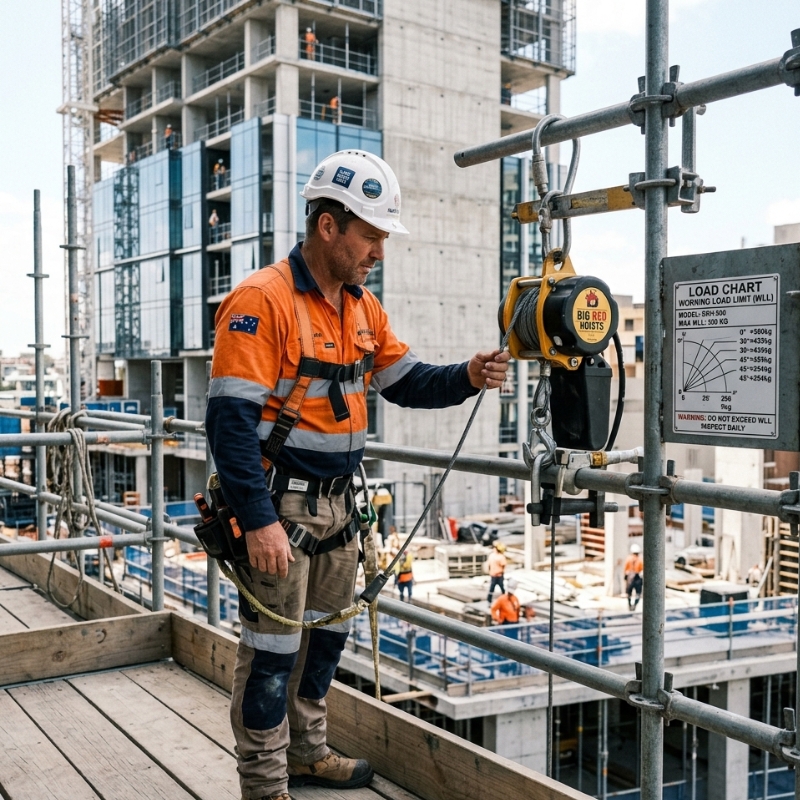
Rope hoists solve one of the oldest challenges in construction—getting materials where they need to be without exhausting the crew or risking manual-handling injuries. Yet even the best hoist is only as safe as its loading practice. Exceed the manufacturer’s limits, and you invite accelerated wear, damaged gear or, worse, a catastrophic drop. This guide breaks down the jargon, maths and visual checks so supervisors, tradies and DIY renovators can keep every lift inside the safe zone. If you’re looking for specifications, accessories or rental options, you’ll find them in the rope hoist product range; the article below focuses purely on practical safety and decision-making.
Why Load Limits Are a Big Deal in Australia
Here in Oz, we’ve got more rules than you can shake a stick at—courtesy of folks like Safe Work NSW and WorkSafe Victoria. They’re keen on ensuring you can:
- Spot the risky stuff with machinery like hoists.
- Assess risks and know the consequences of overloading.
- Do your best to cut risks where you can.
Blowing off these rules? Not a smart move. It leads to fines, holdups, or someone getting hurt. And using a hoist past its limits can cause:
- Rope squishing, which quietly wears things down till they snap.
- Drum stretching, messing up what your hoist can handle long-term.
- Overloaded anchor points, like on scaffolds, can fail miserably.
Get those numbers right—it’s step one to staying in the safe zone.
Breaking Down the Jargon: WLL, SWL, and MBL
If you’ve been around lifting gear, you know it’s acronym central. Let’s break down the top three terms:
- Working Load Limit (WLL) – The max weight your gear should haul in perfect conditions.
- Safe Working Load (SWL) – Usually the same as WLL in Australia, but always double-check the manufacturer’s cheat sheets.
- Minimum Breaking Load (MBL) – Where things snap in the lab. Not what you wanna try on-site.
Got a 200 kg portable hoist, and the rope’s MBL is 800 kg? That’s a 4:1 safety spread. But keep in mind, it shrinks with shock loads, weird angles, wind, or a snag.
Need a load rating refresher? This SWL guide cuts the jargon and gets you up to speed.
Why WLL and SWL Might Confuse You
WLL’s the buzzword now, but SWL still makes appearances in site docs. Playing it safe? Stick to the lower number unless told otherwise.
How Regulations Come Into Play
Safe Work Australia’s risk management guide flags going over rated capacity as a reportable hazard. If you ignore WLL and things go wrong, the regulators won’t be kind.
What Can Change a Rope Hoist’s Capacity?
A hoist’s nameplate assumes you’re lifting a straight-up, evenly balanced load with a fresh rope. But we know—real life doesn’t play by the rules. Here’s what could lower capacity.
Rope Diameter and Condition
- Wear and abrasion – A 10% drop in diameter can mean a 30% strength loss.
- Kinks or bird-caging – These are weak points that can surprise you.
- Contaminants – Stuff like paint or rust speeds up wear and tear.
Angle of Lift
Stray from vertical, and you’re piling up side stress. A 45° angle can nearly double the load on your hoist, making a 200 kg load way dodgier at just 140 kg.
Environmental Nuisances
- Wind – Sets loads swinging, upping the forces.
- Dust or sea spray – It’s like sandpaper on your ropes.
- Heat – Over 60°C? Your synthetic ropes might not hold up.
Regular Checks
Skip checking your gear, and you’re playing with hidden damage. That’s never a good bet.
Red Flags for Overloading
Here’s a table for your toolbox talks. Lists out what’s visible, what it could mean, and what to do about it.
| Situation | What It Could Mean | Suggested Action |
| The hoist motor stalls or slows | The load’s getting too heavy | Stop, lower, check weight |
| Rope squeaks or has shiny spots | Smashed strands | Check rope; replace if needed |
| The bracket flexes or creaks | Excessive force | Lighten the load; check ratings |
| The hook gate won’t shut | Bent from the load | Swap the hook |
| Thermal switch trips | Motor overheating | Measure load; consider a bigger hoist |
| Cracking noises | Internal wear or stress | Stop, inspect |
Spot any of these? Time to rethink your setup.
Easy Calc Before You Lift: Are You Within the Limit?
- Find or calculate the load precisely
– Material invoices help. Add about 10% for moisture or packaging.
- Add rigging weight
– Slings and such can tack on 5–15 kg.
- Think about the angle or motion
– For angles over 15°, factor by 1.2.
- Check against the hoist’s WLL
– Keep a 10% safety net.
For instance, lifting a 150 kg tile pallet with 10 kg rigging at a 20° angle?
Total load = (150 kg + 10 kg) × 1.2 ≈ 192 kg.
With a 200 kg hoist, you’re left with just an 8 kg buffer. Maybe try a bigger rig.
Common Slip-Ups with Load Charts
- Using chain-hoist charts for rope hoists – Safety factors aren’t the same.
- Ignoring the duty cycle – A 200 kg hoist ain’t made for nonstop action. Check the fine print.
- Missing the dynamic loads – Quick moves can jack up forces by up to 30%.
- Assuming all brands match up – Not always true, even if both say 200 kg.
- Seeing “safety factor” as wiggle room – It’s not. It’s for the unknowns.
Questions to Sanity-Check Your Lifting Plan
- Have you double-checked the actual weight? Don’t rely on dusty guesses.
- Is the rope in good nick and clean?
- Will the anchor point take on 1.5 times the hoist’s WLL?
- Is the lift’s angle okay or too much of a stretch?
- Clear no-go zone below?
- Have you got thermal overloads ready in case of stalls?
- Rescue plan if things get stuck?
Run through this list first thing to keep your gear—and your mates—safe.
FAQs
1. How’s Working Load Limit different from Maximum Capacity?
Some manufacturers use “maximum capacity” interchangeably with WLL. Always err on the side of caution with the smaller number unless your manual says otherwise.
2. Can I just swap out the rope to up the WLL?
Not really. Other components, like gearing, set the WLL. Tweaking things without approval can go south.
3. What safety margin goes with wind?
Most folks add 15–20% for winds over 25 km/h and halt altogether at 45 km/h. Consult site plans.
4. How often should ropes be swapped out?
If they’ve lost 10% in diameter, show rust, or have internal breaks, it’s time for a change. Don’t stall.
5. Does renting a rope hoist change my responsibilities?
Nope. You’re still the one responsible for keeping it within limits. Rental places give you test certs, but the site stuff? That’s all you.
Keeping Every Lift Within the Limit
Load limits aren’t just stats. They’re about keeping everyone and everything safe. By understanding those numbers and real-world factors, your hoist becomes more than a tool—it’s a vital ally. If today’s jobs are pushing the limits, consider bigger or dual-line setups. Stick to those numbers, and your rope hoist will manage the heavy stuff just fine.