If you need to move material along a line, whether that’s cartons through a warehouse or soil off a site, one of the first choices is between a gravity roller conveyor and a powered belt conveyor. They look similar in principle but suit quite different jobs, and picking the wrong one wastes money or slows the work. Conveying & Hoisting Solutions hires out both across Sydney, and this guide compares them plainly by what you’re moving, the gradient, the throughput and the cost, so you can choose the right conveyor for your site or warehouse. If you already know rollers are the answer, you can jump straight to our gravity roller conveyor hire.
| Quick answer
Choose gravity rollers when loads are boxed or palletised, the line can slope slightly, and you want a powerless, low-maintenance setup. Choose a powered belt conveyor when material is loose, such as soil, sand or debris, the run is uphill, or throughput must stay constant regardless of gravity. Match the conveyor to the material and gradient. |
What is a gravity roller conveyor?
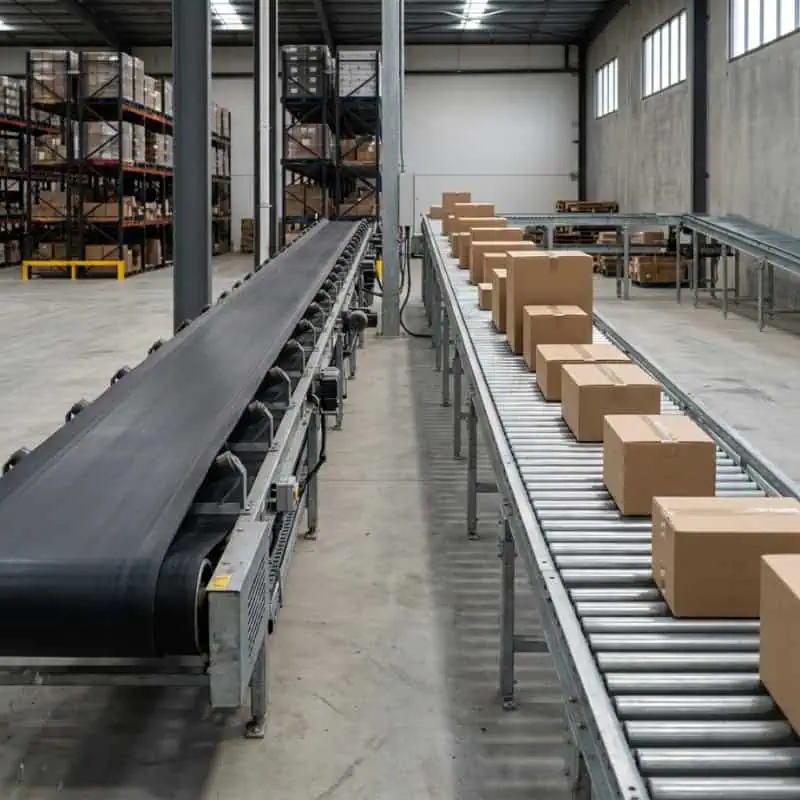
A gravity roller conveyor is an unpowered line of rollers set in a frame, along which goods move under their own weight when the line is set on a slight slope, or with a push on the flat. There’s no motor and no power supply; gravity and a gentle gradient do the work. The rollers are typically galvanised for durability, and the conveyor comes in straight and curved sections that join together, so you can build a line that turns corners and runs where you need it. Adjustable stands let you set the height and the fall of the line to suit the job. Because it’s simple and has no motor, a gravity roller conveyor is low-cost to run and low-maintenance, which is a big part of its appeal. It’s ideally suited to moving boxed, packaged or palletised goods along a line, which is why you see it so often in packing, dispatch and warehouse settings.
What is a powered belt conveyor?
A powered belt conveyor uses a motor-driven belt to carry material along its run, so movement doesn’t depend on gravity or a slope. This is what makes it the right tool for loose and bulk material, such as soil, sand, spoil, gravel or mixed debris, which can’t simply roll along like a box can. Because the belt is driven, it can move material uphill and maintain a constant, steady flow regardless of gradient, feeding material into or out of a space at a reliable rate. Portable belt conveyors are especially handy on constrained sites, where they can be positioned to carry material out of a tight spot to a bin or truck. The trade-off compared with gravity rollers is that a belt conveyor needs power and has a motor to maintain, but for loose material, uphill runs or constant throughput, that’s a worthwhile exchange. Our belt conveyor hire covers these powered options for exactly this kind of work.
Gravity rollers vs powered conveyors: the decision factors
The choice comes down to a handful of practical factors. Weighing them against your job usually makes the answer clear:
| Factor | Gravity rollers | Powered belt conveyor |
| Material type | Boxed, packaged or palletised goods | Loose or bulk material (soil, sand, debris) |
| Gradient | Needs a slight slope, or a push, to move | Moves material on the flat or uphill |
| Throughput | Depends on gravity and operators feeding it | Constant, steady flow set by the motor |
| Power | None required | Needs a power supply |
| Cost and maintenance | Lower to run, simple and low-maintenance | Higher running cost, a motor to maintain |
In short, if you’re moving boxes and can set a slight fall, gravity rollers are the simpler, cheaper choice. If you’re moving loose material, running uphill, or need a constant flow that doesn’t rely on gravity, a powered belt conveyor is the tool for the job. Many operations use both, rollers for the packaged side and a belt for bulk material, which is often the most efficient setup of all.
Best uses on Australian sites and warehouses
Seeing the two in their natural settings makes the choice concrete. In a warehouse packing and dispatch area, gravity rollers are hard to beat: cartons roll along the line from packing to loading under their own weight, no power needed, and curved sections route them around the space. For earthworks and site work moving soil, spoil or gravel, a powered belt conveyor carries the loose material steadily to a bin, truck or the next stage, doing work that would be brutally slow by barrow. On a tight metro renovation, a portable belt conveyor is often the standout, positioned to move demolition debris or bulk material out of a constrained space to a skip at the front. And in mixed operations, the two work side by side, with a belt handling bulk and rollers handling packaged goods. The pattern to remember is simple: rollers for boxed goods on a warehouse or dispatch line, belt for loose material and bulk on sites, and a portable belt where access is tight. Matching the conveyor to the setting is what gets the best result for the money.
Hiring gravity rollers: what to specify
When you come to hire, having a few details ready makes it easy to match the right line to your job. It helps to think through the load, roughly how heavy the items are and their size, so the rollers and frame suit what you’re moving; the frame width, so the line fits your goods and space; whether you need straight sections only or curved sections too, so the line can turn where your layout requires; and the stand height and fall you need, so the line sits at a comfortable working height and runs at the right slope. You’ll also want to consider the length of run and how the line connects to your process at each end. You don’t need exact figures to start the conversation; these are simply the questions worth answering so the setup fits your operation from day one.
Frequently asked questions
Do gravity rollers need power?
No. Gravity roller conveyors are unpowered; goods move along the rollers under their own weight when the line is on a slight slope, or with a light push on the flat. Because there’s no motor, they’re lower cost to run and low-maintenance, which is a key advantage over powered conveyors for moving boxed and packaged goods along a line.
How much weight can gravity rollers hold?
It depends on the rollers and frame you choose, as different setups suit different loads. Rather than assume a figure, it’s best to confirm the weight of your goods when you enquire, so the line is matched to what you’re moving. Tell us the load, and we’ll specify rollers and a frame rated for it.
Can gravity roller lines have curves?
Yes. Gravity roller conveyors come in straight and curved sections that join together, so a line can turn corners and route around your space rather than running only in a straight line. Curved sections connect to the straight frames to build a layout that suits your warehouse or dispatch area, which is one reason rollers are so flexible.
Final thoughts
Choosing between gravity rollers and a powered belt conveyor comes down to what you’re moving and the gradient: rollers for boxed goods on a line that can slope, a powered belt for loose material, uphill runs or constant throughput. Match the conveyor to the material, and many jobs use both. Tell Conveying & Hoisting Solutions your load, site access and timeframe and we’ll match the right gear; then request a quote today.
| Conveying & Hoisting Solutions
Not sure which conveyor suits your line? Tell us your load, site access and timeframe, and we’ll match the right hire gear for the job. |