
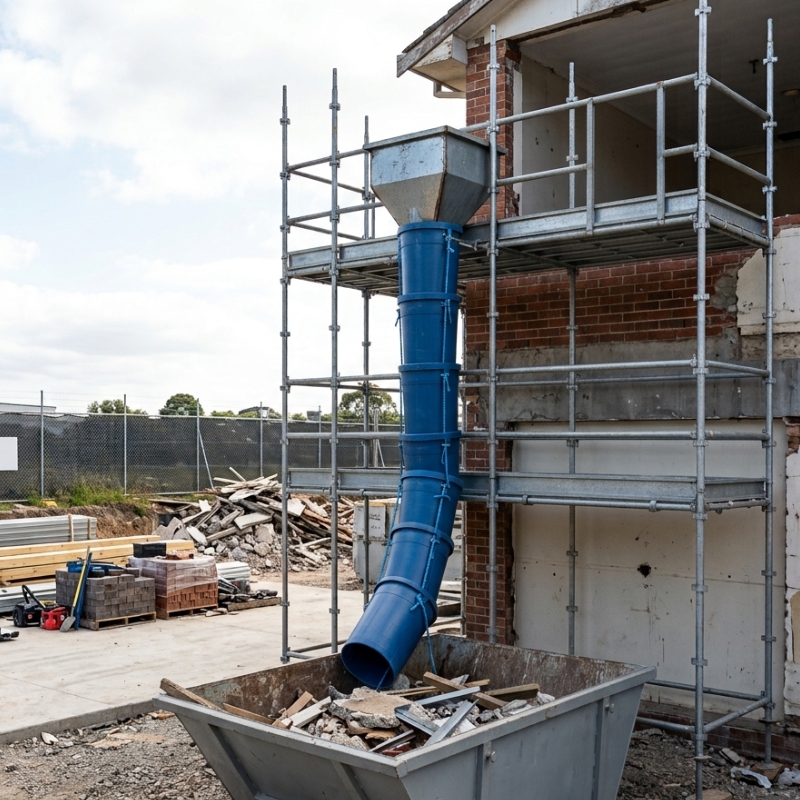
Why Material Choice Matters on Site
From the street, a rubbish chute looks like a simple plastic tube, yet the material linking the hopper to the skip decides how smoothly demolition waste travels, how loud the site sounds at 7 am and how many labourers you need on the scaffold. Most local hire fleets carry two types: light rotational-moulded polyethylene and heavier welded steel. Before booking, you’ll want to know which one fits your site, your schedule and the neighbours’ patience. When comparing rubbish chute hire options, both systems can be effective in the right situation. The key is understanding when each one delivers the best value for your project.
Common Materials on the Market
| Feature | Lightweight Polyethylene | Heavy-Duty Steel |
| Typical segment length | 1 – 1.2 m | 1 m |
| Average segment weight | 7 – 9 kg | 18 – 23 kg |
| Recommended drop height* | Up to 20 m | 20 m + |
| Best for | Renovations, tight access, short hires | Demolition, high-rise, abrasive waste |
| Noise level | Noticeably quieter | Louder on impact |
| Setup crew | Two workers with basic hand tools | Two-plus workers and lifting aid |
| Availability across Australia | Widely stocked | Often limited stock |
*Always follow the engineer’s or supplier’s advice for your exact load.
Polyethylene segments are rotational-moulded, giving a smooth interior that allows less material to be slowed. The lighter weight means installers can hand-ball sections up scaffolding without mechanical lifting, an advantage on suburban renovations where tower cranes are absent. Steel chutes, on the other hand, are welded from plate or rolled sections. The extra mass shrugs off brick and concrete fragments that might gouge plastic, but you pay with heavier lifting needs and higher noise as rubble hits each joint.
Matching Material to Project Conditions
Three site factors usually decide the winner.
Weather exposure
• Northern Australia’s UV index is brutal. Long hours in Cairns or Darwin can fade cheaper plastics and make them brittle. Premium polyethylene with UV stabiliser usually copes, yet a six-month demo through the build-up season may justify steel.
• In southern states, hail risk on exposed upper runs can dent thin-gauge steel and crack budget plastic alike. Look for 5 mm-plus wall thickness in either material.
Waste type
Gyprock, timber off-cuts and light demolition rubble glide down plastic happily. Reinforced concrete and rebar off-cuts chew through plastic lips on impact; steel turns those impacts into vibration and noise but rarely deforms. Choosing the right chute material shows how rubbish chutes improve waste management by making debris removal safer, faster and better suited to the demands of each demolition project. If you know the demo scope includes heavy core drilling or large brick quantities, steel earns its keep.
Site access
Inner-city terraces rarely give you crane or telehandler space. Two carpenters can rope-suspend 10 polyethylene segments off a scaffold in under an hour. Attempting the same with steel quickly blows out labour allowances and can breach manual handling limits.
Safety, Noise and Environmental Factors
Safety regulators focus less on the material and more on secure anchoring, fall protection and dust suppression, yet material choice still affects compliance. Steel units usually come with integrated frames or collars that bolt directly to concrete slabs, satisfying engineers on high-rise sites. Poly systems rely on top-frame brackets clamped to scaffold ledgers, perfectly acceptable when the scaffold is rated for the extra point load.
Noise carries surprising distances. A 15-metre plastic chute filled with gyprock registers around 80 dB at ground level, similar to heavy traffic. Swap to steel and impact peaks jump above 100 dB, triggering mandatory hearing protection and potential council complaints on early morning pours. Adding internal rubber curtains helps but rarely eliminates the clang. Where councils impose strict noise windows, polyethylene buys breathing room.
Dust is another sore point. Plastic tends to generate less internal abrasion, meaning fewer fine particles escape vents. Where silica exposure is already under scrutiny, particularly on concrete demo, pairing a poly chute with a simple misting nozzle at the hopper reduces airborne dust dramatically.
Finally, end-of-life recycling differs. Polyethylene segments can be ground and remoulded; steel can go straight to the scrap yard. Both beat timber site-built trash towers, yet considering disposal aligns your hiring decision with the waste-hierarchy obligations in state Environment Protection Policies.
Making the Rental Decision
Each project balances duration, waste stream, height and community expectations. A practical rule of thumb: up to 20 metres and mostly light materials, pick polyethylene; beyond that, or if rubble is chunky and abrasive, specify steel. Where the decision sits on the fence, ask for a mixed run, poly in the top third to cut weight on the scaffold, steel on the impact-heavy lower metres. Many rental fleets can combine systems with an intermediate coupling.
State safety codes back this blended approach. Safe Work Australia’s construction guidance reminds builders to “ensure waste landing areas and disposal systems are compatible with the material being removed”, wording that keeps the door open for mixed materials so long as the connection is engineered. You can read the full update at Safe Work Australia’s construction resource hub.
Experienced hire companies will also quote on delivery logistics, install crew and removal timing in one package, allowing you to compare apples with apples. Don’t forget the small print: replacement fees for damaged segments differ wildly. Poly sections are cheaper to replace but easier to nick or crush with plant. Steel survives punishment, but dents beyond a certain point can attract the same penalty as a break in plastic.
Final Thoughts
Polyethylene earns its popularity on fast-moving renovation and fit-out jobs across the suburbs. It’s light, quiet and quick to sling from a simple frame. Steel remains the dependable pick for tower demos, long hires under fierce sun and any situation where chunks of reinforced concrete tumble unchecked. When evaluating quotes, pair material to waste, height and surrounding sensitivity rather than headline price alone, you’ll avoid downtime, neighbour complaints and extra labour you didn’t budget.