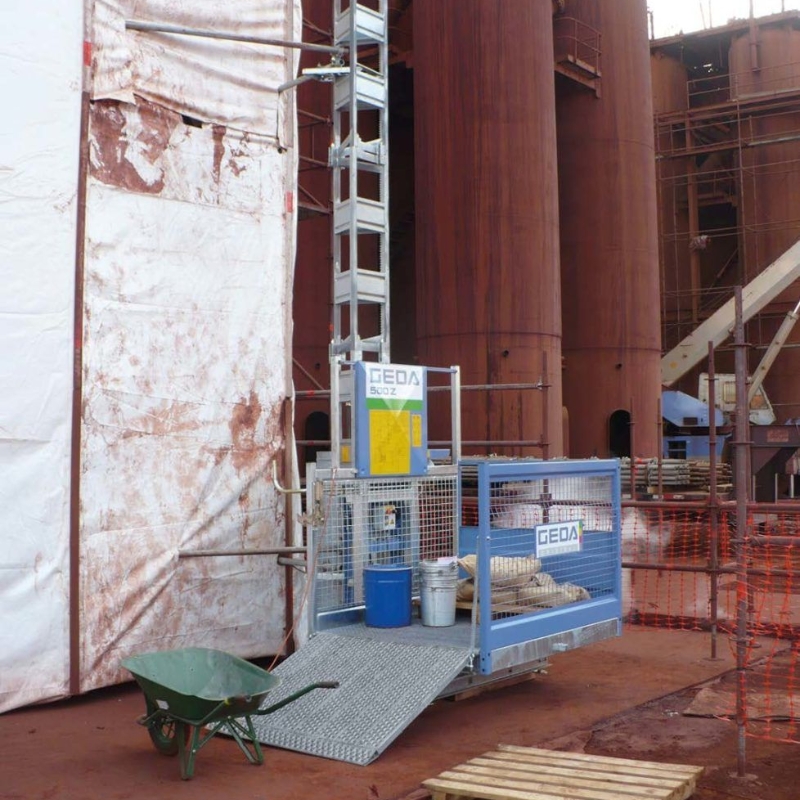
Every year, thousands of tradies strain backs, shoulders and knees shifting bricks, boards and bags around sites. Safe Work Australia still lists hazardous manual tasks among the top causes of lost-time injuries in construction. While better training and team lifts help, they rarely eliminate the core issue: people are still moving heavy or awkward loads by hand. Introducing a mechanical lifter moves that risk away from the body. When used correctly, material hoists available for hire shift kilograms, not workers’ spines, freeing teams to focus on installation, finishing and quality instead of brute force.
In this article, we look at why manual handling injuries persist, how material hoists interrupt that injury chain, and the practical steps builders can take to integrate hoists into everyday workflows without blowing the budget or the schedule.
Why Manual Handling Injuries Persist on Australian Construction Sites
Despite decades of safety campaigns, manual-handling strains remain stubbornly common. Several factors keep the numbers high.
- Tight timeframes: Builders often rush to meet program milestones, so staff take shortcuts like one-person lifts or carrying too much weight.
- Multi-storey works: Moving supplies up scaffold stairs or internal frames demands repeated awkward lifting and twisting.
- Infill and renovation sites: Compact urban footprints make crane access impossible, leaving workers to muscle materials through doorways or balconies.
- Culture: Some crews still see asking for mechanical help as a sign of weakness or wasted time.
- Task variability: Unlike a factory line, every day on a building site brings new load types and routes, making it hard to engineer a one-size-fits-all solution.
Australian WHS regulations expect a “hierarchy of control”, meaning companies must eliminate or, where that is not possible, substitute hazardous manual tasks with a safer method. Material hoists fall squarely in that substitution tier, turning human lifting into supervised machine movement.
How a Material Hoist Changes the Lifting Equation
Material hoists are purpose-built machines that raise bricks, timber, plasterboard, roof sheets, fixtures or demolition waste to upper levels or down to ground without a person carrying the load. They alter three main risk factors.
- Load weight
• Manual task: A worker may attempt to carry a 25 kg bag of cement up flights of stairs dozens of times a day.
• With hoist: The platform takes the weight, keeping each lift within the equipment’s rated capacity and removing cumulative strain.
- Body posture
• Manual task: Twisting through stairwell landings or leaning over guardrails strains backs and shoulders.
• With hoist: Operators stay on level surfaces, controlling the lift with a pendant or remote.
- Repetition
• Manual task: High volume lifts multiply exposure to risk.
• With hoist: One lift can move multiple items together, reducing cycles.
By shifting weight onto machinery, hoists interrupt the kinetic chain that causes musculoskeletal disorders (MSDs). Fewer awkward lifts mean fewer micro-tears, inflammation episodes and chronic pain claims.
Quick comparison: manual lift vs hoist use
Below summarises how the same task looks with and without a hoist.
| Situation | Manual-Handling Risk | Using a Material Hoist | Suggested Control Measure |
| Moving pallets of bricks to level two | High spinal load, crush risk on stairs | Weight secured on the platform, remote lift | Hoist with a rated brick cage |
| Removing demolition waste from level four | Heavy, unstable debris carried down stairs | Debris was lowered in skips | Hoist chute or skip attachment |
| Delivering roofing sheets to a pitched roof | Carried up the ladder, risk of falls and strain | Sheets lifted in one bundle to the roof edge | Hoist with sheet cradle and spotter |
| Daily plasterboard supply to internal levels | Boards lifted, causing wrist and shoulder strain | Stacks were raised vertically and then slid onto trestles | Board carrier attachment |
The table shows how hoists replace people-powered lifts with mechanical motion, in line with WHS expectations.
Common Injury Scenarios a Hoist Can Eliminate
Let’s look at real-world tasks where hoists dramatically cut risk.
Brick and block delivery
Bricklayers often set up on suspended slabs or scaffold decks. Without a hoist, labourers carry packs upstairs or load wheelbarrows onto plank ramps, risking slips and overexertion. A cage sling or brick basket lifted by a hoist keeps pallets intact and workers on a stable footing.
Fit-out materials
Drywall sheets, windows and joinery are large yet relatively light, tempting single-person lifts. Edges catch the wind or walls, forcing sudden twists. A hoist can raise an entire bundle to the installation level in one motion, allowing ergonomic team handling at height.
Waste removal
Demolition rubble is jagged and dusty. Carrying buckets down stairwells exposes workers to cuts, trips and silica dust. Attaching a debris skip to a hoist confines dust and limits handling to controlled loading and unloading zones.
Roof restorations
During re-roofing projects, tile stacks or solar panels must reach roof height repeatedly. Ladder lifts, or compact hoists, position loads right beside the roof, keeping installers clipped on and balanced instead of hauling items up ladders.
Selecting the Right Hoist to Prevent Injuries
Choosing the safest unit involves more than checking the weight chart.
Assess the load type and frequency
• Dense loads like concrete lintels need higher SWL and robust cages.
• Bulky but light loads, such as insulation, may need bigger platforms rather than higher capacity.
• High cycle rates point to electric chain-drive hoists rather than manual winches.
Map the travel path
• Measure vertical lift distance and landing zones.
• Confirm tie-in points on the scaffold or building structure meet engineering requirements.
• Ensure exclusion zones around the base and landing remain clear of traffic.
Factor in site constraints
• Narrow laneways or inner-city footpaths may limit mast or gantry footprints.
• Overhead power lines demand increased clearance or insulated barriers.
• Noise restrictions can steer builders towards quieter battery-powered models.
Verify compliance
Hoists classed as powered plant must meet AS 2550.16 and be inspected by a competent person before use. Always keep logbooks for site safety files.
Mistakes to Avoid When Using Material Hoists
Even the best equipment can introduce new hazards if misused.
- Overloading the platform: Exceeding SWL shortens component life and can lead to sudden failure. Weigh batches or use manufacturer-stated capacities for standard materials.
- Poor ground conditions: A sloping or unstable base shifts mast alignment and increases stress on anchors. Level and compact ground, or spread load using timber sleepers or steel plates.
- Skipping daily checks: Fasteners, limit switches and pendant cables wear. Five-minute visual inspections catch issues before the shift starts.
- Inadequate exclusion zones: Falling objects injure passers-by. Set up barricades and signage around both base and landing levels.
- Insufficient training: Operators must understand load balance, emergency stop functions and hand-signal communication. Toolbox talks beat assumptions.
Avoiding these errors keeps the injury-reduction benefits intact.
Compliance and Best Practice Under Australian WHS Laws
Safe Work Australia’s model WHS regulations require employers to eliminate or minimise manual-handling risks “so far as is reasonably practicable”. Substituting manual lifts with mechanical aids like hoists is a preferred control. According to recent Safe Work Australia data, musculoskeletal disorders still account for roughly one-third of serious workers’ compensation claims in construction, with body stress from lifting and carrying topping the list. Regulators and insurers increasingly expect demonstrable controls rather than posters alone.
Key obligations include:
• Documenting a risk assessment, identifying manual-handling hazards and how the hoist removes them.
• Ensuring the hoist is installed, operated and maintained in line with manufacturer instructions and relevant Australian Standards.
• Providing adequate supervision and refresher training.
• Keeping maintenance records and pre-start checklists available for inspectors.
Many principal contractors now ask subcontractors to show that high-frequency lifts over daily weight limits are either redesigned or mechanised. A hoist plan can be the simplest proof.
Where Hoists Fit in a Broader Manual-Handling Strategy
Material hoists are one control among several. They work best when paired with:
• Conveyors or rubbish chutes for horizontal or downward movement.
• Trolleys and dollies to roll loads from the hoist landing to the installation point.
• Job sequencing that minimises double handling.
For a wider look at pairing different systems, see our guide on reducing manual handling injuries on construction sites.
Questions to Ask Before Deciding a Hoist Is the Answer
- How many vertical lifts will we perform each shift, and can we batch them?
- Where can we install a mast without blocking emergency egress or public footpaths?
- Do our loads fit safely within standard baskets, or do we need custom attachments?
- Is there an adequate power supply, or should we consider battery units?
- Can other engineering controls further reduce manual handling once the load reaches its landing point?
Clarifying these points with the site engineer and the hiring company prevents on-site surprises.
FAQs
1. Do material hoists remove the need for manual lifting completely?
Not entirely. Workers still need to load and unload the platform, but the most hazardous part, carrying the weight up or down levels, is eliminated. Team lifts and trolleys at each end further cut strain.
2. Are hoists only suitable for new-build high-rise projects?
No. Compact rack-and-pinion or ladder-type hoists fit tight renovation sites, inner-city terraces and even backyard extensions where cranes cannot access.
3. Do I need an operator’s licence to run a small material hoist?
For most units under two tonnes or specific platform sizes, a high-risk work licence is not required. However, operators must still be trained in safe use, emergency procedures and load limits. Check state-based rules.
4. How often must a construction hoist be inspected?
Australian Standards generally require a major inspection every 12 months and frequent visual checks daily or weekly, depending on duty cycle. Always refer to the manufacturer’s schedule.
5. What happens if the weather turns bad during a lift?
High winds can swing or overload the hoist. Most sites set wind speed stop-work thresholds and secure loads or lower empty platforms when storms approach.
Final Thoughts
Construction will always involve some degree of physical effort, but carrying heavy gear between levels no longer needs to be part of the job. A correctly selected and installed material hoist cuts the most damaging lifts, helps crews stay fit for work and demonstrates compliance with Australia’s hierarchy of control. If recurring back strains or near misses are creeping into your site reports, exploring a hoist solution could be the practical next step toward a safer, more productive build.