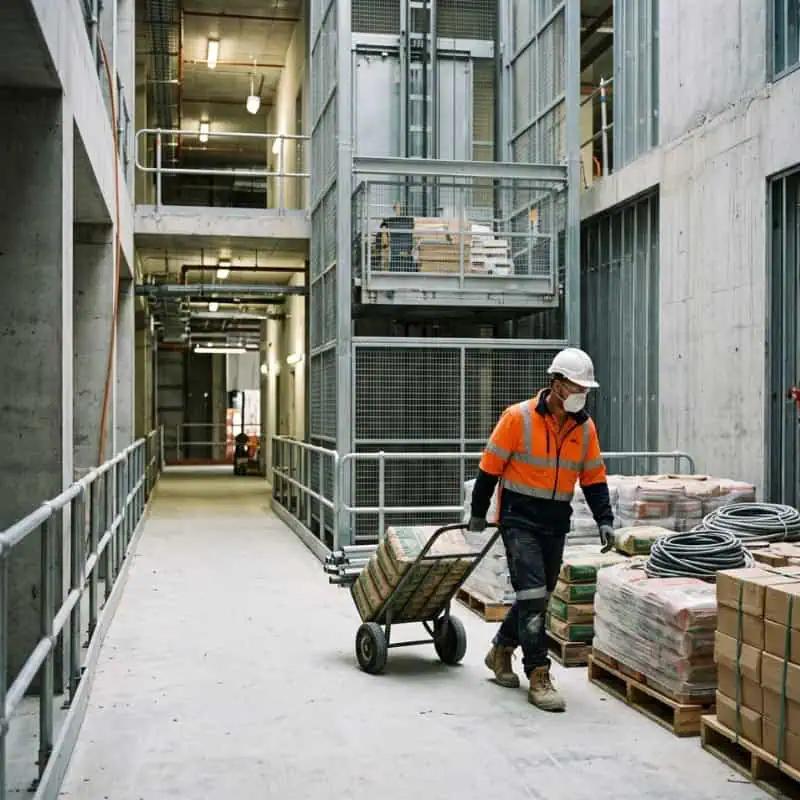
Manual handling injuries don’t usually come from one heroic lift. They build up from the daily grind: carrying packs up stairs, twisting with awkward loads, wrestling plasterboard through tight corridors, dragging bins across rough ground, and “just quickly” shifting materials because the delivery dropped in the wrong place.
On Sydney sites, the risk ramps up even more. Space is tight. Access changes weekly. Deliveries are time-windowed. Upper levels might be a walk-up for longer than anyone wants to admit. The result is predictable: fatigue, shortcuts, and avoidable injuries.
This guide is about reducing those injuries by improving the system, not just repeating “lift with your legs”. You’ll learn how to redesign material flow so people handle less, carry shorter distances, and use mechanical movement options earlier and more consistently.
What counts as a manual handling risk on a construction site?
On construction sites, manual handling risk isn’t only “heavy lifting”. It’s any task that involves forceful exertion, awkward postures, repetitive movements, sustained positions, or unstable loads. Think:
• Carrying plasterboard, doors, sheets, or long lengths through tight spaces
• Repeatedly lifting bags, boxes, buckets, or bundles from floor level
• Twisting while holding loads close to the body (or worse, away from it)
• Pushing wheelbarrows over uneven ground or up grades
• Pulling materials out of utes, cages, or stacked pallets without good access
• Handling awkward items in the wind (tarps, insulation, long frames)
The key idea: injuries spike when high force combines with awkward posture and repetition. If you can remove even one of those factors, you usually cut risk dramatically.
Why are the upper levels a hotspot for injuries
Upper-level work adds three injury multipliers:
• Extra distance: more steps, more turns, more “just one more trip”
• Constrained access: narrow stairwells, temporary lighting, changing edges, clutter
• Time pressure: crews feel behind, so they carry more at once and skip planning
If you’re seeing sore backs, shoulder strains, or tendon pain late in the week, it’s often because material flow to upper levels is inefficient. Fixing that flow is one of the highest-return safety moves you can make.
Q&A: What’s the best way to move materials to upper levels?
The best way is usually a combination of:
• Plan deliveries so materials land as close as possible to their point-of-use (right level, right zone)
• Minimise carry distance with staging areas and clear routes
• Use mechanical vertical movement early (not only when the job is already behind)
• Break loads into stable, manageable units and avoid awkward carries
If people are regularly carrying building materials up stairs, your system is doing too much “manual work” by default.
Build a “smarter material movement system” using five levers
When you step back, most material handling risk comes down to five controllable levers. Improve these, and injuries tend to drop fast.
1) Delivery planning and sequencing
A surprising amount of manual handling happens because materials arrive at the wrong time, in the wrong quantities, or in the wrong place. Fixing deliveries reduces handling before anyone touches a load.
Practical moves:
• Set a delivery “drop map”: where does each trade’s material land and where is it staged?
• Sequence deliveries so heavy/bulky items arrive when access is best (not after corridors are blocked)
• Use smaller, more frequent drops for high-risk items rather than one massive delivery that gets double-handled
• Avoid mixed pallets that force people to unpack and restack repeatedly
Q&A: Isn’t delivery planning just a productivity thing?
It’s a safety control. Every unnecessary re-handle adds force, repetition, and fatigue. When your delivery flow is right, people lift less, carry less, and rush less.
2) Site layout and “flow” (the hidden safety control)
Good sites have clear material “highways”. Bad sites have obstacle courses.
A safer flow includes:
• Dedicated laydown zones (even if small)
• Clear, marked routes kept free of offcuts and packaging
• Lighting that supports safe footing and good visibility
• Waste systems that don’t require carrying rubbish back through work areas
Sydney-specific reality: when you’re tight on space, flow matters even more. If you can’t create big laydown zones, focus on keeping one or two key routes reliably clear. Consistency beats chaos.
3) Staging on the correct level and zone
If materials are delivered to the ground and then carried by hand to upper levels, you’ve created a two-step problem:
- Someone handles it once to move it off the delivery
- Someone handles it again to get it where it’s used
Better approach:
• Stage materials on the level they’ll be used (or as close as possible)
• Create “micro-stages” near work fronts so teams aren’t constantly fetching
• Use signage so everyone knows what belongs where (and what doesn’t)
Q&A: How do you stop staged materials from becoming a trip hazard?
Keep stage areas defined, sized, and reviewed. The trick is “no staging”; it’s “controlled staging” with clear boundaries and regular housekeeping.
4) Mechanical aids for horizontal movement (don’t skip the basics)
Not every site needs advanced gear to improve manual handling. Often, the biggest wins come from simple mechanical aids used consistently.
Examples:
• Trolleys suited to the surface and load type
• Pallet jacks for stable palletised loads
• Lift tables or scissor lifts for reducing bending at low heights
• Carts designed for plasterboard, frames, or boxes
• Wheeled bins and chutes that reduce carrying rubbish
Common failure mode: the trolley exists, but it’s always “somewhere else”, or the wheels aren’t maintained, or it doesn’t fit the route. If it’s hard to use, people won’t use it.
Make mechanical aids easy:
• Store them at the point-of-need, not the site office
• Maintain wheels, brakes, and handles so they glide, not fight back
• Match the tool to the task (wrong trolley = still manual handling, just louder)
5) Mechanical options for vertical movement (upper levels)
This is where injury reduction can jump significantly. If materials are routinely carried to upper levels, you’re relying on people to be the lifting system.
Smarter approach:
• Design the job so materials move up mechanically, then move short distances horizontally
• Prioritise high-risk materials first (plasterboard, tile boxes, bagged materials, framing packs)
• Set simple rules: “If it’s over X kg, awkward, or repetitive, it doesn’t go up by hand.”
If your site needs a dedicated pathway for vertical movement, it’s worth understanding how learning about materials hoists for building sites can fit into the overall system, especially where stair carries are becoming the default. (Internal link)
A practical hierarchy: reduce risk before you “train better lifting”
Many sites start with training. Training matters, but it’s not the highest-leverage control on its own.
A better order looks like this:
• Eliminate unnecessary handling (deliver to the correct location, avoid double-handling)
• Engineer the system (routes, staging, mechanical aids)
• Admin controls (limits, job rotation, pre-start checks, supervision)
• PPE as last line (gloves for grip, etc. — not a solution for poor flow)
This is why “smarter material movement systems” are powerful: they reduce exposure at the source.
The “materials movement plan” you can use tomorrow
You don’t need a thick folder. You need clarity.
Step 1: List your top 10 handled items
Examples:
• Plasterboard sheets
• Tile boxes
• Bags of cement/adhesive
• Stud packs
• Windows/doors
• Toolboxes and consumables
• Waste bins
• Joinery components
Step 2: For each item, answer 4 questions
• Where does it arrive (gate/kerb/laydown)?
>>>• Where is it used (level/zone)?
>>>• How will it travel horizontally?
>>>• How will it travel vertically?
Step 3: Identify “red flag” movements
Red flags include:
• Stair carries repeated more than a few times per day
• Loads that require twisting or long reaches
• Items that need two people because they’re awkward, not heavy
• Carry paths with uneven ground, ramps, or clutter
• Handling in wind-exposed areas
Step 4: Lock in rules and responsibilities
Examples:
• Who controls delivery placement?
• Who maintains and stores mechanical aids?
• Who checks routes and stage areas each morning?
• What tasks are banned for solo handling?
Q&A: What’s the simplest rule that reduces injuries fast?
Stop routine stair carries of materials. If moving materials upstairs is a daily habit, redesign the flow: stage closer, deliver smarter, and use mechanical vertical movement.
Reducing injuries during common high-risk tasks
Carrying plasterboard and sheet materials
Common injury drivers:
• Awkward grip, long lever arm, shoulder elevation, twisting through doorways
Better system:
• Deliver/stage sheets as close as possible to the install zone
• Use purpose-built sheet trolleys that handle corners and corridors
• Keep routes clear and corners protected
• Use team lifts only when necessary and planned (not improvised)
Moving bagged materials (cement, adhesive, grout)
Common injury drivers:
• Repetition, bending, carrying distance, “one more bag” fatigue
Better system:
• Smaller drops staged on the level
• Raise bag height (pallets, lift tables) to reduce floor-level lifting
• Use carts designed for stable loads
• Reduce returns: deliver the right quantity to the right zone
Waste and offcuts
Common injury drivers:
• Carrying awkward rubbish, sharp edges, repeated trips, if your site is near bins
Better system:
• Put waste where it’s created (more small bins, fewer long carries)
• Use wheeled bins and chutes where possible
• Create rules for bundling and weight limits
• Schedule clean-downs to prevent “end of day” rushed carries
Q&A: What about “just being tougher” and getting the job done?
Fatigue is not toughness. Fatigue increases risk and reduces quality. If the system makes people carry constantly, the system is the issue.
Site supervision: what to look for on a walk-through
A quick supervisor scan can reveal whether the material movement system is working.
Look for:
• Are people carrying materials up stairs? (If yes, why?)
• Are mechanical aids easy to find and in good condition?
• Do stage areas match the work fronts?
• Are routes clear, lit, and consistent?
• Are there bottlenecks where people twist, reach, or stop abruptly?
• Are deliveries causing re-stacking and double-handling?
If you see repeated manual carries, especially to upper levels, that’s a sign to review the best way to move materials to upper levels in your plan and switch the default from “manual” to “mechanical”. (Internal link)
Training that actually supports the system
Training should reinforce the system, not compensate for a bad one.
Better training focuses on:
• Recognising hazardous manual task risk factors (force, posture, repetition, duration)
• Using mechanical aids correctly (and choosing the right one)
• Setting up safe carry paths and stage zones
• Clear escalation: when to stop and redesign the task
A small upgrade: include “materials movement” in pre-starts, not just general lifting tips.
When manual handling risk becomes a design and planning problem
Some tasks should trigger a redesign conversation immediately:
• Repeated lifts from floor level for more than a short period
• Loads that can’t be held close to the body
• Tasks that require twisting while loaded
• Work in tight access areas where turning is constant
• Repetitive stair carries or ladder moves
• Handling in exposed wind areas with unstable loads
These are “system” triggers. They mean you need a better route, staging, or mechanical option—not just a reminder to be careful.
A NSW-friendly reference point for hazardous manual tasks
For NSW sites, SafeWork NSW’s guidance on hazardous manual tasks is a solid authority reference for understanding risk factors and control thinking. Here it is, if you want the official framing while you build your site controls: SafeWork NSW guidance on hazardous manual tasks.
Practical checklist: safer material movement system (site-ready)
Use this as a weekly reset.
Plan and deliveries
• Materials are delivered to the closest safe point to use
• High-risk materials are scheduled when access is best
• Mixed pallets that cause restacking are avoided
• Quantities match stages (less double-handling)
Routes and layout
• Key routes are clear, lit, and stable underfoot
• Bottlenecks and pinch points are identified and controlled
• Stage zones are defined and do not block egress
Mechanical movement
• Mechanical aids exist, are maintained, and stored at the point of need
• High-risk loads have a default mechanical method
• Upper-level movement is planned so stair carries aren’t routine
People and supervision
• Pre-starts include material flow risks for the day
• Weight/size rules are enforced (and realistic)
• Workers can escalate unsafe manual tasks without pushback
Q&A: What’s the fastest way to reduce manual handling injuries this month?
Start by removing the most repetitive, awkward carries—usually trips to upper levels, bagged materials, and rubbish runs. Fix the system (delivery, staging, routes, mechanical aids) so manual lifting becomes the exception, not the default.
FAQ
What are hazardous manual tasks in construction?
They’re tasks involving forceful exertion, awkward postures, repetitive movements, sustained positions, or unstable loads that increase the risk of musculoskeletal injuries.
What causes most manual handling injuries on-site?
Usually, a combination of poor layout, long carry distances, floor-level lifting, repetitive handling, and time pressure—especially when materials are moved multiple times.
How can you reduce carrying materials up stairs?
Redesign the flow so materials are staged on the right level, deliveries are sequenced properly, and a mechanical method is used for vertical movement wherever practical.
Are team lifts a good solution?
Sometimes, but they’re often a sign that the load is awkward or the system needs improvement. Team lifts can still create twisting and uneven loading if the route is tight.
What should a supervisor check daily?
Routes (clear and stable), stage zones (controlled), equipment (available and working), and whether anyone is doing repetitive stair carries or rushed manual handling.
How do you choose the right material movement method?
Consider the load (weight, size, stability), the route (distance, surface, turns), and the frequency. The more repetitive or awkward the task, the more you should shift to mechanical aids and better staging.