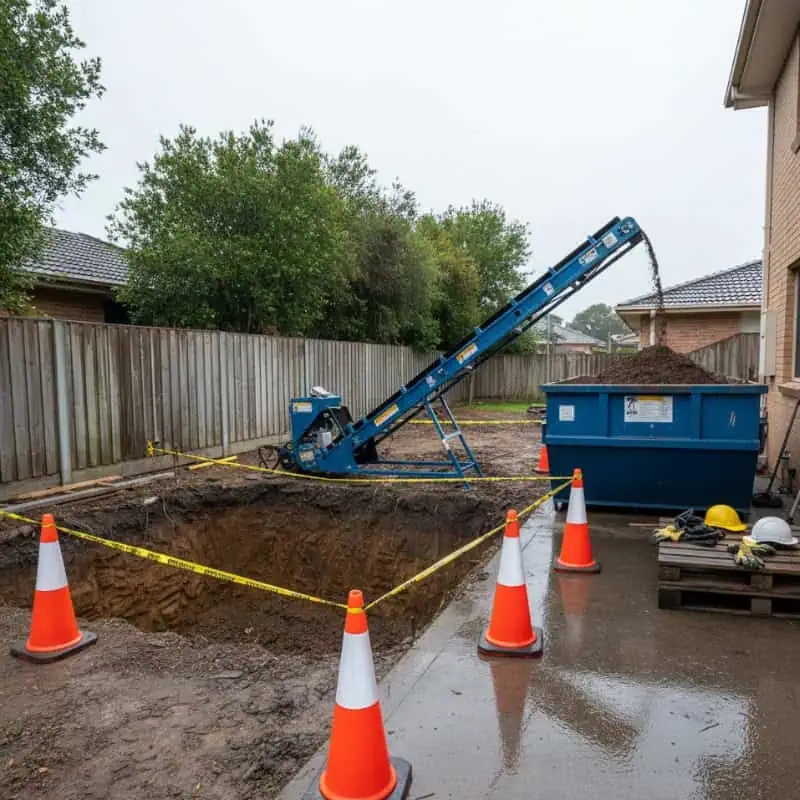
Portable conveyors are one of those bits of site plant that look simple until the job gets messy: uneven ground, wet spoil, tight access, mixed rubble, rushed handovers between trades, and a thousand “quick” adjustments that slowly stack risk.
This guide is a Sydney-focused, practical checklist you can use to set up a portable conveyor so it runs smoothly, moves material predictably, and reduces the common hazards that show up around belts, pulleys, and transfer points. It’s written for real worksites, not perfect factory floors.
Along the way, you’ll see short Q&As you can drop into a toolbox talk, plus a final FAQ to help settle common arguments on site (like belt drift, steep angles, and what to do when it blocks).
Before you unload anything: 60-second job planning check
Start here. Most “conveyor problems” are actually planning problems: wrong placement, wrong angle, wrong loading point, or no room for safe access.
Use this quick scan before the conveyor comes off the trailer/ute:
- Confirm the material type: dry soil, wet clay, sand, demolition rubble, rock, green waste
- Confirm the flow: where it’s coming from, where it’s landing, and how it will be removed from the landing zone
- Confirm constraints: narrow side access, backyard gates, basement stairs, neighbours, overhead services, pedestrian interfaces
- Confirm ground conditions: soft fill, slope, muddy patches after rain, pavers, excavator pads, trench edges
- Confirm who is “hands-on”: one nominated operator (and a clear stop/start signal if visibility is limited)
Q&A: What’s the most common set-up mistake on Sydney residential jobs?
Putting the conveyor where it “fits”, not where it “flows”. Tight-access sites in Sydney often force compromises, but you still need a straight, stable run, room for exclusion zones, and a landing area that won’t become a trip/slip pile-up after 20 minutes.
Checklist 1: Choose the right placement (stability first, then speed)
Portable conveyors don’t forgive poor foundations. Belt tracking issues, spillage, and sudden movement usually start with a conveyor that isn’t stable or level.
Work through this checklist:
- Place the conveyor on firm, even ground wherever possible
- Keep it back from trench edges, voids, and unsupported fills
- Avoid setting up on loose rubble that can shift under vibration
- If you must set up on a slope, create a stable platform (packed base, mats/cribbing as appropriate)
- Ensure the conveyor is straight along its intended line of travel (avoid twisting the frame to “aim” the discharge)
- Leave clearance for safe access around pinch-point areas and for emergency stopping
If you’re still deciding which unit or configuration best suits your site constraints, review your internal reference on portable conveyor options.
What “stable” looks like in practice
Stable means the conveyor doesn’t rock under load, the feet don’t creep as the belt starts and stops, and the discharge end doesn’t bounce enough to throw material. On wet Sydney clay after rain, “stable” might mean you’re building a small pad rather than trusting the ground.
Q&A: Can I put a portable conveyor on pavers or a driveway?
Sometimes, yes — but protect surfaces, manage movement, and watch for vibration creep. The bigger question is whether the area stays safe as spoil builds up. If material piles at the tail/landing zones, your safe walking path disappears quickly.
Checklist 2: Set your angle and length for the material you’re moving
Angle affects everything: throughput, spillage, belt slip, and carryback (material that rides back down the belt).
Use these practical rules of thumb on site:
- If the material is wet, sticky, or clumpy (common after Sydney rain), reduce the angle and shorten the run if possible
- If the material is angular rubble (brick/concrete), reduce drop heights and control bounce at the loading point
- Keep transfer points controlled: the more “free fall”, the more dust, bounce, and spillage
- Don’t chase “steeper is faster” — steeper is often slower once you factor in blockages and clean-up
Q&A: How steep can I run it?
It depends on belt design, cleats (if any), and material behaviour. In practice, the “best” angle is the steepest angle that still feeds smoothly without rollback, spillage, or belt slip. If you see material sliding back down or the belt struggling, you’re already too steep for that material on that day.
Checklist 3: Establish exclusion zones and safe access
Portable conveyors create predictable danger zones: the nip points at pulleys, the loading/transfer area, and the discharge zone where people naturally step in to “fix” the pile.
Build a simple site control plan:
- Mark an exclusion zone around the conveyor line (especially near head/tail ends)
- Keep pedestrians and non-essential workers out of the discharge area
- Keep a clear, dry walking path that doesn’t require stepping over the conveyor frame
- Plan how the discharge pile will be managed so it doesn’t force people into unsafe positions
- Confirm start/stop communication if the operator can’t see the full conveyor length
For general expectations on managing plant risks (including guarding awareness, isolation, and controls), SafeWork NSW has guidance you can refer to: Managing the risks of plant.
Q&A: Do I really need an exclusion zone for a “small” conveyor?
Yes. “Small” doesn’t reduce entanglement risk at a pulley or the likelihood of someone stepping into the discharge zone to kick a pile flat. A simple exclusion zone is one of the easiest controls to apply consistently.
Checklist 4: Do a pre-start inspection that actually prevents stoppages
A pre-start is only useful if it catches the things that cause the first stoppage, the first spill, or the first “quick reach-in”.
Run this checklist before you energise:
- Frame and supports: no visible damage, cracks, loose fasteners
- Belt condition: no obvious tears, excessive fraying, or missing joins
- Rollers/idlers: rotate freely, no seized rollers, no obvious misalignment
- Tracking: belt sits centrally at idle (as much as possible)
- Guarding awareness: identify where the nip points are, and confirm nobody will work near them during operation
- Controls: start/stop works as expected; emergency stop access is clear
- Area control: no tools, offcuts, or loose debris that can be pulled into moving parts
- Housekeeping plan: where spillage will go and who addresses it (without reaching into moving equipment)
If you’re standardising this across crews, keep your internal checklist aligned with your portable conveyor planning guide so set-up and inspection steps stay consistent between sites.
Q&A: What’s the one pre-start check that saves the most time?
Seized rollers and mis-tracking early warning. A single seized roller can shred a belt edge, create heat/friction, and trigger repeated drift and spillage. Catch it before the first load.
Checklist 5: Load it the safe way (and the efficient way)
A portable conveyor performs best when it’s fed steadily and centrally. Most belt drift, spillage, and blockages come from uneven loading and “dumping” too much at once.
Use these loading best practices:
- Feed centrally: aim material to the centreline of the belt
- Feed steadily: avoid big dumps that overload and force manual clearing
- Control the drop: reduce bounce with controlled drop height where practical
- Keep hands out: use tools and plant positioning rather than manual “nudges”
- Keep the loading zone tidy: loose rubble around the tail can become a trip hazard and also migrate onto the belt
Sydney-specific reality check: wet clay + sticky spoil
Wet clay often rides the belt (carryback) and drops where you don’t want it — building a slippery mess under the return side. If conditions turn after rain, treat it as a new setup: lower angle, reduce load, increase housekeeping frequency.
Q&A: Why does the belt drift when we load it?
Because the load isn’t centred, or the conveyor isn’t square/level, or a roller is seized/misaligned. Loading off-centre “pulls” the belt sideways. Fix the cause (alignment/level/loading technique) rather than constantly adjusting in a hurry.
Checklist 6: Keep it running smoothly during operation
Once it’s running, your goal is consistency: consistent feed, consistent discharge, consistent housekeeping.
Do these simple checks during operation:
- Watch tracking at both ends: if drift starts, reduce load and reassess alignment
- Watch for spillage at transfer points: small spillage becomes a big slip hazard fast
- Keep the discharge pile managed: don’t let it back up into the discharge end
- Keep communication clear: one operator owns stop/start decisions
- Listen for change: new squeals, knocks, or grinding often mean a roller or contact point issue
If you’re choosing units known for robustness and site-friendly design, it helps to standardise on high-quality portable conveyors so operating “feel” stays consistent from job to job.
Q&A: What should we do if the discharge pile builds up?
Stop and manage the pile safely. A backed-up discharge can force material to spill, load the belt unpredictably, and push people into unsafe positions. Treat discharge management as part of the conveyor task, not an “extra”.
Checklist 7: Troubleshooting without creating new hazards
Troubleshooting is where most near-misses happen: people rushing, stepping into zones they shouldn’t, or trying to clear blockages while the belt is still energised.
Use this rule set:
- If it’s blocked, drifting badly, or making abnormal noise: stop first
- Don’t “reach in” to clear material while parts are moving
- Reassess set-up: angle, alignment, loading position, discharge management
- Fix causes, not symptoms: centred loading and stable placement usually solve 80% of issues
Common issues and practical fixes
Belt tracking to one side
Likely causes:
• conveyor not level/square on the ground
• off-centre loading
• seized/misaligned roller
Practical fixes:
• reduce load and correct the loading point to the centre
• re-level the conveyor and ensure it isn’t twisted
• inspect rollers and replace/repair seized components as required
Spillage at the tail/loading point
Likely causes:
• dumping too much at once
• drop height too high
• belt speed/load mismatch
Practical fixes:
• slow the feed and keep it steady
• control drop height and centralise feed
• improve housekeeping and add controlled barriers if appropriate (without creating pinch hazards)
Carryback and mess under the return
Likely causes:
• sticky wet spoil
• too steep for conditions
• belt surface build-up
Practical fixes:
• lower the angle
• reduce feed rate
• increase cleaning frequency during the shift (planned, not reactive)
Q&A: If it’s only a small blockage, can we just clear it quickly?
The “small” ones are the ones people try to clear while it’s running. If you need hands near the belt line, treat it as a stop-and-control task—plan for minor stoppages rather than normalising risky clearing.
Checklist 8: Shutdown, clean-up, and handover
Safe shutdown is what keeps the next start-up safe.
Use this shutdown checklist:
- Stop the conveyor and confirm it’s fully stopped before approaching moving areas
- Clear surrounding trip hazards and spillage (especially under return areas)
- Check belt condition and rollers for damage that occurred during the shift
- Remove build-up at the discharge zone so the next start doesn’t jam immediately
- Handover notes: tracking behaviour, wet material issues, any unusual noise/vibration, any near-miss or control weakness observed
Q&A: What’s the best handover note?
“Belt was tracking left when loaded heavily on the right” is far more useful than “works fine”. Good notes stop the next crew from repeating the same set-up errors.
Quick toolbox talk prompts you can reuse on Sydney sites
Use these as short Q&As mid-shift:
Q: What are the main danger zones on a portable conveyor?
A: The nip points at pulleys/rollers, the loading point where hands get close, and the discharge zone where people step in to manage piles.
Q: What changes after rain?
A: Ground stability, slip risk, and material behaviour. Wet clay carries back, spillage increases, and the “right” angle yesterday may be wrong today.
Q: What’s the fastest way to improve efficiency without taking risks?
A: Centre the load, steady the feed, keep the discharge managed, and fix alignment early before drift becomes a spill-and-clean cycle.
FAQ: Portable conveyor set-up and safe operation
Do portable conveyors need guarding?
Portable conveyors have the same fundamental hazards as larger conveyors: moving belts and nip points. Even if guarding isn’t a feature on a small unit, you can still manage risk with exclusion zones, safe access planning, and disciplined “stop before approaching” behaviour.
Why does the belt keep running off the rollers?
Most commonly: it’s not level/square on the ground, the load is off-centre, or a roller is seized/misaligned. Start with placement and loading technique before making repeated adjustments.
What PPE should be used?
PPE depends on the site and material (dust, sharp rubble, noise). The bigger point is that PPE doesn’t replace controls like exclusion zones, good housekeeping, and keeping people away from moving parts.
How do we stop spillage from becoming a slip hazard?
Plan housekeeping as part of the conveyor task. Assign responsibility, keep walking paths clear, and don’t let discharge piles back up into the conveyor line.
Can we run it steeper to speed things up?
Sometimes steeper helps, but often it creates rollback, spillage, and blockages that slow you down overall. The best angle is the steepest angle that still runs smoothly for that material in those conditions.
What should we do if the conveyor starts making an unusual noise?
Stop and inspect. Unusual noise often indicates a roller issue, rubbing contact, or debris caught where it shouldn’t be. Continuing to run can cause belt damage and increase hazard exposure during an eventual stop.