
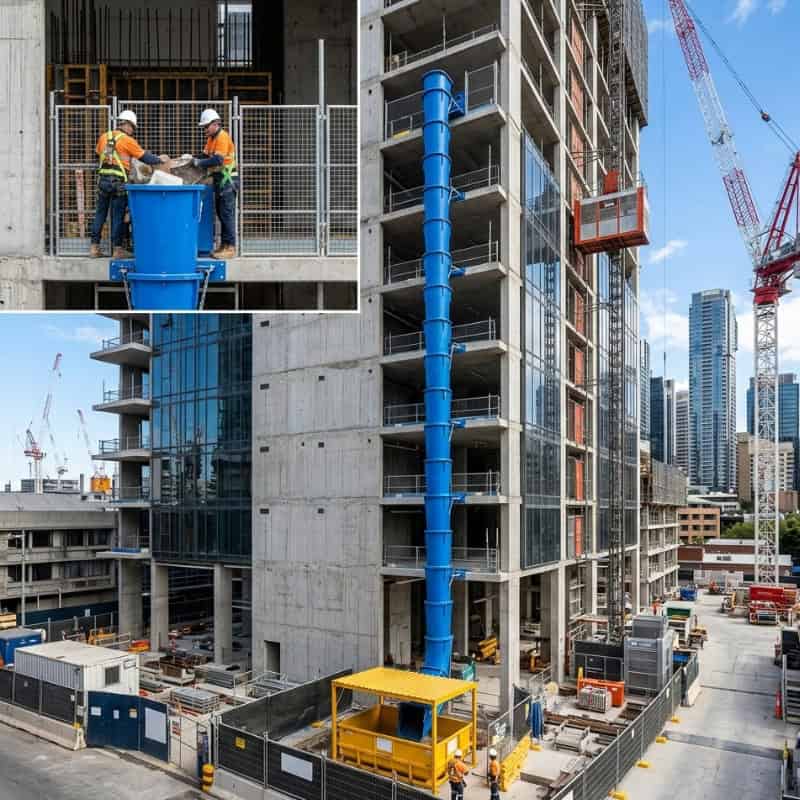
On a high-rise build, waste isn’t just something you “deal with later”. It’s a daily production flow that either supports the programme or quietly drags it down.
Sydney sites feel this more than most. Tight loading zones, limited laydown, sensitive neighbours, strict traffic and pedestrian interfaces, and constant competition for crane and hoist time can turn “just chuck it in a skip” into a recurring bottleneck.
This guide is designed for builders, site managers, forepersons, and project teams who need practical ways to move construction waste down and off-site efficiently—especially when standard skip bins aren’t keeping up. It also explains where rubbish chute systems fit into the mix, when they’re the right tool, and how to keep them safe, controlled, and productive without turning your site into a mess.
When skip bins stop being enough on multi-storey sites
Skip bins can work well—until vertical reality kicks in.
Here are the common trigger points that signal your waste strategy needs an upgrade:
• Waste is being carried down multiple levels (slow, fatiguing, high manual-handling load)
• The hoist queue is constant, and trades are losing time just moving rubbish
• Crane time is being burned on ad-hoc waste lifts instead of critical materials
• The loading zone becomes a conflict point (deliveries, concrete, pumps, waste swaps)
• Waste volumes spike during demolition, framing, or fit-out, and the site can’t “catch up”
• Housekeeping deteriorates because removal can’t keep pace
• Dust, noise, and falling-object risks increase as height and congestion increase
• Waste streams get mixed and contamination creeps in (cost and disposal risk)
The goal is not “more bins”. The goal is a cleaner waste pathway: predictable movement from the workface to containment, then down, then off site—without constant double-handling.
Quick answer
If your team is spending meaningful time carrying waste down stairs or waiting for lifts, or your loading zone is repeatedly blocked by bin swaps, you’re paying for waste twice: once in labour and once in delays. That’s when you start comparing hoist-based runs, scheduled craneable containers, staged segregation, and controlled vertical drop options (including rubbish chute systems) as part of a planned logistics approach.
The five-part framework for choosing the right option in Sydney
Before you compare methods, answer these five questions. They’ll guide you to a realistic solution for your site constraints.
1) How far is waste travelling from the workforce?
If waste has to travel too far horizontally (corridors, ramps, long internal paths), you’ll lose time, create trip hazards, and see more dumping “wherever it fits”.
2) What is the vertical movement method?
This is the biggest lever on a multi-storey site:
• Lift-based movement (builder’s hoist, material hoist, crane lifts)
• Controlled vertical drop systems (a defined, contained waste route downward)
• Hybrid approaches by stage and waste stream
3) What happens at ground level?
Ground logistics is where good plans fail:
• Where does waste land?
• How is it contained?
• How is it swapped out without blocking everything?
• Who resets and maintains the receiving area daily?
4) What are your access and neighbour constraints?
Sydney variables often decide the method:
• Limited street frontage and set-down windows
• Busy footpaths and public interfaces
• Noise and dust sensitivity near occupied buildings
• Tight CBD lanes and restricted truck movements
5) What safety controls are non-negotiable?
Vertical waste movement raises the consequences of small mistakes. Falling objects, struck-by hazards, exclusion zones, containment, and disciplined loading all matter.
Option 1: Smarter skip bin strategy (when bins still work)
Sometimes the solution isn’t “no bins”. It’s “bins plus discipline”.
When it works best
• Lower-to-mid rise stages
• Sites with a reliable loading zone and manageable swap access
• Predictable waste volumes and stable work fronts
Upgrades that actually help
• Smaller bins are swapped more frequently (reduces overflow and unsafe piling)
• Dedicated bin zones with barricading and clear signage
• Separate bins for common streams (packaging/timber vs masonry vs mixed)
• Fill-limit rules and swap triggers before overflow becomes normal
• Covered bins where wind-blown litter and dust are issues
Limitations
If the waste still has to travel down multiple levels manually, bins aren’t solving the core problem—they’re just the final container.
Q&A
What’s the biggest skip-bin mistake on high-rise sites?
Treating the bin as the plan. If waste removal depends on people carrying rubbish down too many levels or dumping it near lifts “until later”, the bin becomes a symptom, not a solution. The fix is to shorten travel distance and make vertical movement predictable.
Option 2: Builder’s hoist as a planned waste pathway
Builder’s hoists are often already there, so it’s tempting to let waste “use it when it can”. That’s exactly why waste becomes a constant frustration.
When it works best
• Fit-out stages with steady packaging, offcuts, and mixed light waste
• Projects where crane time is too valuable for regular waste lifts
• Sites where you can schedule and standardise hoist waste runs
What a good hoist-waste system looks like
• Set waste runs at predictable intervals (rather than constant ad-hoc trips)
• Use consistent containers (wheeled bins, cages, or trolleys that suit the hoist)
• Create level-based marshalling points so trades aren’t roaming for somewhere to dump
• Keep routes clear and protected (especially near finished areas)
• Put one person “in charge” of the system each shift (even if it rotates)
Common failure mode
Hoist waste systems fail when:
• Everyone tries to use the hoist at once
• Waste containers overflow while waiting
• Dusty waste is pushed through sensitive or near-finished zones
• No one owns housekeeping around the hoist waiting area
Q&A
How do you stop the hoist queue from turning into a dumping ground?
Make waste runs scheduled and enforce container rules. If there’s a set time and a set container type, trades stop improvising if the system is “whenever someone feels like it”, it will drift toward overflow and trip hazards.
Option 3: Scheduled craneable containers (bins, stillages, cages)
Crane lifts can move serious volumes quickly, particularly for heavier debris. The downside is that crane time is precious and in demand.
When it works best
• Demolition and structural phases with heavy waste streams
• Sites where crane capacity is available at planned times
• Projects that can schedule waste lifts into the daily lift plan
How to make it work on Sydney high-rise sites
• Treat waste lifts like a planned activity: put them in the lift schedule
• Use consistent lift windows (for example, mid-morning and late afternoon)
• Set up safe loading points on levels to reduce roaming and manual handling
• Keep the ground receiving area clearly separated from deliveries and public interface zones
• Ensure loads are stable, within limits, and not overfilled
Where it goes wrong
• Ad-hoc lifts = ad-hoc outcomes
• Overfilled containers and loose debris increase drop risk
• Poor receiving-zone control creates struck-by and congestion hazards
Q&A
Is “crane it down” always safer than carrying waste down?
It can reduce manual handling and stair travel, but it introduces lift hazards and falling-object risk if loads aren’t contained and controlled. “Safer” depends on disciplined loading, stable containers, exclusion zones, and a receiving area that stays controlled every time.
Option 4: Controlled vertical drop methods for high-volume waste
When you’re producing waste high above ground and the carry-down is killing productivity, a controlled vertical drop route can reduce labour time and keep waste movement more predictable.
This is where rubbish chute systems often come into the conversation—not as a “magic fix”, but as a way to create a defined downward waste pathway that reduces repeated manual trips.
If your site is evaluating chute-based approaches, you can see examples of rubbish chutes for building sites as one category within a broader high-rise waste movement plan.
When this option fits best
• Multi-storey buildings produce steady high volumes on upper levels
• Sites where internal travel is long and hoist time is already tight
• Stages like framing and fit-out, where waste is frequent and repetitive
• Projects needing better housekeeping to maintain safe, clear work areas
What “controlled” needs to mean
A controlled vertical drop approach works when:
• Loading points are designed to reduce “throwing” and prevent overfilling
• Rules exist for size, shape, and waste type to prevent jams
• A ground receiving area is contained and protected
• Exclusion zones are respected (every time)
• The receiving zone gets reset and maintained daily
Common mistakes to avoid
• Treating it as a “dump hole” rather than a controlled system
• Allowing oversized items, long offcuts, or tangled materials that cause blockages
• Under-planning the receiving area so it becomes messy, dusty, and hazardous
• Failing to control falling-object risk at the base and along the route
Q&A
What’s the number one success factor with chute-based approaches?
The receiving end. The top loading point gets attention, but the ground-level receiving zone determines whether the system stays safe and clean. Containment, exclusion zones, supervision, and daily resets matter as much as the chute itself.
Option 5: Floor-by-floor segregation and staged removal
This option is less about a single piece of equipment and more about process. On high-rise projects, the most expensive waste is the waste you move twice.
When it works best
• Fit-outs and refurbishments with distinct trade waste streams
• Projects trying to reduce contamination and disposal cost blowouts
• Sites where you can create consistent marshalling points on each level
How it works in practice
• Set small, labelled collection points on each active level
• Separate common streams early (packaging, timber, metal, general)
• Schedule removal to match production (end of day, twice daily, or after specific tasks)
• Use hoist/crane/controlled drop methods to move full containers predictably
• Keep the workface clear so productivity doesn’t get swallowed by housekeeping
Where it fails
• Inconsistent labels and container types confuse trades
• Removal doesn’t happen frequently enough, and overflow returns
• No one enforces “this goes here” rules, so contamination rises
Option 6: Hybrid systems (the most common Sydney high-rise answer)
Most successful Sydney high-rise projects don’t choose one method for the entire build. They shift the method by stage and waste stream.
A realistic hybrid approach often looks like:
• Demolition/heavy debris: scheduled craneable containers and controlled receiving zones
• Structural phase: bins plus planned lifts and strong housekeeping rules
• Fit-out: hoist-based runs with level marshalling points and segregation
• High-volume repetitive stages: controlled vertical drop routes to reduce carry-down time
• Final stages: smaller, more frequent removals to protect finishes and keep access clean
If you’re aiming to reduce delays and site mess quickly, pick the stage where waste is currently causing the biggest friction, then introduce one method change with measurable targets.
Safety controls that matter most for vertical waste movement
Waste movement becomes risky when it’s rushed, improvised, or uncontrolled. Vertical movement multiplies the consequences.
Falling objects and struck-by risk
Key controls to take seriously:
• Establish exclusion zones around receiving areas and lift paths
• Use physical containment at receiving points, not just signage
• Enforce fill limits and prohibit loose debris perched on top of loads
• Ensure loads are stable and appropriate for the method used
• Maintain consistent supervision and “stop the job” authority around drop zones
For a plain-language overview of the hazard and controls, SafeWork NSW’s falling objects guidance is worth keeping in your induction and prestart rotation: SafeWork NSW – Falling objects in construction.
Manual handling and fatigue
Controls that improve both safety and productivity:
• Shorten travel distance with better placement of collection points
• Use wheeled containers appropriate to corridors and lift thresholds
• Keep waste pathways clear (don’t let rubbish become the trip hazard)
• Increase removal frequency so waste doesn’t become a late-day emergency
Dust, noise, and neighbour impacts
Sydney sites often operate with neighbours close by. Practical controls include:
• Contained receiving areas and covered bins where dust and litter are issues
• Rules preventing “drop from height” behaviours that create plumes and bounce-outs
• Thoughtful timing for noisy changeovers where feasible
• Rapid clean-up response if debris escapes containment
Q&A
When should a site switch methods instead of “pushing through”?
Switch when any of these keep repeating:
• Overflows become normal
• Trades lose significant time moving waste instead of building
• Hoist/crane congestion delays critical work
• Housekeeping keeps slipping despite effort
• Near-misses or complaints indicate controls aren’t holding
At that point, the method isn’t supporting the build—it’s competing with it.
A practical step-by-step plan you can use on Sydney sites
If you want a straightforward way to tighten high-rise waste logistics, use this sequence.
Step 1: Map the waste pathway (workface to off-site)
Walk a level and write down:
• Where waste is created
• Where it is placed first
• How it moves vertically
• Where it lands at ground level
• How it leaves the site
If any step involves “temporary dumping” or “someone carries it down later”, that’s a bottleneck.
Step 2: Set collection points that reduce roaming
Aim for:
• One or two clear collection points per active level
• Standard container types and labels
• Placement that doesn’t block access, egress, or high-finish areas
Step 3: Decide on the vertical method for the current stage
Match method to reality:
• Heavy debris and demolition: lift-based tends to win
• High-volume repetitive waste from height: controlled vertical drop can reduce labour time
• Fit-out: hoist scheduling plus segregation prevents congestion and mess
Step 4: Engineer the ground receiving zone
This is where safety and efficiency are won:
• Clear boundaries and containment
• Exclusion zone discipline
• Defined swap/changeover procedure
• Named ownership for reset and daily maintenance
Step 5: Simplify the rules so they get followed
Keep it practical:
• Fill limits
• “Doesn’t go here” list (oversized items, prohibited materials, long offcuts)
• Who to call when something doesn’t fit
• What to do when a container is full (so overflow doesn’t start)
If your team is trying to reduce travel time and keep the waste pathway controlled, a useful next step is to look at methods and equipment that can improve site waste safety by reducing repeated carry-downs and creating a predictable waste route.
What to do when street access is severely constrained
Sydney’s inner suburbs and CBD can make bin swaps difficult. When set-down windows are limited:
• Shift to smaller, more frequent changeovers rather than rare massive swaps
• Schedule swaps around major deliveries and peak congestion periods
• Reduce street-interface frequency by improving internal waste movement predictability
• Maintain a tight ground receiving zone so swaps happen quickly and safely
• Keep paperwork and coordination ready so trucks aren’t waiting while the site scrambles
The biggest improvement is often reducing how often you need to touch the street interface at all.
Final FAQ: High-rise waste movement options in Sydney
What’s the best option beyond skip bins for high-rise sites?
There isn’t one universal best option. Heavy debris phases often suit planned craneable containers. Fit-out phases often suit hoist-based scheduled runs with level marshalling points. High-volume repetitive waste from upper levels often suits controlled vertical drop approaches when the receiving area is properly contained and managed.
How do you reduce the wasted time spent moving rubbish?
Shorten travel distance from the workface to collection points, schedule vertical movement (hoist/crane runs), prevent overflow with fill limits and swap triggers, and keep the receiving area controlled so changeovers don’t become a daily disruption.
How do you reduce falling-object risk when moving waste from height?
Use physical containment at receiving zones, enforce exclusion zones, prevent overfilling and throwing behaviours, and keep loads stable and appropriate for the method. SafeWork NSW’s falling objects guidance is a good reference for controls and reminders.
When is a rubbish chute approach most useful on a high-rise building?
When waste is being produced high above ground, volumes are frequent and repetitive, and manual carry-downs or hoist congestion are slowing the job. It works best when the loading point is disciplined and the ground receiving end is contained, supervised, and reset daily.
What’s the simplest way to cut mess, dust, and rework?
Stop double-handling and stop mixed dumping. Standardise collection points, separate key waste streams early, keep receiving zones contained, and increase removal frequency before overflow becomes normal.
How can a site tighten waste logistics without creating a complicated system?
Pick one problem (overflow, carry-down time, hoist congestion, dust complaints) and make one measurable change: scheduled waste runs, improved receiving containment, or a more controlled vertical pathway. If you’re reviewing ways to manage construction debris efficiently, prioritise the option that reduces labour travel distance and makes movement predictable.