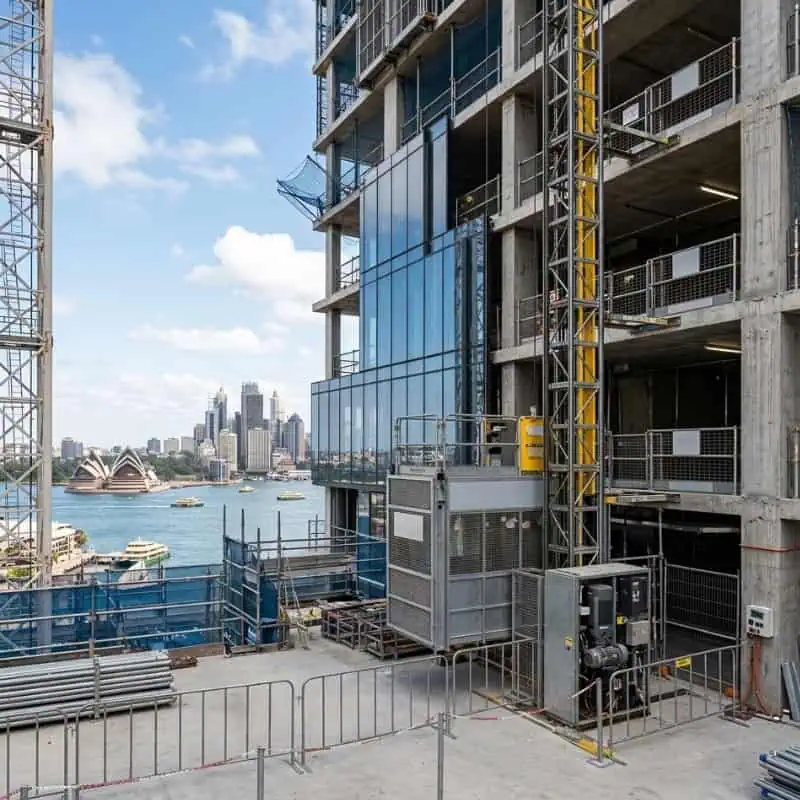
Choosing a construction hoist sounds simple until you’re dealing with a tight CBD footprint, a fast-moving programme, limited laydown, and a mix of people and materials that all need to move up the building at the same time. The “right” hoist isn’t just about maximum load. It’s about throughput, safe access, weather exposure, power, landing design, and how your site actually operates at 7:00 am, 10:30 am smoko, and 3:30 pm when everyone’s trying to get one last run in.
This guide walks through a practical, Sydney-specific way to choose a hoist that fits your site, supports your workflow, and reduces the risk of bottlenecks.
Start with the most important question: people, materials, or both?
Before you look at capacities or speeds, lock in the hoist’s purpose. In practice, this shapes almost everything else (controls, gates, landings, traffic flow, and how you manage risk).
Materials-only hoist
Best when:
• You primarily need to move pallets, tubs, barrows, plasterboard, blocks, tools, and waste
• People movement can be handled safely via stairs/temporary access (where appropriate)
• You want to keep personnel separate from loads to simplify control of risk
Watch-outs:
• Sites often underestimate “people movement” impacts on productivity. Even if it’s materials-only, the project may still lose time if workers are trekking up flights with tools and small items.
Personnel and materials hoist
Best when:
• You need to move crews and materials efficiently (common in multi-storey builds)
• You’re managing tight time windows, frequent deliveries to levels, and multiple trades
Watch-outs:
• People + materials increase demand, queueing, and the consequences of poor landing design. You’ll need stricter rules for loading, capacity control, and separation of pedestrians from loading zones.
Quick on-site reality check
Ask your supervisors:
• What’s the single biggest vertical transport pain point on our last similar job?
• At peak times, are we moving more people, more materials, or both?
• Are we trying to solve productivity, safety, or programme risk (or all three)?
If you’re mapping options and need a broader operational lens, this kind of planning sits well alongside your overall conveying and hoisting solutions thinking—because selection is only half the battle; site integration is where you win or lose time.
Define your site constraints (Sydney makes this step non-negotiable)
Sydney sites often have constraints that don’t show up in generic hoist guides. Spend 30 minutes on these factors early and you’ll avoid expensive changes later.
1) Footprint and placement
Consider:
• Where can the base go without blocking deliveries, pumps, or emergency access?
• Do you have room for safe queuing and a controlled loading zone?
• Are you adjacent to a footpath, laneway, neighbouring property, or shared boundary where falling-object risk and exclusion zones become harder?
A hoist that fits on paper can fail on-site if it creates constant conflict with traffic management or forces poor loading behaviours.
2) Height now, height later
Don’t spec for “today’s height”. Spec for:
• Maximum building height during the hoist’s use
• How often you’ll need to extend/alter ties as the building rises
• Whether the programme requires the hoist to stay productive through multiple stage changes
3) Wind exposure and weather
Sydney conditions vary dramatically: coastal gusts, exposed edges as the structure rises, and wind tunnelling between buildings in dense areas. The right approach is to:
• Identify likely exposure zones (open slabs, corners, street canyons, ridge lines)
• Build in stop-work triggers based on the hoist manufacturer’s requirements and your site rules
• Plan where you’ll measure wind (and who makes the call)
Wind is not just a comfort issue. It can affect stability, landing behaviour, loading control, and the safety of people near the hoist.
4) Power and shutdown risk
Confirm early:
• What temporary power is available (and when)
• What happens during outages or switching events
• Who owns the interfaces (builder, electrical contractor, hoist provider, etc.)
If power is inconsistent, you’ll want operational plans for peak periods so you don’t end up with queues, rushed loading, and poor decision-making.
Choose the hoist type that matches your workflow, not just your load
A hoist is a production system. If you choose a unit that can lift heavy loads but can’t handle the number of trips you need per hour, you’ll get delays, frustration, and unsafe workarounds.
Think in throughput, not capacity
Instead of asking “What’s the max weight?”, ask:
• How many loads per hour do we need at peak?
• How many levels will be serviced regularly?
• How long does it take to load/unload safely at each landing?
• How many trades will be competing for the hoist at the same time?
A common Sydney pain point is underestimating peak demand windows:
• Morning start: multiple crews + materials
• Midday: deliveries and internal moves
• Afternoon: waste down, tools down, last-minute moves
If you’re unsure, plan for the peak you’ll actually experience—because a hoist that’s “fine most of the day” still becomes a daily schedule risk if it collapses under peak demand.
Speed, travel height, and stop frequency matter
Hoist performance in real life depends on:
• Travel speed (up and down)
• Acceleration/deceleration profiles (comfort and control for personnel hoists)
• Door/gate cycles
• The number of stops per run (multi-landing operations)
On multi-storey jobs, frequent stops and slow gate cycles can be just as limiting as capacity.
Work out your required capacity properly (without guesswork)
Capacity needs to cover more than a single idealised load. It needs to cover:
• Typical load weights (not the lightest loads)
• Variability (wet materials, overfilled tubs, mixed loads)
• People + tools + small materials (if personnel and materials)
• The temptation factor (if it’s tight, people will try to “make it fit”)
Practical capacity planning questions
• What are the top 10 items we’ll lift weekly? (by weight and size)
• Will we be lifting pallets, stillages, barrows, or long items?
• Will loads be uniform, or will they vary heavily by trade and stage?
• Do we have a plan for awkward loads (length, centre of gravity, stability)?
Q&A: What if we’re not sure about the heaviest loads?
If you don’t have exact weights yet, don’t “average it out”. Use worst-case planning:
• Identify a conservative top-end load scenario (typical, not extreme)
• Check whether that scenario happens daily, weekly, or rarely
• If it’s daily/weekly, capacity should handle it comfortably
• If it’s rare, plan alternative methods for those rare loads (so you’re not overspec’ing the whole system)
Landing design is where hoist plans succeed or fall apart
Landing design isn’t a minor detail. It drives:
• Loading safety
• Queue behaviour
• Materials flow
• Time lost to congestion
• The risk of falls and dropped objects
What a good landing design looks like
• Clear approach routes (no squeezing past stored materials)
• A defined waiting area that doesn’t spill into edge-risk zones
• Gates/interlocks that encourage correct behaviour (not bypassing)
• Good lighting and clear signage
• Space to turn and move loads without pushing people into pinch points
Sydney-specific landing problems to avoid
• Landings that face directly into narrow corridors
• Landings that force barrows or pallets to turn sharply immediately
• Landings placed where wind gusts hit the opening hard (increasing instability risk for people and loads)
• Landings that conflict with concrete pump lines, deliveries, or scaffold access paths
If your hoist selection is being driven by “what can fit”, take a step back and consider whether placement changes or staging changes could improve landing safety and flow. If you need help framing those trade-offs, start from construction hoist support thinking: you’re optimising the system, not just buying a machine.
Match the hoist to your site stage and programme
A hoist that’s perfect for structure may not be perfect for fit-out, and vice versa.
Early stage (structure and frame)
Typical needs:
• Heavy materials (formwork items, stillages, blocks)
• Rapid level changes as height increases
• High exposure to wind at open edges
• Frequent reconfiguration of landing priorities
Selection priorities:
• Robust capacity and stable loading control
• A clear plan for tie-ins/extensions
• Strong controls for weather exposure and exclusion zones
Mid stage (envelope and services)
Typical needs:
• Mixed loads: tools, services, materials, fixings, and smaller pallet loads
• Higher trade overlap, higher queue risk
• More frequent stops to multiple levels
Selection priorities:
• Throughput and reliability
• Multi-level efficiency
• Clear booking or priority rules during peak conflicts
Fit-out stage
Typical needs:
• High people movement + lighter but frequent material moves
• Tight internal pathways and sensitive finishes
• More risk of “just one quick trip” behaviour
Selection priorities:
• Efficient people movement with strong loading rules
• Landing design that suits finished corridors and protected areas
• Clear housekeeping standards around landings
Don’t ignore licensing, competency, and documentation
Your hoist selection must align with how it will be operated and what competency requirements apply. In NSW, high-risk work licensing applies to certain classes of hoist operation, and requirements depend on the hoist type and use case.
For an authoritative starting point on hoist-related licensing classes and definitions, refer to SafeWork NSW’s hoist licensing information.
What to confirm during planning (practical, not legal advice)
• Who will operate the hoist day-to-day?
• What training/competency is required for your hoist class and site rules?
• Who is responsible for pre-start checks, maintenance coordination, and shutdown decisions?
• What documentation must be available on-site (manuals, inspection records, signage, etc.)?
Build a simple “selection checklist” you can actually use on-site
Use this as a structured way to compare options.
Site requirements
• Maximum travel height during the hoist’s use
• Number of levels needing regular service
• Available footprint and safe queuing space
• Public interface risks (footpaths, laneways, neighbouring properties)
• Wind exposure zones and measurement plan
• Temporary power availability and reliability
Workflow requirements
• People vs materials vs both
• Peak hour demand (number of trips needed)
• Typical load sizes and shapes
• Peak conflict times (morning start, deliveries, waste down)
• Booking/priority rules (if multi-trade congestion is likely)
Safety and control requirements
• Landing gates/interlocks and loading behaviour controls
• Exclusion zones and pedestrian separation
• Housekeeping standards at landings
• Emergency procedures and shutdown triggers
• Operator competency and supervision model
If you want a “sanity check” before you lock anything in, use your selection notes to pressure-test whether you’re truly choosing the right construction hoist for Sydney construction site realities—tight access, variable wind, and peak demand that hits hard and fast.
Common mistakes that cause delays (and how to avoid them)
Mistake 1: Choosing on capacity alone
Fix:
• Compare options by peak throughput, not just max load
Mistake 2: Ignoring landing behaviour
Fix:
• Design landings for flow and safe queuing, not “minimum viable space”
Mistake 3: Underestimating wind exposure
Fix:
• Plan measurement and stop-work triggers, and place landings with wind behaviour in mind
Mistake 4: Assuming power will “sort itself out”
Fix:
• Confirm temporary power capacity and interfaces early, and plan for outages
Mistake 5: No rules for peak demand
Fix:
• Use simple booking/priority rules (especially when multiple trades pile in)
On-site Q&A scenarios (Sydney-style)
Q&A: Our site is narrow, and we can’t fit a big hoist base. What now?
Options to explore:
• Adjust the placement to reduce conflict with deliveries and create safer queuing
• Stage your loading zone differently so the hoist isn’t competing with truck movements
• Revisit the number of landings serviced (and how often) to reduce stop frequency
• Consider whether two smaller flows (materials strategy + people strategy) works better than one overloaded system
The key is not to force a hoist into a footprint that creates constant pinch points. Congestion drives rushed behaviour, and rushed behaviour drives incidents.
Q&A: We’re getting queues every morning. Do we need a bigger hoist?
Not always. Check:
• Is loading slow because landings are cramped or poorly laid out?
• Are people riding with mixed loads, causing longer loading cycles?
• Are stops too frequent because everyone is requesting “one-off” runs?
• Is there a simple priority/booking rule that would smooth peak demand?
If the hoist is genuinely under-specced for throughput, then yes—equipment change may be required. But don’t assume size fixes poor flow.
Q&A: How do we decide when to stop hoisting due to wind?
Avoid using a made-up “universal” wind number. Instead:
• Follow the hoist manufacturer’s instructions and your site rules
• Identify who measures wind, where it’s measured, and who makes the call
• Treat gusts and sudden wind changes seriously (especially on exposed elevations)
• Keep people out of risky zones around loading areas when wind is up
Final FAQ
What’s the first step to choosing the right construction hoist?
Start with purpose: materials-only, personnel and materials, or a staged approach. Then map your real site constraints (footprint, height, wind exposure, power) and your peak-demand workflow.
How do I estimate the hoist size I need?
List your typical loads (weights and dimensions), then estimate peak trips per hour during your busiest periods. Capacity without throughput planning often leads to daily bottlenecks.
Should we separate people and materials?
If your site allows it, separation can simplify control of risk and reduce loading conflicts. On many multi-storey Sydney sites, a combined personnel and materials solution is still practical—but it needs stronger rules, landing design, and supervision.
What role do landings play in hoist performance?
Landings often determine whether the hoist feels “fast” or “slow”. Cramped landings, poor approach routes, and unsafe queuing can waste more time than a slightly slower hoist ever would.
How does Sydney weather affect hoist choice?
Wind exposure can change as the building rises and edges open up. Plan for wind measurement, shutdown triggers, and landing placement that minimises gust impacts—especially in coastal or high-rise corridor effects.
Do licensing and competency affect which hoist we choose?
Yes. The way a hoist is used and the class/type can affect competency and licensing requirements in NSW. Check SafeWork NSW guidance and ensure your operational plan matches the equipment.
Is it better to overspec a hoist “just in case”?
Not always. Overspec’ing can introduce placement issues, higher costs, and more complex site interfaces. A better approach is to spec for realistic peak demand and plan alternative methods for rare abnormal loads.
What’s the biggest mistake site teams make with hoists?
Treating the hoist as a single piece of equipment instead of a production system. The best results come when selection, placement, landings, rules, power, and supervision are designed as one integrated plan.