Height safety compliance in Sydney isn’t “a harness and a folder.” It’s a repeatable system that prevents falls first, proves controls are in place, and keeps your crew ready for the reality of NSW sites—tight access, mixed trades, public interface, and weather that can turn a roof into a skating rink.
If you want a simple way to think about NSW compliance, it’s this:
• Plan the task and identify fall hazards (including brittle surfaces and voids)
• Select controls using the hierarchy (prevention before restraint/arrest)
• Confirm competency, supervision, and a method everyone will follow
• Maintain evidence: inspections, suitability, and documentation
• If fall arrest is used, have a rescue plan you can actually execute
This guide walks through what “compliant” tends to look like on real Sydney worksites—and where height safety hire can support compliance by keeping the right gear, inspection evidence, and compatible components consistent from job to job.
What counts as “working at heights” in NSW?
Many serious falls happen lower than people expect. SafeWork NSW emphasises that PCBUs must protect workers from the risk of falling from one level to another—no matter the height.
On Sydney jobs, “working at heights” commonly includes:
• Roof work near edges on warehouses, terraces, and strata buildings
• Plant rooms and HVAC access on multi-storey buildings (CBD and metro sites)
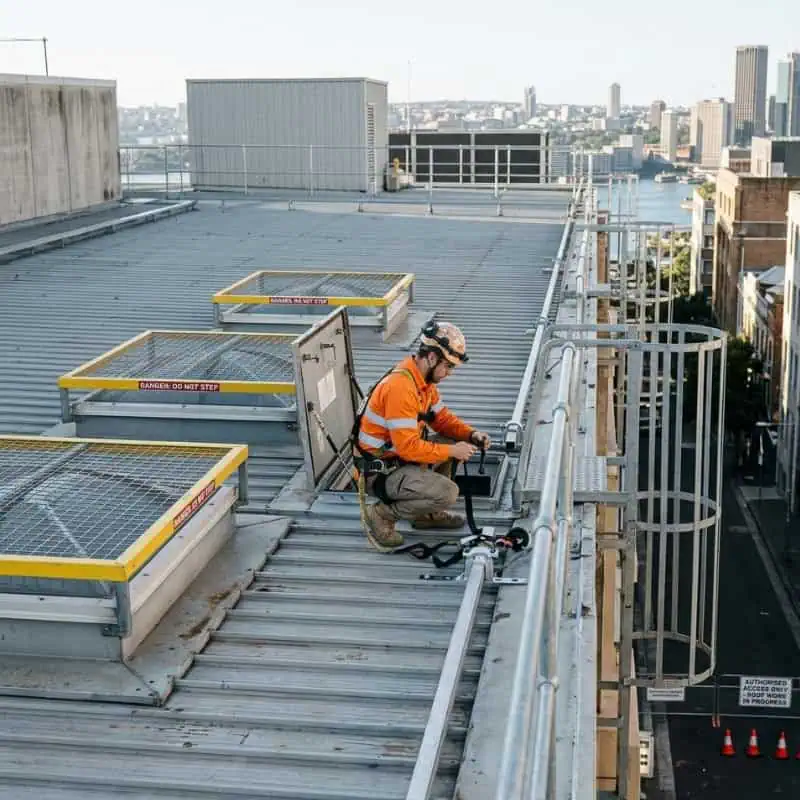
• Skylights and roof penetrations—especially on older industrial roofs
• Mezzanines, loading docks, and racking access in logistics and warehousing
• Signage, lighting, façade tasks using ladders or EWPs
• Any work near voids, stairwells, pits, service risers, or penetrations
Quick answer
Don’t rely on a “minimum height” to decide whether to manage falls risk. If someone falls and is injured, treat it as a fall hazard and control it properly.
Who is responsible for height safety compliance on Sydney sites?
In NSW, the PCBU has primary responsibility to ensure health and safety so far as is reasonably practicable. That responsibility doesn’t remove duties from supervisors, contractors, or workers. What inspectors and investigators typically look for is whether you:
• Identified the hazards
• Choose controls in the right order (prevention first)
• Implemented and maintained those controls
• Trained and supervised people to follow the method
• Can show evidence (documentation and inspection records)
In practice, strong compliance is visible on site—not just in documents.
The hierarchy of control: what compliant control selection looks like
A common compliance weakness is jumping straight to “wear a harness” as the primary control. In NSW guidance, the hierarchy matters: eliminate if possible, then reduce risk using higher-order controls before relying on administrative measures and PPE.
A practical falls-control order for Sydney sites looks like:
• Eliminate work at height (prefabricate at ground level, use extendable tools, relocate work)
• Fall prevention (guardrails, scaffolds with edge protection, EWPs, covers over penetrations)
• Work positioning/restraint (prevent reaching the fall edge)
• Fall arrest (stop the fall after it happens—requires clearance and rescue planning)
• Admin + PPE to support all the above (training, supervision, inspections, exclusion zones)
Real Sydney example: roof work after storms
After heavy rain, roofs can be wet, slippery, and littered with debris. A compliant plan often includes delaying work until conditions are safe, improving access, and prioritising edge protection—rather than relying on a harness as the first answer.
Q&A: Fall prevention vs restraint vs arrest—what’s the difference?
• Prevention stops you from falling in the first place (rails/platforms).
• Restraint stops you from reaching the edge (you cannot physically get to the fall point).
• Arrest catches you after a fall has occurred (you must plan clearance + rescue).
If you’re using fall arrest, you’re accepting that a fall could occur—and your system must manage what happens next.
The Sydney pre-start compliance checklist
Before anyone goes up, your site should be able to answer these questions clearly.
1) What’s the task, and what are the fall hazards?
Write the task in plain language and identify hazards such as:
• Roof edges, voids, penetrations, stairwells, mezzanine edges
• Brittle or fragile surfaces (older sheeting, skylights, roof lights)
• Access/egress risks (ladder transitions, roof hatches, plant room routes)
• Changing levels and trip hazards near edges
• Dropped objects risk (tools, fixings, offcuts, materials)
• Weather exposure (wind gusts, rain, heat, glare)
Sydney-specific considerations worth calling out:
• Wind exposure on high-rise rooftops and coastal sites
• Wet surfaces after rain (slip risk spikes quickly)
• Limited laydown and tight access on strata/city sites
• Public interface controls (footpaths, shared driveways, building occupants)
2) What controls will be used—and why are they appropriate?
This is where compliance becomes defensible. A solid plan shows you’ve worked through the hierarchy and chosen controls that suit the actual site.
Examples of what “good” looks like:
• Edge protection is installed where reasonably practicable
• Penetrations/skylights are physically protected (covers/mesh)
• Access equipment is selected for the job (ladder vs scaffold vs EWP)
• Exclusion zones are set to protect people below from dropped objects or falls
• Stop-work triggers are defined (wind/rain thresholds, missing controls, damaged gear)
3) Do you need a SWMS for working at heights?
Safe Work Australia guidance notes that for high-risk construction work involving a risk of falling more than two metres, a SWMS needs to be prepared. SafeWork NSW resources echo that expectation and reinforce that falls risk must be managed regardless of height.
Even when an SWMS isn’t legally required for a specific non-construction task, you still need a safe method and documented risk controls that match the real job.
What makes a SWMS site-specific (and not copy-paste)?
A site-specific SWMS includes details such as:
• The actual access route and equipment placement
• The roof type and known brittle zones/skylights/penetrations
• The chosen controls (rails, platforms, restraint or arrest method)
• The exclusion zone boundaries and signage
• Weather constraints and stop-work triggers
• Assigned roles (supervision and rescue responsibilities)
If it reads like it could be used anywhere in Australia without changing a word, it’s usually not specific enough.
4) Are workers trained and competent for the method?
Compliance isn’t just “someone did a course once.” Strong sites ensure:
• Training is relevant to the method (heights, EWP where required, rescue approach)
• Competency is verified (VOC if your system uses it)
• A pre-start briefing/toolbox talk reflects today’s conditions
• Supervision matches the risk level and worker experience
5) Is all equipment fit for purpose, compatible, and inspected?
A major failure point is having gear available, but not being able to prove it’s suitable, compatible, and maintained.
A practical equipment check includes:
• Harness condition (webbing cuts, stitching, buckles, labels)
• Lanyards/energy absorbers (damage, deployment indicators)
• Connectors (locking gates, corrosion, deformation)
• Anchors/lifelines (rating, suitability for loading direction, inspection evidence)
• Access equipment checks (ladder condition; scaffold tags; EWP pre-starts)
If you regularly change sites, hiring can reduce the risk of “mismatched kit” by keeping the components consistent and traceable—especially when you need to demonstrate inspection evidence quickly. For crews that want a consistent, job-ready setup, using height safety equipment rental can support standardisation across different sites and task types.
When height safety hire supports compliance (without replacing planning)
Hiring doesn’t make a job compliant by itself—but it can support compliance in very practical ways when:
• You have short-duration or intermittent work at height (maintenance, inspections, install days)
• Site conditions change frequently (strata, facility work, metro projects)
• You need task-specific systems (temporary lifelines, compatible connectors, rescue capability)
• You want predictable inspection evidence and traceability across multiple crews
• You’re scaling up for shutdowns or project spikes
The compliance test is still the same: you must select the right controls and use them correctly. The benefit of hiring is reducing variability and closing common gaps, such as missing components, incompatible gear, or unclear inspection records.
What to confirm when hiring (compliance-focused checklist)
Before gear arrives on site, confirm:
• The system suits the task (prevention/restraint/arrest choice is appropriate)
• All components are compatible (don’t mix-and-match without checking)
• Inspection evidence is current and accessible
• You have what you need for the full workflow (including rescue if fall arrest is used)
• Your SWMS/method matches the equipment and the way it will be used
If you want to hire to genuinely support compliance, treat it like part of your planning—not a last-minute replacement for it. For Sydney crews juggling varied sites, height safety rental in Sydney can be a practical way to keep systems consistent while still tailoring the method to each job.
What inspectors commonly look for on Sydney worksites
While every site is different, enforcement attention tends to focus on high-consequence gaps such as:
• Roof edges with no edge protection, and workers are exposed
• Unprotected skylights/brittle surfaces
• Harness systems used with unclear anchor suitability or missing inspection evidence
• SWMS present but obviously generic or not followed
• No realistic rescue plan for fall arrest work
• Unsafe access setup (ladder transitions, unstable placement, poor handholds)
• No exclusion zones where people below are at risk
SafeWork NSW provides hazard guidance and practical expectations for managing fall risks, including using the hierarchy of control and addressing falls “no matter the height.” It’s worth keeping their NSW guidance handy: SafeWork NSW — Working at heights.
Rescue planning: the part that separates “paper compliant” from safe
If you’re using fall arrest, a rescue plan is not just a line in a document. It’s a practical capability: who does what, with which equipment, in this exact environment.
A workable rescue plan includes:
• Likely fall scenarios and where the person may be suspended
• Assigned roles (rescue lead, communications, first aid)
• Rescue equipment and where it is stored on site
• Access method to reach the person (EWP, ladder, rescue kit)
• Communication steps and escalation
• Practice expectations (especially for repeat tasks)
Sydney complexity factors include:
• Tight rooftop access through plant rooms and internal ladders
• Public interface restrictions in the CBD and busy commercial precincts
• After-hours work with fewer people present
• Wind conditions affecting EWPs and rooftop travel
If fall arrest is part of your work, make sure your approach includes rescue-ready components—not just the harness and lanyard. For some worksite setups, safety harness hire in Sydney can help ensure the right compatible components are available as a complete set, but you still need a site-specific rescue method and trained roles.
Sydney scenarios and what “compliant” looks like
Roof work with skylights and brittle sheeting
Skylights and older sheeting can look safe until someone steps on them. Compliant setups typically include:
• Physical protection (covers/mesh) that can’t be easily displaced
• Clear marking of fragile zones and travel paths
• Controls that keep workers off brittle areas where practicable
• Exclusion zones below to protect other workers and the public
High-rise rooftops and wind exposure
Wind on rooftops can be stronger and more unpredictable than at ground level. Compliant sites:
• Set clear stop-work triggers for wind and rain
• Secure materials/tools (dropped object control)
• Choose access methods suitable for conditions (including EWP limits)
• Brief the crew based on today’s exposure and forecast
“Quick jobs” that tempt shortcuts
Short tasks often bypass planning and setup. Compliant crews keep a consistent pre-start routine and resist improvising when conditions change (wet surfaces, poor lighting, unexpected penetrations).
Documentation: what you should be able to produce quickly
A practical “site-ready” pack commonly includes:
• Risk assessment / task-based assessment
• SWMS where required
• Pre-start briefing/toolbox records
• Training evidence and VOC records, where applicable
• Equipment inspection logs and maintenance records
• Rescue plan (especially where fall arrest is used)
• Permits/authorisations if your site system requires them (e.g., roof access permits)
The goal is speed and clarity. If someone asks for proof, you can produce it without a scramble.
Common compliance mistakes Sydney sites can fix fast
Mistake 1: Harness-first thinking
If prevention controls are reasonably practicable, relying only on fall arrest is often a weak position.
Better: prevent exposure first, then add restraint or arrest where needed.
Mistake 2: No fall clearance check
If fall arrest is used, clearance matters. If no one has verified it, the system may be unsafe even if the gear is “rated.”
Better: confirm anchor position, free-fall distance, and clearance before work begins.
Mistake 3: “We have anchors” with no evidence they’re suitable
Anchors and lifelines must be appropriate for the task and how they’re loaded—and inspection evidence needs to be accessible.
Better: keep inspection evidence and compatibility details available on site.
Mistake 4: A rescue plan that can’t be executed
If the rescue kit isn’t there, or no one knows how to use it, it’s not a plan.
Better: assign roles, keep equipment ready, and practise for realistic scenarios.
Mistake 5: Unsafe access/egress
The transition from ladder to roof, or the travel path across a roof, is often where incidents happen.
Better: treat access and travel as part of the task and control it properly.
FAQs: Height safety compliance in Sydney (NSW)
Do I always need a SWMS for working at heights?
For high-risk construction work involving a risk of falling more than two metres, a SWMS needs to be prepared. Even when a SWMS isn’t strictly required for a particular task, you still need a safe method and documented controls suited to the job.
What’s the first thing to check before roof work in Sydney?
Safe access and surface condition. Confirm access/egress, identify skylights/brittle zones, check weather and wind exposure, then verify prevention controls (like edge protection) before starting.
If we’re using fall arrest, what must be in place?
Suitable anchorage, compatible equipment, adequate clearance, trained users, inspection evidence, and a realistic rescue plan with roles and equipment available on site.
Are ladders acceptable for working at heights?
Sometimes, but often they’re misused. Ladders are generally for access or short-duration tasks where the worker can maintain stable footing and three points of contact. If the task involves reach, force, duration, or handling materials, a platform, scaffold, or EWP may be more appropriate.
What documentation should be on site?
Commonly: a risk assessment, SWMS where required, toolbox/pre-start records, training/VOC evidence, equipment inspection logs, and a rescue plan for fall arrest work.
When does hiring equipment make sense for compliance?
When work is intermittent, sites change frequently, you need task-specific systems, or you want consistent inspection evidence and compatible components across multiple crews. Hiring supports compliance best when it’s planned into the method—not used as a last-minute fix.