
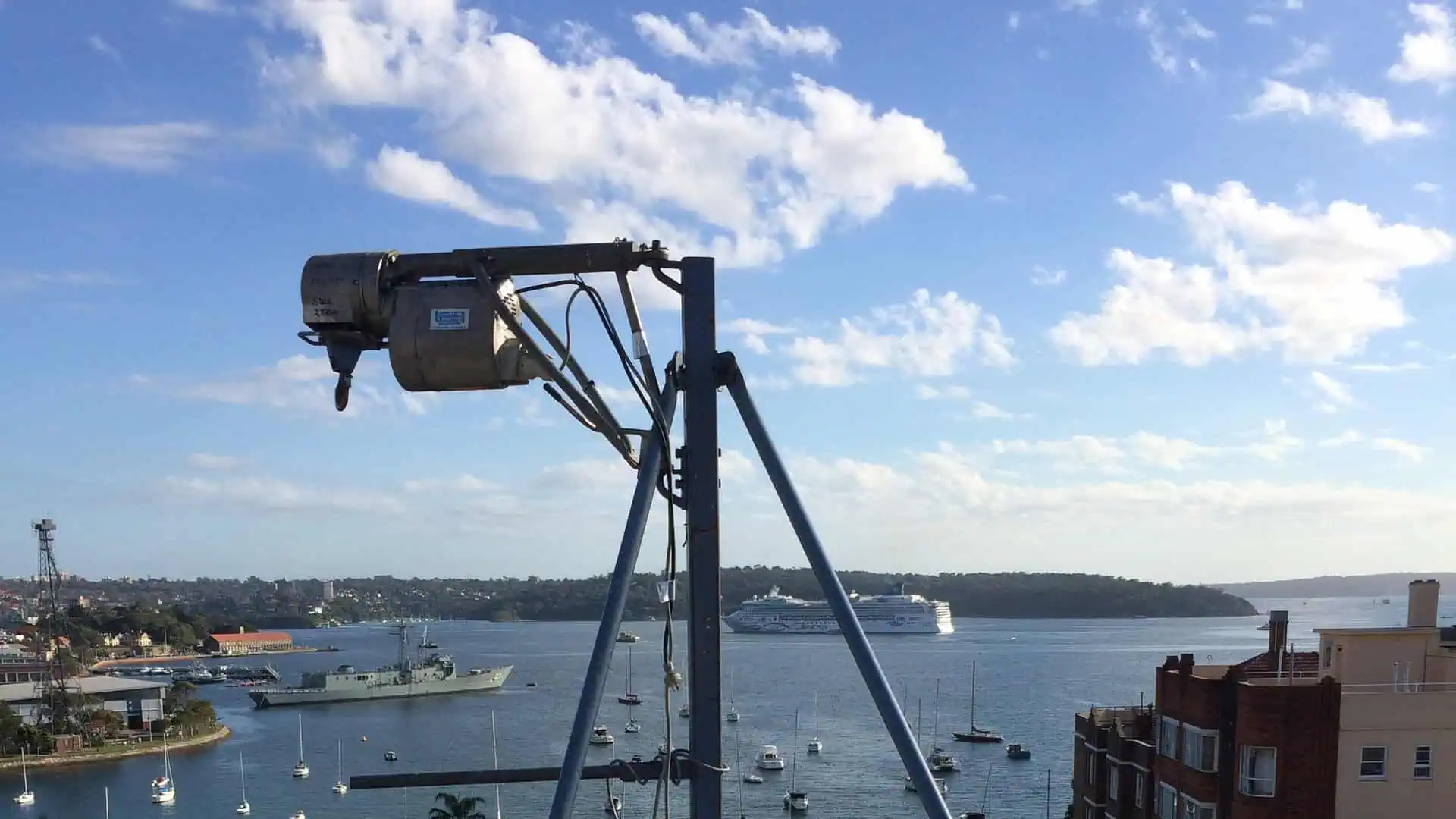
A star hoist is a swivel-arm rope hoist. It lifts up to 250 kg on a hook, then swings the load inside the building to land it. Our current GEDA Star 250 runs on standard 240 V power and lifts up to 50 metres. It mounts on scaffold, on a floor-to-ceiling prop through a window or balcony opening, or on a counterweighted tripod frame on a flat roof. We still have a few of the older 150 kg units in the fleet.
This guide covers choosing a mounting, setting it up, and the checks that keep it safe. The figures come from our Star Swivel-Arm Hoist Installation and Operating Instructions (Form 3000), our current Star 250 specification sheet and our star hoist hire page.
Key takeaways
- The Star 250 lifts up to 250 kg, up to 50 m, on single-phase 240 V power. Older units are rated at 150 kg.
- Three mountings: scaffold bracket, floor-to-ceiling prop (2.30 to 3.25 m) or counterweighted tripod frame.
- On the tripod frame, the Star 250 needs all 38 × 18 kg counterweights fitted before use.
- On scaffold, tie the frame the hoist hangs on to the building at the top and bottom, rated to at least 1.5 kN.
- No licence is needed to operate it, but anyone slinging a load needs a dogging or rigging licence.
What is a star hoist?
A star hoist is an electric winch on a swivel arm. The hook lifts the load clear of the ground, and the arm then swings the load back over the landing so it comes down inside the scaffold or building, not over the edge. On our current units the head swivels 170 degrees.
The winch separates from the arm, so one person can carry the parts up and install it. It suits one-off lifts and moving material in tight, congested areas.
| Star 250 (current) | Star 150 (older units) | |
|---|---|---|
| Rated load | 250 kg | 150 kg |
| Maximum lift height | 50 m | 50 m |
| Lifting speed | 28 m/min | 22 m/min |
| Power | 240 V, 10 A, single phase | 240 V, 10 A, single phase |
| Drive | 1.0 kW at 2,800 rpm, 60% duty cycle | 1.0 kW at 2,800 rpm, 60% duty cycle |
| Wire rope | 5 mm, 18 × 7 non-rotating, 12.1 kN minimum breaking strain | 12.1 kN minimum breaking strain, non-rotating |
| Noise | 80 dB(A) | 80 dB(A) |
Never exceed the rated load on the unit you have. Check which model is on site before you plan the lifts.
Which mounting suits your site?
Pick the mounting from the structure you have.
| Mounting | Mass | Use it when | Key requirement |
|---|---|---|---|
| Scaffold bracket | 16 kg | Scaffold is already up | Frame tied to the building top and bottom, rated to at least 1.5 kN |
| Floor-to-ceiling prop | 60 kg | Lifting through a window or balcony opening, no scaffold | Clear height 2.30 to 3.25 m; opening at least 700 mm wide |
| Counterweighted tripod frame | 96 kg plus counterweights | Flat roof or open slab edge with nothing to fix to | All counterweights fitted; operate from behind the edge protection |
The tripod frame measures about 1,950 mm by 1,720 mm on the ground and stands 2,290 mm high, so check you have the roof space before you book it.
Before you install
Whatever the mounting, the operating instructions ask for these first:
- Keep clear of power lines. The hoist and the load must stay out of the “No Go Zone” for overhead power lines, at set-up and in use.
- Check the structure. The mounting point must be firm, stable and able to take the hoist, the load and the forces of lifting.
- Inspect the hoist using the daily checks below.
- Keep people out of the mounting area while you install.
- Wear your safety gear, including height safety equipment at an open edge.
- Level the winch. The winch and motor unit must sit exactly horizontal, or the wire rope won’t wrap neatly on the drum.
How do I mount a star hoist on scaffold?
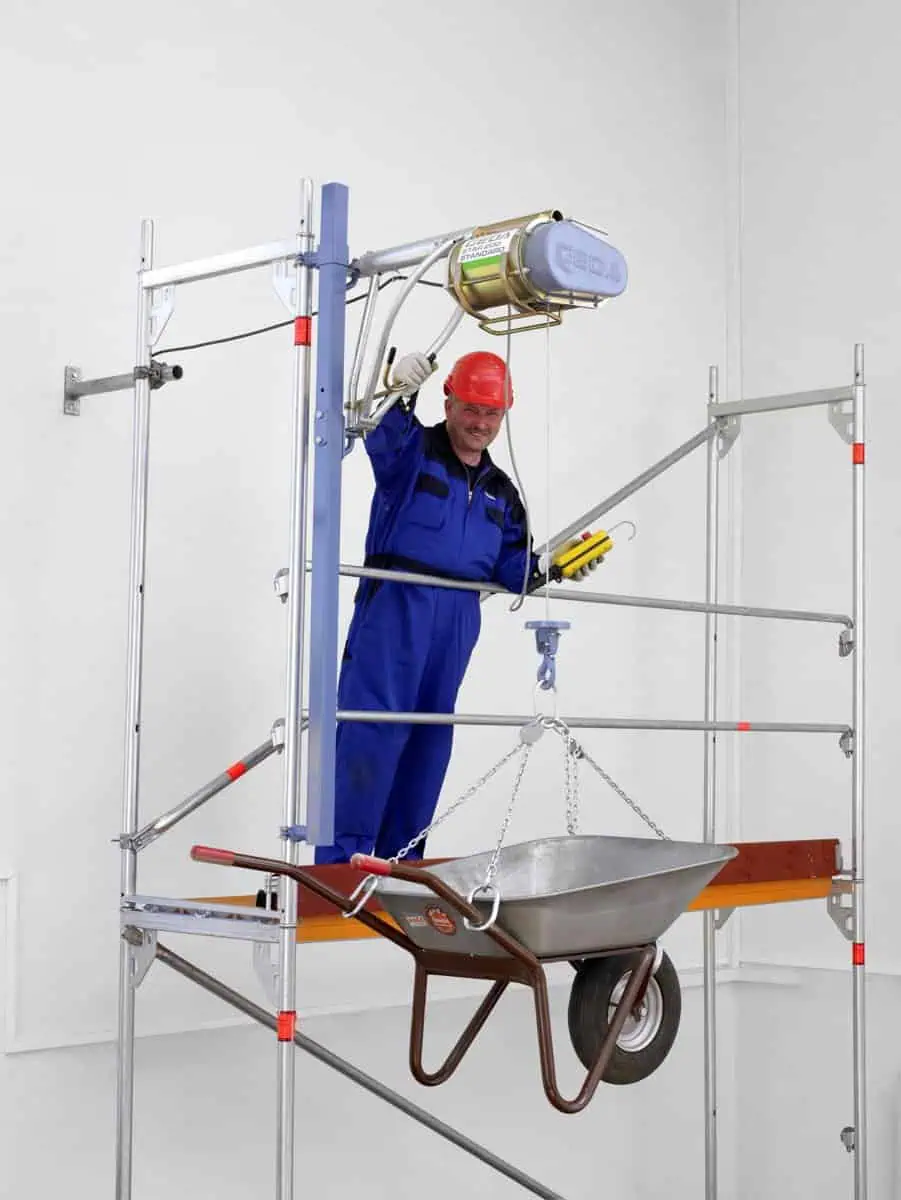
- Fasten the scaffold clamp to the scaffold with a scaffold coupling.
- Fit handrail tubes to prevent falls, each fixed to two vertical frames with 90-degree couplings.
- Anchor the vertical frame the hoist hangs on to the building at the top and the bottom, in addition to the normal scaffold ties. Each anchor must take at least 1.5 kN in tension and compression. Brace it well.
- Hang the swivel arm and secure it with the folding cotter pin.
Our advice: the extra ties and bracing change the scaffold, so have your scaffolder fit or sign off on them.
How do I use a floor-to-ceiling prop?
The prop is telescopic, from 2,300 to 3,250 mm, and jacks between the floor and the ceiling slab. It needs no fixings. Loads can swing in through window openings from 700 mm wide.
- Install the prop by screwing out the lower spindle between floor and ceiling, with the large end plate at the top. Set it so the arm stops in the swung-out position.
- Hang the swivel arm and secure it with the folding cotter pin.
If you’re working from a balcony, make sure the hoist and its loads won’t overload the balcony.
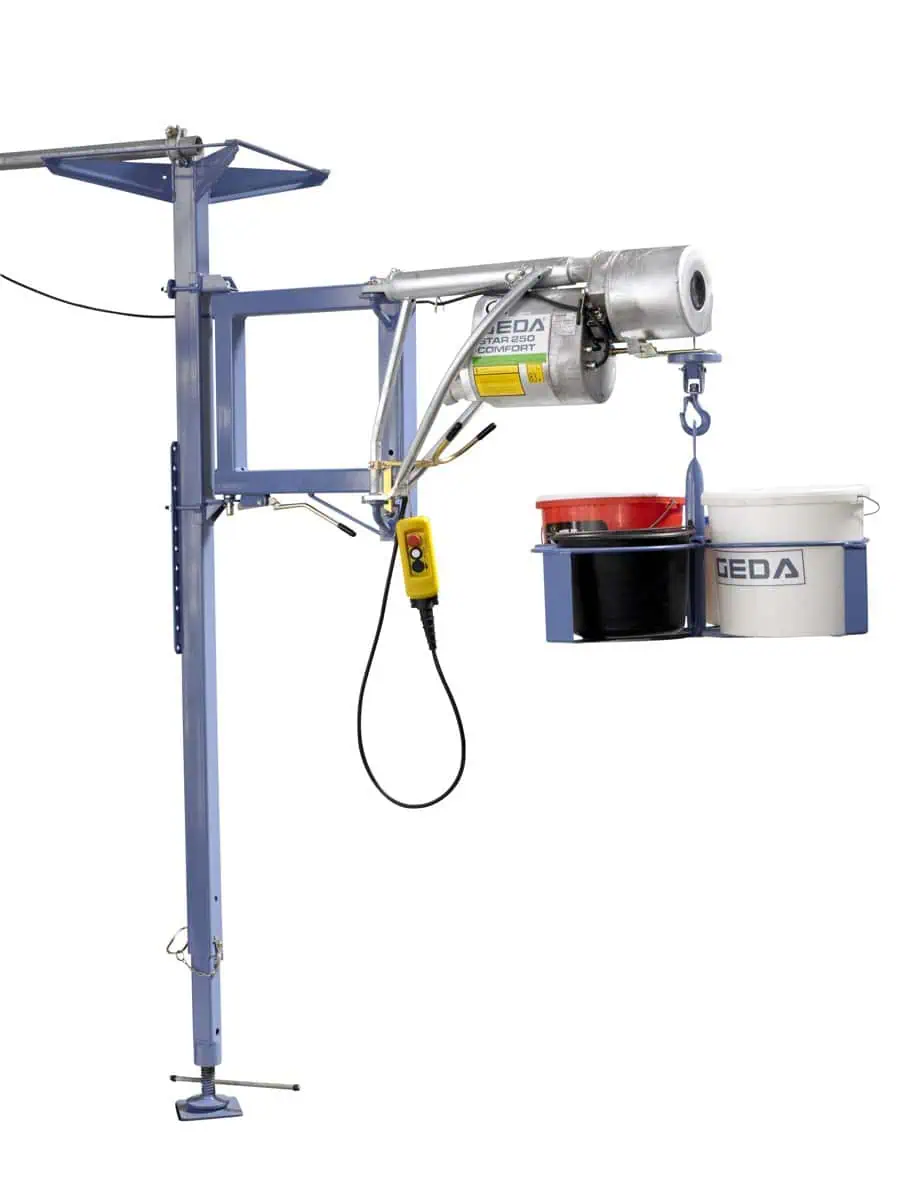
How do I set up the counterweighted tripod frame?
This is the roof-top option. Assemble it well back from the edge, because the risk of falling is highest while you’re building the frame.
- Lay out both U-section rails on level ground in a triangle.
- Fit the counterweight frame, then the standpipe and struts. The standpipe turns 180 degrees to suit the direction the arm will swing.
- Tighten the strut bolts at both ends and the standpipe bolt. Adjust the stabiliser so it rests on the floor.
- Hang the swivel arm and secure it with the folding cotter pin.
- Slide the whole frame carefully to the work edge.
- Fit every counterweight. For the Star 250 that is 38 counterweights of 18 kg each. Older 150 kg units use a different count, so confirm it with us for the unit you have.
- Always operate the hoist from behind the edge protection.
Hanging the swivel arm
The same steps apply on every mounting:
- Fit the mounting yoke to the fixing by placing its tabs over the spigots.
- Secure the yoke at the top tab with the folding cotter pin.
- Swing the yoke over the landing using the slew locking lever.
- Slide the winch and motor unit’s mounting tube into the yoke and secure it with the securing pin and cotter pin.
- Plug in the hand control, then the power lead.
Use a safety switch (RCD) on the power supply. If you need extension leads, use no more than 30 m of 3-core 2.5 mm² lead.
Lifting a load
- Swing the hoist out over a clear space. Lift the slew locking lever, swing the arm by the yoke, then lower the lever to lock it.
- Lower the hook to the pick-up point. Don’t let the hook land and the rope go slack on the drum. Loose, untidy rope can fail.
- Attach the load to the hook only. Never wrap the wire rope around a load as a sling.
- Raise the load, watching it the whole way from the operating point.
- Swing the arm in so the load is over the landing.
- Lower the load until it lands, then release the DOWN button straight away so the rope stays tight.
Never stand or work under a suspended load. Never leave the hoist loaded: unload it before you leave it unattended, and secure it against unauthorised use. Stop in winds over 70 km/h. At the end of the day, unload it, raise the hook to the upper limit switch, remove the hand control and lock the slew lever.
Daily and weekly checks
Before each shift, the operator should:
- Check the power lead and plug for damage.
- Check the wire rope. Run the hook to the ground and, wearing gloves, pull the rope out while pressing DOWN. With all the rope pulled out, look for kinks, bends, twists or flattened sections. Don’t use the hoist if the rope is damaged. Rewind it under tension so it wraps tightly and neatly.
- Check the hook’s safety latch closes below the hook tip.
- Check the mounting is tight and the yoke’s locking pin is in place and locked.
- Check the load-carrying attachments are undamaged.
- Test the upper travel limit switch.
- Check the barricades and signs under the hoist are in place.
Once a week, oil the pivot point of the mounting yoke.
Who can operate a star hoist?
No licence is needed to operate a star hoist under our operating instructions. The person in charge of the site must make sure the operator is at least 18 and competent to use it.
Slinging is different. Our instructions require a dogger or rigger to load the hoist if slinging practices are needed. The NSW Work Health and Safety Regulation 2025 defines dogging work as “the application of slinging techniques, including the selection and inspection of lifting gear, to safely sling a load”. Dogging is a high risk work licence class (Schedule 3, item 4).
The purpose-built attachments hook straight on:
- Tipping container: 65 L, 16 kg
- Mortar skip: 65 L, 23 kg
- Brick cage with pallet: 620 × 320 × 500 mm
- Board lifting frame: 24 kg
A radio remote control with an emergency stop is also available.
As a rule, count each attachment’s own weight towards the rated load.
Hiring a star hoist
We hire GEDA star hoists with all three mountings and the full attachment range, delivered or collected from Condell Park. See star hoist hire. For heavier or more frequent lifts, compare our materials hoists, and for roof-height loads up a ladder, see our ladder hoists. Call (02) 9707 2797 to check availability.
Specifications are from CHS Star Swivel-Arm Hoist Installation and Operating Instructions (Form 3000), the CHS Star Hoist Technical Specification Sheet and our star hoist hire page. They apply to CHS hire units only. Your site’s own risk assessment still applies.