On a tight Sydney site, moving materials is often the hidden bottleneck. There’s rarely room to swing a crane or store much, access is constrained, and every barrow carried by hand costs time and risks injury. The good news is that a bit of planning up front, matching the right gear to each stage, transforms how a job runs. Conveying & Hoisting Solutions hires out the full range of material-moving equipment across Sydney, and this guide gives you a practical framework for planning material flow on a constrained site, so materials move up, along and off efficiently from day one.
| Quick answer
On a tight Sydney site, plan material flow as three moves: ACROSS, using belt or roller conveyors for bulk and cartons; UP, using material or rope hoists to lift to height; and OFF, using rubbish chutes for waste. Map each move to the right gear before the job starts to cut manual handling and delays. |
Why material flow planning matters on tight Sydney sites
On a constrained metro site, poor material flow quietly eats your program. When there’s no plan for how materials move, crews double-handle everything, carrying loads by hand, setting them down and picking them up again, which is slow and tiring. Materials pile up in the wrong places and create congestion on an already tight site, blocking access and trades. All that manual carrying and lifting drives up the risk of strains and injuries, which is both a safety and a cost problem. And when moving materials is slow, the whole job slips, because trades wait on supply. Sydney’s tight-access conditions, narrow streets, small footprints, limited storage and multi-storey work, make all of this worse. Planning the flow before you start, rather than improvising on the day, is what keeps a constrained site moving smoothly.
The three movements: across, up, and off
Almost every material flow problem comes down to three movements. ACROSS is horizontal movement, getting materials along the site or into position. UP is vertical movement, lifting materials to the level they’re needed. And OFF is removal, getting waste and debris off the site. Plan each of these three moves, match it to the right piece of equipment, and you have a flow plan. The rest of this guide works through each in turn.
Moving material ACROSS the site (conveyors and rollers)
Horizontal movement is where conveyors earn their keep, because they carry a continuous flow of material along the site without anyone carrying it. For loose or bulk material, such as soil, sand, spoil or mixed debris, a belt conveyor is the tool of choice. It moves material steadily along its run, including over obstacles or up a slope, which is ideal for feeding a bulk material into or out of a tight space where a barrow would be slow and heavy going. Portable belt conveyors are particularly useful on constrained sites because they can be positioned into awkward spots. For boxed, palletised or packaged goods, such as cartons of materials or supplies, gravity roller conveyors are often the smarter choice, letting items roll along a slightly sloped line under their own weight with no power needed. On a tight site, the key is matching the conveyor to the material: belts for loose and bulk, rollers for boxed and packaged. Our range of conveyor hire in Sydney covers both, so you can move material across the site steadily rather than one barrow at a time, freeing up your crew and clearing congestion.
Moving material UP (material hoists and rope hoists)
Once materials are in position, getting them up to height is the next move, and carrying loads up ladders or stairs is exactly the kind of slow, injury-prone work you want to design out. For lifting bulk materials, barrows, tools and general loads to an upper level, a material hoist is the workhorse. It raises loads on a platform quickly and safely, doing the heavy lifting a crew otherwise does by hand, trip after trip. For loads that are better slung or lifted directly, a rope hoist lifts items on a rope or cable, and is well suited to raising materials up the face of a building or into position at height. The two factors that decide which you need are the load, how heavy and how bulky the material is, and the height, how far up it has to go. Match those to the equipment rather than forcing one solution to do everything. Our material hoist hire and rope hoist options cover the vertical part of your flow plan, so materials reach the level they’re needed without a chain of workers on the stairs.
Moving waste OFF the site (rubbish chutes)
The third movement is removal, and on a multi-storey job it’s one that’s easy to underestimate. Carrying waste and debris down stairs by hand, level after level, is slow, tiring and a real injury risk, and it ties up crew who should be working. A rubbish chute solves this by channelling debris straight down from each level into a bin or skip at ground level, so waste leaves the building quickly and safely without anyone carrying it down. This beats a skip-only setup, where debris still has to be transported down to the skip somehow, and it’s far safer than manual carrying on a tall job. Positioned down the facade or an internal void with a bin at the base, a chute keeps each level clear as work progresses. Our rubbish chute hire handles the OFF part of your flow plan, keeping the site clean and your crew productive rather than carrying rubbish down the stairs.
Putting it together: a tight-access flow plan
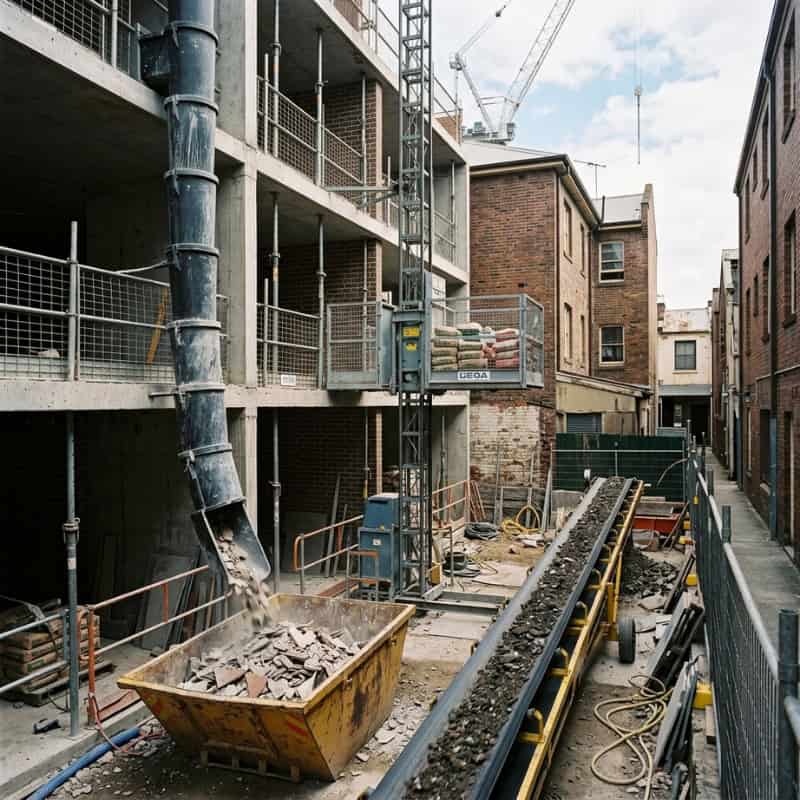
Here’s how the framework looks on a real job. Picture a small multi-storey renovation on a tight Sydney street, with limited frontage and no crane access. Before starting, you map the three moves. For ACROSS, you set up a portable belt conveyor to move spoil and bulk material out to a bin at the front, and use gravity rollers to feed boxed materials into the ground floor. For UP, you position a material hoist to lift barrows, tools and materials to the upper levels, so nothing goes up the stairs by hand. For OFF, you rig a rubbish chute down the facade into a skip, so strip-out and demolition waste drops straight to ground level. Then you sequence it: the chute and belt clear the demolition and spoil, the hoist supplies the new materials to height, and the rollers keep packaged goods flowing at ground level. Coordinating the hire so the right gear is on site for each stage, rather than scrambling mid-job, is what keeps the whole flow smooth. Plan it once, and the site runs itself.
Frequently asked questions
What equipment reduces manual handling on a construction site?
Conveyors, hoists and rollers all remove carrying and lifting by hand. Belt and gravity roller conveyors move material across the site so no one barrows it, material and rope hoists lift loads to height instead of crews carrying them up stairs; and rubbish chutes send waste down without hand-carrying. Together they cut the manual handling that causes delays and injuries.
How do I move materials on a site with no crane access?
Use conveyors and hoists instead. Belt and roller conveyors handle the horizontal movement, carrying material along and into position, while material hoists and rope hoists handle the vertical movement, lifting loads to height. This combination moves materials up, along and off a site without a crane, which suits tight-access Sydney jobs where crane access isn’t possible.
Can I hire conveyors, hoists and chutes together?
Yes. Conveying & Hoisting Solutions supplies the full set for hire, so you can arrange conveyors, hoists and rubbish chutes from one place, and we can advise on the right combination for your site, loads and access. Tell us about the job, and we’ll match the gear, then you can request a quote for everything you need.
Final thoughts
Planning material flow on a tight Sydney site comes down to three moves: getting materials across with conveyors, up with hoists, and off with chutes. Map each move to the right gear before you start, and you cut manual handling, ease congestion and keep the job on program. Tell Conveying & Hoisting Solutions your load, site access and timeframe and we’ll match the right gear, then request a quote today.
| Conveying & Hoisting Solutions
Working a tight-access Sydney site? Tell us your load, site access and timeframe and we’ll match the right hire gear for the job. |