
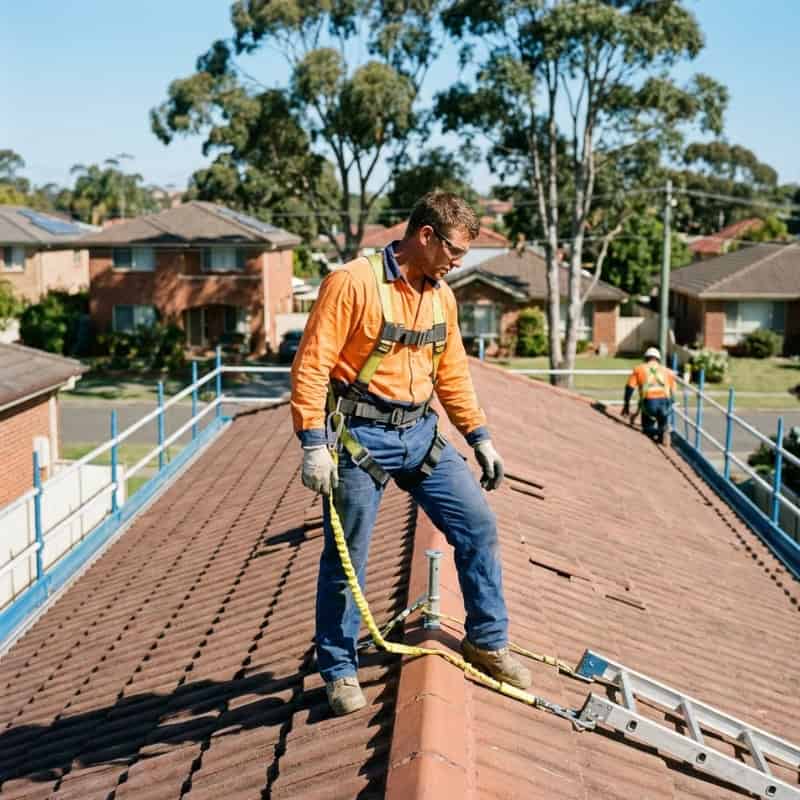
Sydney roofs can be deceptively risky. You might be dealing with steep pitches in older suburbs, slippery tile roofs after coastal showers, skylights that look solid but aren’t, or quick “just a minute” tasks that quietly add up to big exposure—especially without a properly fitted roofing harness kit.
This guide is designed to be used like a real checklist. It’s written for two audiences:
• Homeowners who want the job done safely (and want to know when roof work is a hard “no” for DIY)
• Contractors and tradies who need a practical pre-start routine and clear stop-work triggers
It’s also Sydney-specific in the way roof work actually happens here: variable weather, sun and heat, busy streets, tight access, and neighbours close enough to be in your drop zone if you don’t plan properly.
The most important idea before you start
Fall prevention isn’t “put a harness on and hope for the best”. The safest approach is to control the hazard earlier, using higher-level controls first (planning, isolation, edge protection, scaffolds, platforms), then using personal protective equipment only when those higher controls can’t fully remove the risk. SafeWork NSW emphasises that workers must be protected from the risk of falling from one level to another, no matter the height.
Roof work safety checklist for Sydney
1) Decide whether you should be on the roof at all
Before you think about ladders or gear, decide if the task belongs on the roof.
Homeowner “do not DIY” triggers
If any of these are true, treat the job as professional-only:
• The roof is steep, brittle, or you can’t confidently stand without sliding
• There are skylights, clear sheets, old sheeting, or any area that could be fragile
• The roof is wet, windy, or likely to be wet/windy during the task
• You can’t set a ladder on stable, level ground
• You don’t have a clear rescue plan if someone slips or is suspended
• You’re alone (no spotter, no one to call help, no one to steady access)
Contractors: if the job looks “small”, treat that as a risk factor. Short-duration tasks often skip planning, which is exactly how people end up stepping onto a roof without controls.
Q&A: “Do I need fall protection on a one-storey roof?”
If there’s a risk of falling from one level to another, you need controls that eliminate or minimise that risk—even on lower roofs where the drop is onto concrete, fences, retaining walls, or tools/materials. In NSW, the trigger isn’t “storeys”, it’s the risk profile of the task and site.
For construction work, if there’s a risk of someone falling more than 2 metres, the job is high risk construction work and requires a SWMS (and the work must follow it).
2) Plan the job like it’s a proper worksite (even for a “quick” task)
This is the section most falls begin with: the plan is vague, the time pressure is real, and people improvise.
Quick planning prompts
• What’s the task, step-by-step (including set-up and pack-down)?
• Where will people move on the roof?
• Where is the edge exposure (eaves, verandas, voids, stairwells, split levels)?
• What’s fragile (skylights, plastic sheets, old sheeting, patched areas)?
• What’s the drop zone below (paths, driveways, neighbouring yards, public footpaths)?
• What’s the weather doing in the next 2–4 hours?
Sydney-specific planning gotchas
• Afternoon sea breezes can change stability on exposed ridges
• Sudden showers make tiles and metal sheeting slick fast
• Tight side access and narrow driveways make ladder positioning harder
• Busy streets and shared driveways require better exclusion zones
3) Set up exclusion zones and manage falling-object risk
Even if nobody falls, dropped tools and debris can cause serious injury. This matters more in Sydney, where neighbouring properties and footpaths can be close.
Exclusion zone checklist
• Mark a no-go drop zone under the work area (cones, tape, barriers)
• Keep people out of the drop zone, including kids, visitors, and clients
• Keep tools tethered where possible
• Keep roof materials secured against wind gusts
Debris and waste control
Mess drives risk. A cluttered roof increases trips; a cluttered ground area increases unstable ladder footing and makes rescue harder.
If you’re running renovations or repeated roof tasks, plan waste movement so you’re not carrying awkward loads down ladders. A simple, controlled disposal pathway can reduce ladder trips and keep access routes clear. If you’re mapping out your waste flow, this guide on how to choose a roofing harness kit can also help you think through the full system: access, movement, and what happens when the plan goes wrong.
4) Choose the safest access method for the site
Most roof jobs start and end with access. A good roof plan can still fail if the ladder is wrong.
Ladder set-up checklist (practical, not theoretical)
• Place on firm, level ground (not loose soil, wet grass, or pavers that rock)
• Secure the base area so nobody bumps it (especially on tight Sydney sites)
• Extend high enough for safe stepping on/off (don’t “hop” onto the roof edge)
• Maintain three points of contact when climbing
• Don’t carry bulky loads up ladders by hand (plan hoisting or staged materials)
If you can’t set the ladder safely, stop. This is a hard stop-work trigger, not a “we’ll be careful” moment.
Q&A: “What’s the safest way to get onto a roof?”
The safest roof access is the one that avoids unstable transitions. If your ladder can’t be positioned securely on level ground and extend high enough to step on/off without reaching or jumping, it’s not safe. If site constraints make proper ladder set-up impossible, use alternative access (platforms, scaffolding, or other engineered solutions) rather than forcing a bad ladder position.
5) Control the edge risk before you rely on a harness
Harness systems can be part of a safe plan, but they’re not the first control you reach for. For many jobs, the safest choice is preventing a fall by isolating the edge.
Higher-level controls to consider first
• Temporary edge protection (guardrails)
• Scaffolding or work platforms
• Catch platforms where appropriate
• Working from the ground with extension tools (where feasible)
If these controls are reasonably practicable for the site and task, they’re often safer than relying on personal fall arrest alone.
6) Identify fragile roof areas and treat them as “fall-through” hazards
Fragile doesn’t always look fragile. Skylights, old clear sheeting, and patched areas can fail under bodyweight.
Fragile-roof checklist
• Identify skylights and any translucent sheets
• Treat any aged or unknown material as suspect until confirmed
• Never step, sit, or place tools on fragile areas
• Mark fragile zones clearly so everyone sees them
• Don’t assume “it held last time” means it’s safe today
Homeowners: this is one of the biggest reasons roof work becomes non-DIY. Fragile-roof management is a professional planning task, not a guess.
7) Use a harness only when the rest of the plan supports it
Harnesses can reduce harm when used correctly, but they introduce their own requirements: correct fit, compatible components, anchor points you can trust, and an actual rescue plan.
If your site plan is basically “we’ll wear harnesses”, but you can’t clearly explain the anchor point, the fall distance, the swing-fall risk, and the rescue plan, then the system isn’t ready. If you’re unsure, see when to use a harness on a roof for the key decision points and system basics.
A good way to keep this practical is to think in scenarios:
• “If someone slips near the eaves, where do they go?”
• “If they swing, what do they hit?”
• “If they’re hanging, how do we get them down quickly?”
For contractors, it’s also worth checking whether the kit is appropriate for your task and site conditions. If you’re selecting gear for real-world Sydney sites (tight access, variable weather, mixed roof types), start with high quality roofing harness for Sydney site considerations such as compatibility, adjustment range, and inspection readiness, not just “does it exist in the ute”.
Q&A: “When should I use a harness on a roof?”
Use a harness when there’s a risk of falling and higher-level controls (like edge protection or platforms) can’t reasonably eliminate that risk for the job. A harness should be part of a complete system: correct fit, compatible connectors/lanyards, an anchor point suited to the task, and a rescue plan. If any of those are missing, stop and fix the system before anyone steps onto the roof.
8) Run a pre-start equipment check (every time)
This is where “good gear” turns into “safe gear”. Pre-use checks should be quick, consistent, and done before anyone is exposed to the edge.
Practical pre-start check prompts
• Harness webbing: no cuts, frays, burns, chemical damage, or UV degradation
• Stitching: intact, no pulled threads
• Buckles and adjusters: operate smoothly, no distortion or cracking
• Connectors (karabiners/hooks): gate closes properly, no deformities
• Labels/ID: readable so the item can be tracked and inspected on schedule
• Compatibility: components match the intended system (no mix-and-match guesswork)
If anything fails, it’s removed from service. “It’ll be fine today” is how failures become incidents.
9) Fit and adjustment: treat it like a safety-critical step
An incorrectly fitted harness can increase injury risk, cause discomfort that leads to unsafe movement, or fail to do what you expect in a fall.
Fit checks that matter
• Snug but not restrictive (you should be able to breathe and move normally)
• Leg straps secure and correctly positioned (not twisted)
• Chest strap positioned correctly (not too high/low)
• All straps tightened and excess webbing secured
• Nothing interfering with buckles (hoodies, tool belts, bulky layers)
Contractors: don’t assume “one size fits most” fits the person wearing it today. Changing clothing layers, different body types, and different tasks all affect fit.
10) Weather stop-work triggers for Sydney roofs
Sydney weather changes quickly, and roof surfaces punish optimism. If you’re unsure, step down and reassess.
Stop-work triggers (practical and conservative)
• Rain begins, or surfaces are visibly wet (tiles and metal become slippery fast)
• Wind picks up enough to affect balance, material control, or ladder stability
• Thunder/lightning in the area
• Heat stress risk is rising (high UV, high temps, limited shade)
• Debris and dust are blowing into the eyes or making footing uncertain
If you’re “trying to finish quickly before it gets worse”, you’re already in the danger zone.
11) Keep the roof and the ground tidy (housekeeping reduces falls)
Trips happen because of small things: offcuts, loose tiles, cords, hoses, misplaced tools. Good housekeeping is a control, not a nice-to-have.
Housekeeping habits that prevent falls
• Keep walk paths clear and predictable
• Stage tools so you’re not reaching or stepping backwards unexpectedly
• Control cords/hoses so they don’t cross foot paths
• Store materials so wind can’t shift them
• Keep ladder landing zones clear (nothing to trip on when you step off)
12) Have a rescue plan before you need it
This is the part people skip, and it matters. If someone falls and is suspended, time matters. A rescue plan should be real, not theoretical.
Rescue plan prompts
• Who is responsible for initiating the rescue?
• How will you contact emergency services (and what’s the exact address)?
• What equipment is on-site to assist rescue (if applicable)?
• How will you prevent a second person from becoming a casualty?
• Where will the rescued person be moved to (shade, first aid access)?
Even on smaller jobs, you should know what you would do in the first 60 seconds.
Q&A: “I’m just cleaning gutters—what’s the worst that can happen?”
Gutter cleaning often involves repeated ladder climbs, awkward reaching, and working near edges while handling debris. The biggest risks are ladder instability, overreaching, slippery surfaces (especially after light rain or morning dew), and complacency because the task feels familiar. Treat it as a real roof-access task: stable ladder, exclusion zone, tidy work area, and stop-work triggers for weather.
A practical pre-start checklist you can print mentally
Use this quick sequence before anyone steps up:
• Plan the steps and hazards (edges, fragile zones, weather, drop zone)
• Set exclusion zones and tidy the ground
• Choose safe access and confirm ladder stability
• Use higher-level controls first (edge protection/platforms where practicable)
• If using a harness system, confirm fit, compatibility, anchor/tie-off basics, and rescue plan
• Re-check weather and stop-work triggers
• Start work slowly, reassess after the first 5 minutes
If any step feels uncertain, treat that as a signal to stop and redesign the plan.
FAQ
Is it ever safe for a homeowner to go onto a roof in Sydney?
Sometimes, but only when the risk is low and the access and surface conditions are genuinely safe. If the roof is steep, wet, fragile, or difficult to access, it’s not a DIY task. When in doubt, stay off the roof and seek professional help.
What roof types are most slippery after rain?
Tiles and metal sheeting can both become dangerously slippery when wet. Even light moisture (dew or drizzle) can reduce traction. Treat any moisture as a high-risk condition and reassess.
Are skylights always dangerous to step near?
Skylights and translucent sheets should be treated as fragile unless you have confirmed they’re designed and protected for foot traffic. Many are not. They can fail suddenly and lead to a fall-through.
What’s a “swing fall” and why does it matter?
A swing fall can happen when your anchor point is not positioned to keep you directly beneath it. If you fall, you can swing like a pendulum and strike structures, edges, or the ground. This is one reason anchor selection and work positioning matter.
How often should fall protection gear be checked?
You should do a quick pre-use check every time. Formal inspection and maintenance schedules depend on the equipment and site requirements, but pre-use checks are non-negotiable because damage can occur between jobs.
What’s the biggest mistake people make on “quick” roof jobs?
Skipping planning. “Just a minute” jobs often skip exclusion zones, ladder stability checks, and weather reassessment—then someone overreaches, slips, or rushes the transition on/off the roof.